
 Worksheets
Unit 3: Population Ecology.1
Total questions: 26
Worksheet time: 21mins
What is the carrying capacity?
The number of individuals that can migrate into an ecosystem.
The maximum number of individuals that an environment can support indefinitely.
The minimum number of individuals required for a population to survive.
The average number of individuals in a population over time.
Which of the following is a biotic limiting factor?
Availability of nutrients
Space
Temperature
Predation
What happens when a population exceeds its carrying capacity?
The population will migrate to a new area.
The population will remain stable.
The population will continue to grow indefinitely.
The population will decrease due to lack of resources.
Which of the following is an abiotic limiting factor?
Pollution
Mutualism
Disease
Competition
What is the equilibrium point in population ecology?
The point where the population size can be maintained by the environment.
The point where the population size starts to decline.
The point where the population size is zero.
The point where the population size reaches its maximum growth rate.
How does competition affect carrying capacity?
It stabilizes the carrying capacity.
It decreases the carrying capacity.
It has no effect on the carrying capacity.
It increases the carrying capacity.
What is ecological homeostasis?
The ability of a population to grow indefinitely.
The cycling of a population above and below the equilibrium point.
The extinction of a population.
The migration of a population to a new area.
Which of the following can alter the carrying capacity of an ecosystem?
All of the above
Human activities
Introduction of new species
Natural disasters
What is the effect of increased mutualism on carrying capacity?
It decreases the carrying capacity.
It stabilizes the carrying capacity.
It has no effect on the carrying capacity.
It increases the carrying capacity.
Which of the following is NOT a factor that influences carrying capacity?
Food availability
Color of the species
Water availability
Shelter availability
What happens when resources are removed from an ecosystem?
The carrying capacity becomes infinite.
The carrying capacity remains the same.
The carrying capacity decreases.
The carrying capacity increases.
How does predation affect the carrying capacity of a population?
It decreases the carrying capacity.
It increases the carrying capacity.
It stabilizes the carrying capacity.
It has no effect on the carrying capacity.
What is the effect of extreme climatic events on carrying capacity?
They stabilize the carrying capacity.
They decrease the carrying capacity.
They have no effect on the carrying capacity.
They increase the carrying capacity.
Which of the following is an example of a positive biotic factor?
Mutualism
Predation
Parasitism
Competition
What is the result of increased competition in an ecosystem?
No change in carrying capacity
Decreased carrying capacity
Increased carrying capacity
Infinite carrying capacity
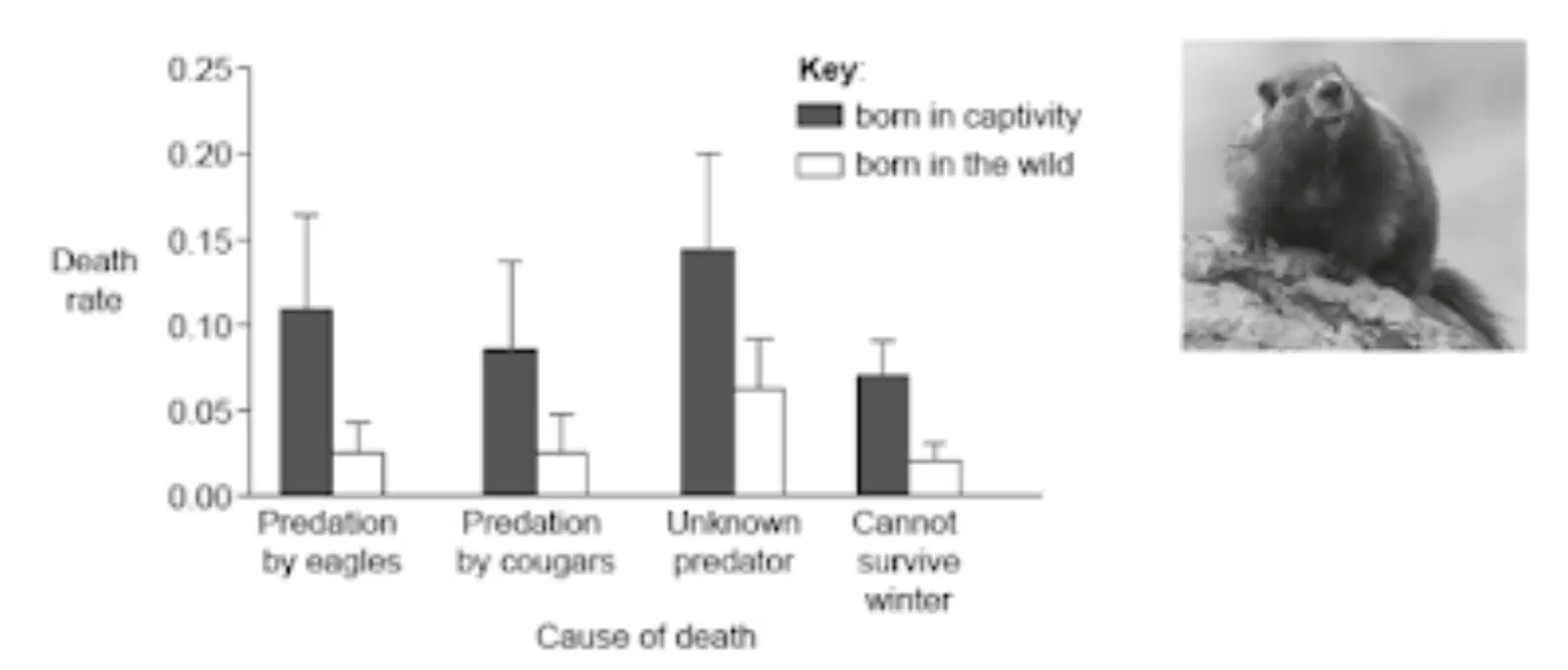
The Vancouver island marmot (Marmota vancouverensis) is a small rodent that is only found on Vancouver Island and is listed as critically endangered. Captive breeding and release programs for this species began in 1997 to attempt to restore population numbers on the island. The graph shows the causes of death of the marmots born in the wild and of those marmots released after being born and reared in captivity.
Distinguish between levels of predation in marmots born in the wild and those born in captivity.
Draw a line to show the carrying capacity


A population of foxes has 36 individuals. In one year, 10 baby foxes are born and 6 older foxes die. The population at the end of the year is (a) .

This graph shows ....
When one population increases, the other decreases.
When one population decreases, the other increases.
When one population increases, the other increases instantly.
When one population increases, it causes the other to increases shortly after.
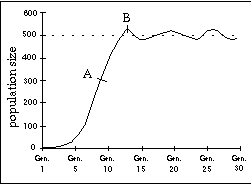
around 500
around 600
around 15
around 30
Match the picture with the type of population distribution

uniform distribution

Random distribution

Clumped distribution

What type of growth is this graph representing
Logistical Growth
Exponential Growth

What type of growth is this graph representing?
Logistical Growth
Exponential Growth
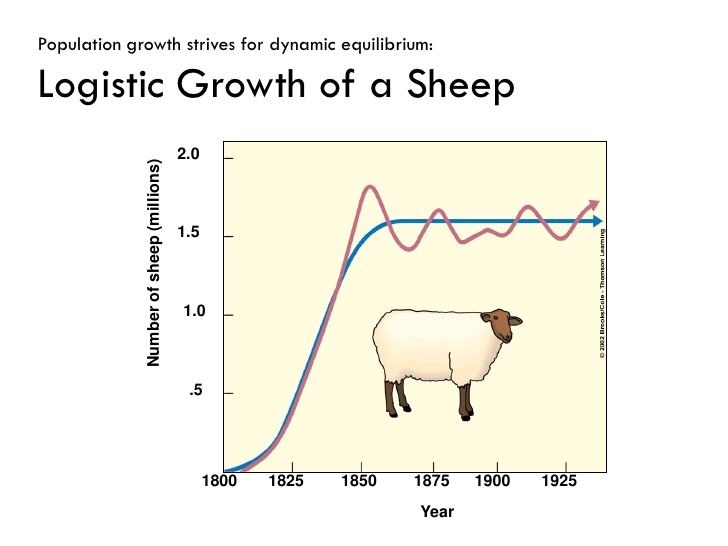
Organize these organisms into the correct catagories.



