
NEW
Font size
 Worksheets
Classification Concepts
Total questions: 25
Worksheet time: 17mins
What is classification?
Classification is the process of categorizing data into different classes or groups based on certain characteristics or features.
Classification is the process of identifying data
Classification is the process of encrypting data
Classification is the process of sorting data alphabetically
What are the main types of classification?
binary classification, multi-class classification, multi-label classification
single classification, multiple classification, label classification
Explain supervised classification.
Supervised classification does not require labeled data
Supervised classification is unsupervised learning
Supervised classification involves learning from labeled data to predict labels for unseen data.
Supervised classification does not involve predicting labels
Describe unsupervised classification.
Unsupervised classification involves grouping data points based on similarities in their features without using labeled examples.
Unsupervised classification always results in accurate and precise categorization.
Unsupervised classification requires a large amount of labeled training data.
Unsupervised classification involves labeling data points based on predefined categories.
What is the purpose of classification in machine learning?
Classification in machine learning is used to generate random predictions
The purpose of classification is to analyze data visually
The purpose of classification in machine learning is to categorize data into different classes based on features and predict class labels for new data points.
The goal of classification is to sort data alphabetically
Provide an example of classification in real life.
Organizing files on a computer
Sorting books in a library
Separating laundry by color
Classifying fruits in a grocery store
What is the difference between classification and clustering?
Classification involves grouping data points based on similarity, while clustering involves predicting class labels based on past data.
Classification involves predicting class labels based on future data, while clustering involves grouping data points based on dissimilarity.
Classification involves grouping data points based on dissimilarity, while clustering involves predicting class labels based on present data.
Classification involves predicting class labels based on past data, while clustering involves grouping data points based on similarity.
How does decision tree classification work?
Decision tree classification works by recursively splitting the data based on features to create a tree-like structure.
Decision tree classification works by averaging the values of features to make predictions.
Decision tree classification works by sorting the data based on features in descending order.
Decision tree classification works by randomly assigning labels to data points.
What is the role of features in classification?
Features have no impact on classification accuracy.
Features are only used for visualization purposes.
Features provide the necessary information for the classification algorithm to learn and make accurate predictions.
Features are randomly selected without any significance.
Explain the concept of overfitting in classification.
Overfitting in classification happens when a model learns the training data too well, including noise and outliers, leading to poor performance on new data.
Overfitting is not a concern in classification tasks.
Overfitting occurs when a model learns the testing data too well.
Overfitting leads to better performance on new data.
What is the importance of training data in classification?
Training data is only needed for regression, not classification.
Training data is primarily used for visualization purposes in classification.
Training data is optional for classification tasks.
Training data is essential for teaching machine learning models how to classify new data points accurately.
Discuss the challenges faced in classification tasks.
Using all available features without selection
Ignoring model evaluation and performance metrics
Dealing with imbalanced datasets, selecting the right features, handling noisy data, choosing the appropriate algorithm, and evaluating the model's performance.
Relying solely on one classification algorithm
What are some popular classification algorithms?
Linear Regression
Logistic Regression, Decision Trees, Random Forest, Support Vector Machines (SVM), k-Nearest Neighbors (k-NN)
Naive Bayes
Principal Component Analysis
How can evaluation metrics be used to assess the performance of a classification model?
Evaluation metrics such as accuracy, precision, recall, F1 score, and ROC-AUC can be used to assess the performance of a classification model.
Mean Squared Error
Confusion Matrix
Area Under Curve
Explain the concept of multi-class classification.
Multi-class classification involves classifying instances into one of three or more classes.
Multi-class classification is a regression problem.
Multi-class classification involves classifying instances into only two classes.
Multi-class classification does not involve predicting classes.

Five general characteristics of organisms in kingdoms Plantae or Fungi are listed in the box.
Which table correctly lists the characteristics of the organisms in the two kingdoms?


Which of the following taxa contain the fewest members?
phyllum
family
genus
class
In a properly written scientific name, which part is written entirely in lowercase?
species
genus
phylum
family
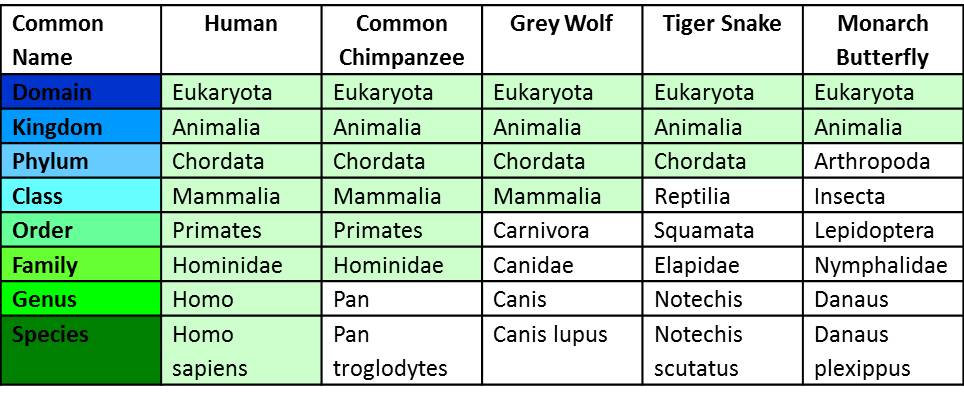
Gray Wolf: Canis lupus
Aardwolf: Proteles cristatus
Coyote: Canis latrans

