
 Worksheets
Unit Test_Measurement
Total questions: 25
Worksheet time: 49mins
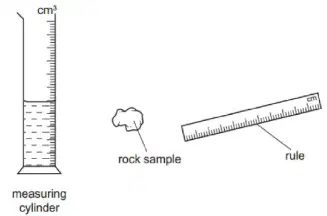
A scientist needs to determine the volume of a small, irregularly shaped rock sample. Only a rule and a
measuring cylinder, partially filled with water, are available.
To determine the volume, which apparatus should the scientist use?
Neither the measuring cylinder nor the rule
The rule only
Both the measuring cylinder and the rule
The measuring cylinder only
Calculate the density of mercury if 500 cm3
has a mass of 6.0 kg.
1.2 g/cm3
12.0 g/cm3
3.0 g/cm3
30.0 g/cm3
A student is trying to find the density of water and of a large, regularly-shaped solid. Which apparatus is
needed to find the density of both?
Clock, ruler, string
Balance, measuring cylinder, ruler
Balance, measuring cylinder, string
Balance, clock, ruler
What happens to the least dense of two immiscible liquids?
It rises to the top
It mixes
It falls to the bottom
None of the above
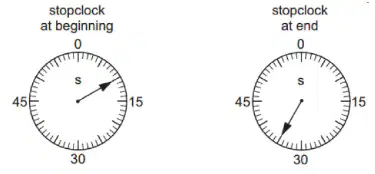
The diagrams show the times on a stopclock at the beginning and at the end of an experiment.
How long did the experiment take?
10 s
45 s
60 s
25 s
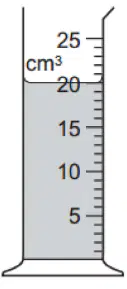
The diagram shows some liquid in a measuring cylinder. The mass of the liquid is 16 g.
What is the density of the liquid?
360 g/cm3
320 g/cm3
1.25 g/cm3
0.80 g/cm3
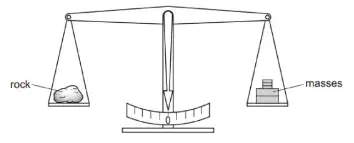
A geologist places a small rock on the left-hand pan of a balance. The two pans are level as shown when
masses with a total weight of 23N are placed on the right-hand pan. Take the weight of 1.0kg to be 10N.
What is the mass of the small rock?
2.3 kg
23 kg
230 kg
2300 kg
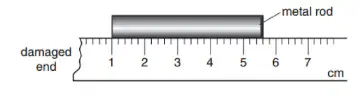
A girl uses a rule to measure the length of a metal rod. Because the end of the rule is damaged, she places one end of the rod at the 1 cm mark as shown.
How long is the metal rod?
56 mm
50 mm
46 mm
43 mm
A stone has a volume of 0.50 cm3
and a mass of 2.0 g. What is the density of the stone?
1.50 g/cm3
2.50 g/cm3
4.0 g/cm3
3.0 g/cm3

A cylindrical can is rolled along the ruler shown in the diagram.
The can rolls over twice. What is the circumference (distance all round) of the can?
28 cm
14 cm
15 cm
13 cm
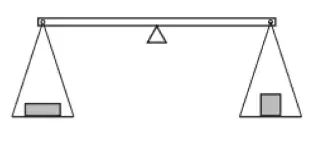
Two objects are placed on a balance, one on each side:
Which properties of the objects can be compared using the balance?
Weight, mass and volume
Weight and mass only
Volume and density
Density only
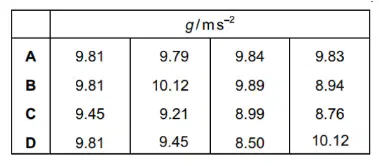
Four students each made a series of measurements of the acceleration of free fall g. The table shows the results obtained.
Which set of results could be described as the most precise measurement?
A
B
C
D
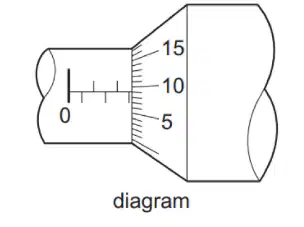
A micrometer screw gauge is used to measure the thickness of a metal plate. The reading with the thickness is shown in the diagram.
What is the thickness of the plate?
1.90 mm
2.45 mm
2.59 mm
2.73 mm
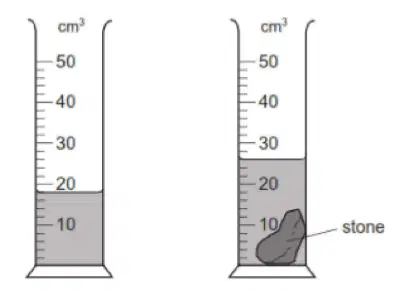
An object of mass 100 g is immersed in water as shown in the diagram.
What is the density of the material?
12.5 g/cm3
125 g/cm3
0.125 g/cm3
1.25 g/cm3
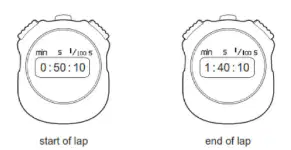
A stopwatch is used to time a runner in a race. The diagram shows at the start and at the end of a lap of the race.
How long did runner take to finish the lap of the race?
50.00 s
50.10 s
90.00 s
92.10 s
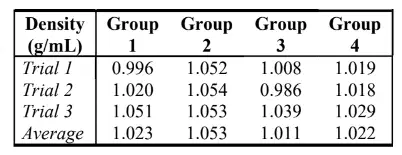
The chart shows the density of seawater samples collected from the Lampuuk beach by four different groups. Which group's data are most precise?
Group 1
Group 2
Group 3
Group 4
What is the formula for density?
Density = mass x volume
Density = mass / volume
Density = mass + volume
Density = mass - volume
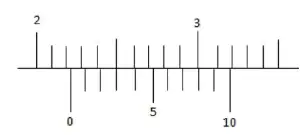
What is the reading of measurement for vernier caliper below?
2.20 cm
2.21 cm
2.23 cm
2.30 cm
Which of the following will allow measurement of a liquid’s volume with the highest precision?
50 mL cylinder graduated in 1 mL increments
100 mL cylinder graduated in 0.5 mL increments
150 mL cylinder graduated in 1 mL increments
200 mL cylinder graduated in 5 mL increments
The following quantities are
1. Density
2. Velocity
3. Force
4. Temperature
5. Acceleration
Which of quantities are included into vector quantity?
1, 2, 3, 4, and 5
1, 3, and 5
2, 3, and 5
3 and 5
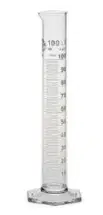
What is measured with a graduated (Measuring) cylinder?
Passage of time
Distance from one thing to another
Weight of an object
Volume of liquid
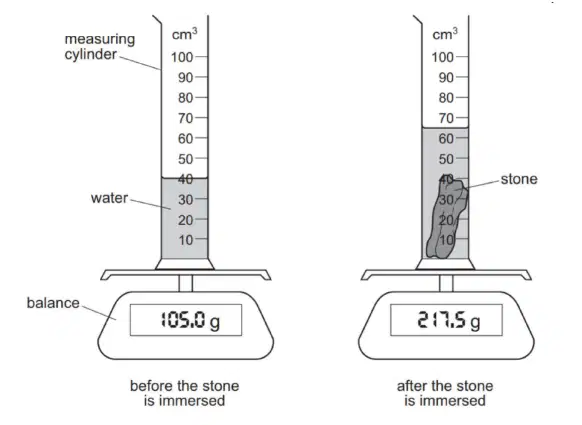
A measuring cylinder containing only water is placed on electronic balance. A small irregularly shaped stone is now completely immersed in the water. The diagrams show the equipment before and after the stone is immersed.
Calculate the density of the material of the stone!
45 g/cm3
0.45 g/cm3
4.5 g/cm3
450 g/cm3
Calculate the density of mercury if 500 cm3 has a mass of 6.0 kg.
1.2 g/cm3
0.12 g/cm3
120 g/cm3
12 g/cm3
Which is the value of a vector quantity?
100 V
300 kg/m3
20 m/s, to the east
25 J/(kg °C)

An object of mass 100 g is immersed in water as shown in the diagram.
What is the density of the material from which the object is made?
2.5 g/cm3
25 g/cm3
250 g/cm3
0.25 g/cm3

