
 Worksheets
UV Visible spectroscopy Part 1
Total questions: 10
Worksheet time: 2mins
Select the wavelength range corresponding to UV-visible region.
400-800 nm
200-800 nm
25 μm-2.5 μm
2.5 μm – 1mm
The possible transitions for water molecule in UV-visible region are
σ →σ*
n→π*, π→π*
σ→σ*, n→π*
n → σ*
UV visible spectroscopy is also called as................................................................ spectrometry
Electronic
Vibrational
Rotational
All
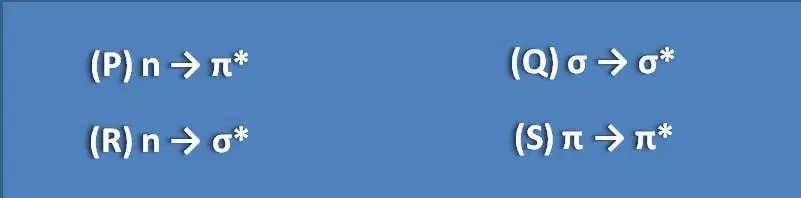
Energies required for the following transitions in increasing order
P<Q<R<S
Q<S<R<P
S<R<Q<P
P<S<R<Q
UV spectroscopy is useful for detection of................
Functional group
Extent of cojnjugation
geometrical isomers
all of these

Which of the following absorbs at more wavelength
P) Benzene
Q) Phenol
R) Anilin
S) Anilinium ion
Which of the following spectroscopy techniques is associated with molecular emission?
UV-Visible spectroscopy
IR spectroscopy
Fluorescence spectroscopy
X-ray diffraction
In the equation, A = ebc, what quantity is represented by "e"?
Absorptivity
Molar absorptivity
Pathlength
absorbance
Beer’s law states that the intensity of light decreases with respect to…..................
Concentration
thickness
distance
volume
Bathochromic shift is also known as
Hypochromic shift
Blue shift
Red shift
Hypsochromic shift

