
 Worksheets
Sharpening Hand Tools Quiz
Total questions: 33
Worksheet time: 17mins
Which of the following is recommended for the trainee when freehand grinding chisels and plane blades?
Using gloves
Using goggles
Using a mask
Using ear protection
What types of stones are recommended for sharpening chisels and plane blades?
Only natural stones
Only manufactured stones
Both natural and manufactured stones
Neither natural nor manufactured stones
What types of chisels should the trainee grind and sharpen?
Only bevelled chisels
Only firmer chisels
Both bevelled and firmer chisels
Only plane blades
What additional resource is recommended for the trainee to use for this project?
Workshop lesson notes
Online tutorials
Instructional videos
Textbooks
What knowledge will trainees gain through this project?
Correct sharpening angles, method of sharpening, use of lubricants for oilstones, and names and parts of each tool
How to build a workshop
How to use power tools
How to design new tools
What is the correct angle for sharpening a chisel?
45 degrees
30 degrees
60 degrees
90 degrees
Which of the following is NOT a step in sharpening a plane blade?
Ground at the correct angle without burning
Sharpened at the correct angle
Correct lubricant used for oilstone
Heated to a high temperature
What should be done after sharpening a plane blade?
It should be painted
It should be assembled correctly
It should be heated
It should be cooled in water
Which of the following is an associated task when sharpening basic hand tools?
Using a hammer
Following safe working practices
Measuring with a ruler
Painting the tools
What is used as a lubricant when sharpening chisels and plane blades?
Water
Oilstone
Grease
Sand
Which of the following tools is NOT required for sharpening hand tools?
Bench grinder
Oilstone and oilcan
Hammer
Selection of plane irons, chisels, and saws
When do chisels and plane irons require grinding?
When they become blunt
When the cutting edge becomes chipped
When the grinding iron becomes too thick/steep
All of the above
At what angle are chisels and plane irons sharpened on an oilstone?
10 - 20°
20 - 30°
30 - 40°
40 - 50°
What is a combination stone?
A stone that is coarse on one side and fine on the other
A stone that is medium on one side and fine on the other
A stone that is coarse on one side and medium on the other
A stone that is coarse on both sides
At what angle are chisels and plane irons ground?
15°
25°
35°
45°
What is wet grinding?
Grinding on a carborundum wheel without lubrication
Grinding on a sandstone wheel with water lubrication
Grinding on a sandstone wheel without lubrication
Grinding on a carborundum wheel with water lubrication
What is the main advantage of wet grinding?
It produces a rougher edge
It is carried out at higher speed
It will not burn the edge of the tool being ground
It does not require water
What is dry grinding?
Grinding on a sandstone wheel with water lubrication
Grinding on a carborundum wheel without lubrication
Grinding on a carborundum wheel with water lubrication
Grinding on a sandstone wheel without lubrication
What is the main disadvantage of dry grinding?
It is carried out at a slower speed
It requires water lubrication
It has a tendency to burn the tool
It produces a finer edge

What is hollow grinding?
Grinding on a flat surface
Grinding on the circular circumference edge of the grinding wheel
Grinding without lubrication
Grinding with water lubrication
What is the advantage of hollow grinding?
It produces a rougher edge
It produces a finer edge
It is faster
It does not require water
What should operatives do before fitting any grinding wheels onto a grinding machine?
Attend an abrasive wheel course
Read the manual
Wear safety goggles
Check the wheel for defects
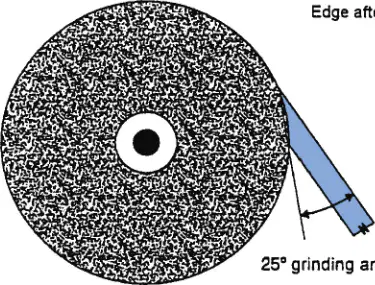
What is the recommended grinding angle for sharpening chisels and plane irons?
15°
25°
35°
45°
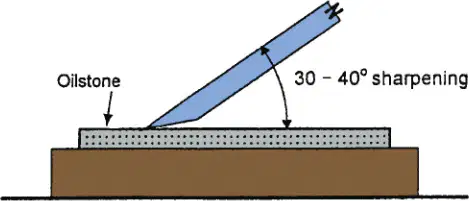
At what angle should chisels and plane irons be sharpened?
20°-30°
25°-35°
30°-40°
35°-45°
What should be used to lubricate the oilstone during sharpening?
Water
Oil
Grease
Wax
What should be done to the oilstone after use to avoid clogging?
Wash with water
Wipe clean with a dry cloth
Wipe clean with oil
Leave it as is
How should the oilstone be held during sharpening?
In hand
On a flat surface or in a vice
On a slanted surface
In water
What is a common result on the cutting edge after sharpening?
It becomes dull
It becomes rusty
There will be a slight burr
It becomes thicker
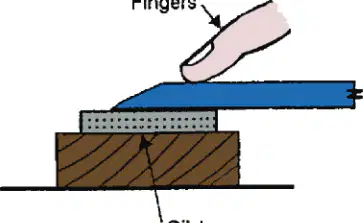
What should you do with the back edge of the blade when sharpening on the oilstone?
Press it lightly with fingers.
Press it firmly with fingers.
Hold it loosely with fingers.
Do not touch it with fingers.
In which direction should you work when sharpening a blade on the oilstone?
Against the direction of the arrows.
In the direction of the arrows.
Perpendicular to the arrows.
In a circular motion.
What should you always keep flat on the oilstone while sharpening?
The front edge of the blade.
The back edge of the blade.
The middle of the blade.
The handle of the blade.
What is the final step in sharpening a chisel or plane blade to remove any slight trace of burr?
Sharpen the blade at a 90-degree angle.
Strop the chisel or plane blade.
Soak the blade in water.
Sand the blade with sandpaper.

What should the chisel or plane blade have upon completion of sharpening?
One distinct angle.
No angles.
Two distinct angles.
Three distinct angles.

