
 Worksheets
Lead-Tin Phase Diagram QCAA Engineering Unit 4
Total questions: 20
Worksheet time: 11mins
What does the inverse lever rule help to calculate in the context of the lead-tin phase diagram?
Percentages of solid and liquid
Melting points of components
Electrical conductivity
Thermal expansion coefficients
Which of the following is NOT a key feature to be identified in the lead-tin thermal-equilibrium phase diagram?
Electrical resistance
Components
Phases
Key features
What is the inverse lever rule used to determine?
A) The balance of mechanical forces
B) The proportions of two phases in a two-phase region of a phase diagram
C) The length of a mechanical lever
D) The overall composition of a phase diagram
In the lever rule, what acts like a lever?
A) The balance point
B) The overall composition
C) The tie line in a phase diagram
D) The segments on either side
What is the inverse lever rule sometimes referred to as?
A) The balance rule
B) The fulcrum rule
C) The lever rule
D) The phase rule
What does the overall composition, C0 , represent in the lever rule?
A) The balance point
B) The fulcrum
C) The tie line
D) The segments
What is done after determining the length of the tie line from the overall alloy composition to the phase boundary for the other phase?
A) The length is multiplied by 100
B) The length is divided by the total tie line length
C) The length is added to the total tie line length
D) The length is subtracted from the total tie line length

What does the vertical axis in the phase diagram represent?
A)Composition(wt
B)Massfraction
C)Temperature(°C)
D)Phaseamount
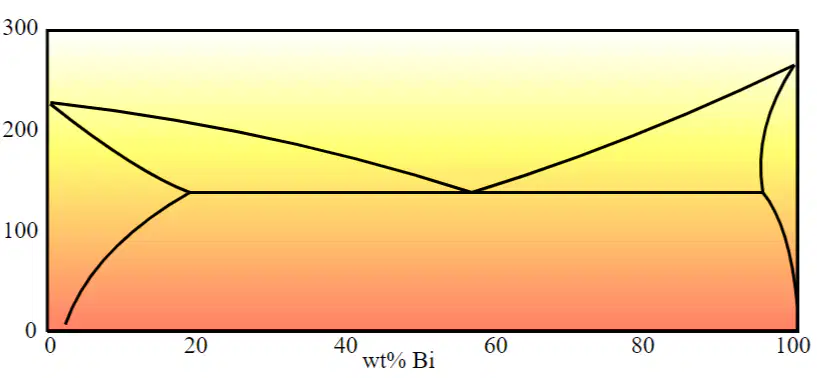
At 20 wt% Bi and a temperature of 180 degrees, what phases are present in the alloy?
Alpha
Alpha + L
L
Beta + alpha
What is the first step in determining the mass fractions of phases present in an alloy?
Draw a tie line from to liquidus and solidus at the specified temperature
Read the CL and Calpha from the x axis
From liquidus drop vertical to obtain Liquid phase composition
From solidus line drop vertical to obtain Solid phase composition
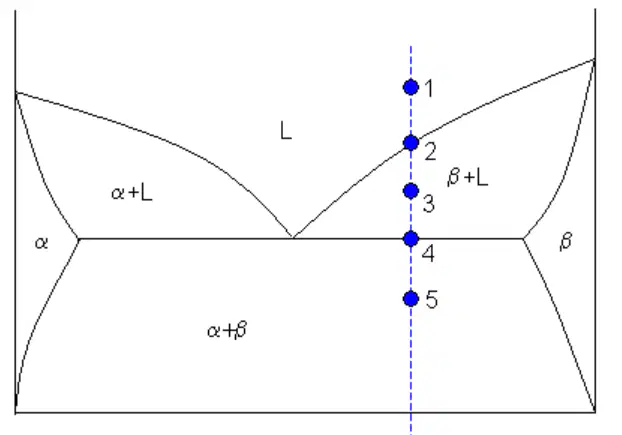
At point 5, the structure of the alloy consists of:
the eutectic structure
grains of alpha plus the eutectic structure
beta + L
grains of beta plus the eutectice structure
What is the primary purpose of a phase diagram in materials science?
A) To determine the electrical properties of materials
B) To understand the thermal expansion of materials
C) To map the stability of phases at different temperatures and compositions
D) To calculate the density of materials
In a binary phase diagram, what does the eutectic point represent?
A) The temperature at which a single phase exists
B) The lowest temperature that an alloy goes from liquid to two solid phases simultaneously
C) The point where the solidus and liquidus lines intersect
D) The maximum solubility of one component in another
What information can be obtained from the tie line in a phase diagram?
A) The melting point of the alloy
B) The compositions of the phases in equilibrium
C) The density of the alloy
D) The electrical conductivity of the alloy
What is the primary characteristic of a eutectoid reaction in a phase diagram?
A) Transformation from one solid phase to two different solid phases
B) Transformation from liquid to two solid phases
C) Transformation from solid to liquid
D) Transformation from one liquid phase to two different liquid phases
In a phase diagram, what does the liquidus line represent?
A) The temperature above which the material is completely liquid
B) The temperature below which the material is completely solid
C) The temperature at which solid and liquid phases coexist
D) The temperature at which the material starts to melt
What is the significance of the solidus line in a phase diagram?
A) It indicates the temperature above which the material is completely liquid
B) It indicates the temperature below which the material is completely solid
C) It indicates the temperature at which the material starts to melt
D) It indicates the temperature at which solid and liquid phases coexist
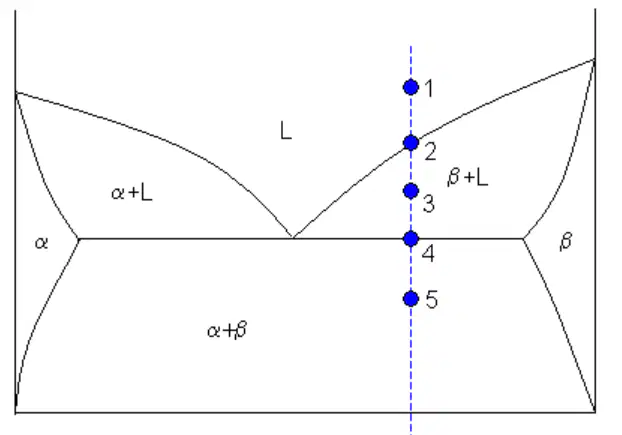
What is the name of the line that separates the α phase from the α + β phase?
the solidus
the solvus
the isotherm
the liquidus
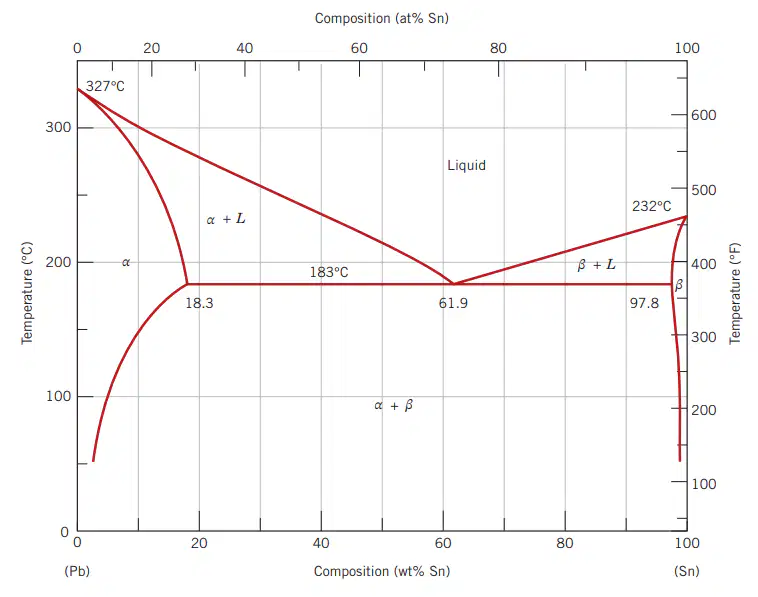
In the β phase of the lead-tin phase diagram, the solvent is
(a)
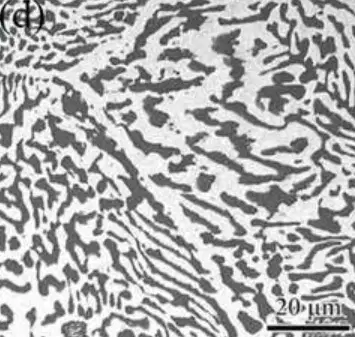
What microstructure is pictured in the image?
hypereutectic
eutectic
hypoeutectic
perieutectic

