
 Worksheets
IGCSE Thermal Physics
Total questions: 193
Worksheet time: 4hrs 47mins
A liquid at room temperature is put on a metal surface which is also at room temperature. A student blows gently across the liquid and its temperature decreases. What causes the liquid to become cooler?
Bubbles of water vapour form in the liquid and go into the air.
The moving air reduces the kinetic energy of all the particles in the liquid.
Thermal energy flows from the liquid into the metal.
The more energetic particles in the liquid escape into the air.

Very small pollen grains are suspended in water. A bright light shines from the side. When looked at through a microscope, small specks of light are seen to be moving in a random, jerky manner.
What are the moving specks of light?
pollen grains being hit by other pollen grains
pollen grains being hit by water molecules
water molecules being hit by other water molecules
water molecules being hit by pollen grains
A gas is contained in a sealed container in a laboratory. The temperature of the gas increases. What happens to the average speed and what happens to the total kinetic energy of the gas molecules?
average speed does not change, total kinetic energy does not change
average speed does not change, total kinetic energy increases
average speed increases, total kinetic energy does not change
average speed increases, total kinetic energy increases

The same mass of a gas is trapped in four identical cylinders by a piston that can move. The diagrams show the samples of gas in different conditions of volume and temperature. Which list gives the pressure of the gas in order from lowest to highest?
1 → 2 → 3 → 4
1 → 3 → 2 → 4
4 → 2 → 3 → 1
4 → 3 → 2 → 1
The liquid level in a thermometer rises when the thermometer is placed in hot water. What causes this?
The liquid contracts.
The liquid evaporates.
The liquid expands.
The liquid freezes.

The diagram shows a liquid-in-glass thermometer. Which change to the design would result in a more sensitive thermometer?
Increase the density of the liquid.
Increase the diameter of the capillary tube.
Increase the number of scale markings.
Increase the volume of the bulb.
A student calculates the energy needed to raise the temperature of an aluminium block from 50 °C to 60 °C. He then does an experiment to measure the energy used to do this. Which statement about the measured energy is correct?
The measured energy will be greater than the calculated energy because some energy is
transferred to the surroundings.
The measured energy will be greater than the calculated energy because the block absorbs
energy from the surroundings.
The measured energy will be less than the calculated energy because the mass of the block
decreases as it gets warmer.
The measured energy will be less than the calculated energy because the thermal capacity
of the block is low.
Which statements correctly describes a liquid that is boiling
no bubbles seen, takes place on the surface only
no bubbles seen, takes place throughout the liquid
bubbles seen, takes place on the surface only
bubbles seen, takes place throughout the liquid
Which statement about boiling and evaporation is correct?
Boiling requires a supply of thermal energy but evaporation does not.
Evaporation takes place at the surface of a liquid but boiling takes place throughout the
liquid.
When water boils in a kettle, its temperature decreases.
When water evaporates, its temperature increases.
Why are small gaps left between the metal rails of a railway track?
to allow for expansion of the rails on a hot day
to allow for contraction of the rails on a hot day
to allow for expansion of the rails on a cold day
to allow for contraction of the rails on a cold day
A block of metal absorbs 2000 J of thermal energy. The temperature of the block rises from 10 °C to 20 °C. The mass of the block is 2.0 kg. What is the specific heat capacity of the metal?
50 J / (kg °C)
100 J / (kg °C)
200 J / (kg °C)
400 J / (kg °C)
A block of aluminium of mass 2.0 kg has an initial temperature of 20 °C. It absorbs 7300 J of thermal energy. The specific heat capacity of aluminium is 913 J / (kg °C). What is the final temperature of the aluminium block?
4.0 °C
8.0 °C
24 °C
28 °C

The diagram shows the apparatus used to measure the specific latent heat of vaporisation of water. After the water begins to boil, 110 g of water is converted to steam in 120 s. Using these results, what is the value of the specific latent heat of vaporisation of water?
1.8 J / kg
1800 J / kg
2200 J / kg
2 200 000 J / kg

A metal rod is heated at end X. Why does end Y of the metal rod become hot?
Energy is transferred from end X of the rod to end Y by vibration of positive ions and by
movement of electrons.
Energy is transferred from end X of the rod to end Y by movement of positive ions only.
Energy is transferred from end X of the rod to end Y by vibration of positive ions only.
Energy is transferred from end X of the rod to end Y by movement of electrons only.

Two square sheets of metal, P and Q, are heated to the same temperature. The metal sheets are shown. Sheet Q is emitting more radiation than sheet P. Which statement explains this?
Dull black surfaces are better conductors of radiation.
Dull black surfaces are better emitters of radiation.
The surface area of Q is larger than that of P.
White surfaces are better absorbers of radiation.
Three students are planning an experiment to test thermal conduction in different materials. The students each propose a hypothesis.
1 I think the copper rod will be a good thermal conductor because it is a metal.
2 I think the glass rod will be a good thermal conductor because it has free electrons which vibrate and transfer energy quickly.
3 I think the wooden rod will be a poor thermal conductor because it can only transfer energy along the rod by vibrating the lattice particles.
Which of their hypotheses are correct?
1 and 2 only
1 and 3 only
2 and 3 only
1, 2 and 3

A
B
C
D

A
B
C
D

A
B
C
D

A
B
C
D

A
B
C
D

A
B
C
D

A
B
C
D

A
B
C
D

A
B
C
D

A
B
C
D

A
B
C
D

A
B
C
D

A
B
C
D

A
B
C
D

A
B
C
D

Describe what occurs in each of the sections A, B, C and D
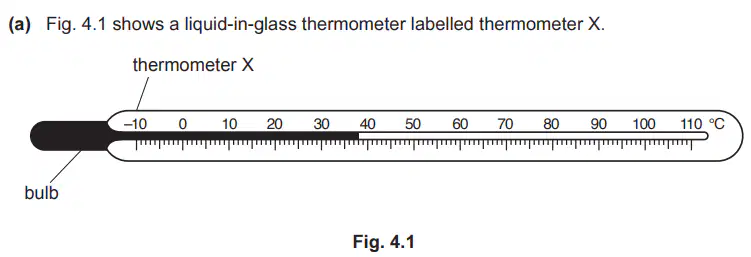
(i) State the physical property which varies with temperature in a liquid-in-glass thermometer.

(ii) Thermometer Y has a bulb that contains twice the volume of liquid compared to thermometer X. State and explain how the sensitivity of thermometer Y compares with the sensitivity of thermometer X.
statement .......................................................................................................................... explanation ........................................................................................................................ ........................................................................................................................................... [2]

(iii) State and explain one change that can be made to the design of thermometer X to increase its range.
statement ..........................................................................................................................
explanation ........................................................................................................................ [2]

(b) A liquid-in-glass thermometer cannot measure a temperature of 1300°C. State a physical property which varies with temperature in a thermometer which can measure a temperature of 1300°C.
A liquid at room temperature is put on a metal surface which is also at room temperature. A student blows gently across the liquid and its temperature decreases. What causes the liquid to become cooler?
Bubbles of water vapour form in the liquid and go into the air.
The moving air reduces the kinetic energy of all the particles in the liquid.
Thermal energy flows from the liquid into the metal.
The more energetic particles in the liquid escape into the air.
Very small pollen grains are suspended in water. A bright light shines from the side. When looked at through a microscope, small specks of light are seen to be moving in a random, jerky manner.
What are the moving specks of light?
pollen grains being hit by other pollen grains
pollen grains being hit by water molecules
water molecules being hit by other water molecules
water molecules being hit by pollen grains
A gas is contained in a sealed container in a laboratory. The temperature of the gas increases. What happens to the average speed and what happens to the total kinetic energy of the gas molecules?
average speed does not change, total kinetic energy does not change
average speed does not change, total kinetic energy increases
average speed increases, total kinetic energy does not change
average speed increases, total kinetic energy increases
The same mass of a gas is trapped in four identical cylinders by a piston that can move. The diagrams show the samples of gas in different conditions of volume and temperature. Which list gives the pressure of the gas in order from lowest to highest?
1 → 2 → 3 → 4
1 → 3 → 2 → 4
4 → 2 → 3 → 1
4 → 3 → 2 → 1
The liquid level in a thermometer rises when the thermometer is placed in hot water. What causes this?
The liquid contracts.
The liquid evaporates.
The liquid expands.
The liquid freezes.
The diagram shows a liquid-in-glass thermometer. Which change to the design would result in a more sensitive thermometer?
Increase the density of the liquid.
Increase the diameter of the capillary tube.
Increase the number of scale markings.
Increase the volume of the bulb.
A student calculates the energy needed to raise the temperature of an aluminium block from 50 °C to 60 °C. He then does an experiment to measure the energy used to do this. Which statement about the measured energy is correct?
The measured energy will be greater than the calculated energy because some energy is
transferred to the surroundings.
The measured energy will be greater than the calculated energy because the block absorbs
energy from the surroundings.
The measured energy will be less than the calculated energy because the mass of the block
decreases as it gets warmer.
The measured energy will be less than the calculated energy because the thermal capacity
of the block is low.
Which statements correctly describes a liquid that is boiling
no bubbles seen, takes place on the surface only
no bubbles seen, takes place throughout the liquid
bubbles seen, takes place on the surface only
bubbles seen, takes place throughout the liquid
Which statement about boiling and evaporation is correct?
Boiling requires a supply of thermal energy but evaporation does not.
Evaporation takes place at the surface of a liquid but boiling takes place throughout the
liquid.
When water boils in a kettle, its temperature decreases.
When water evaporates, its temperature increases.
Why are small gaps left between the metal rails of a railway track?
to allow for expansion of the rails on a hot day
to allow for contraction of the rails on a hot day
to allow for expansion of the rails on a cold day
to allow for contraction of the rails on a cold day
A block of metal absorbs 2000 J of thermal energy. The temperature of the block rises from 10 °C to 20 °C. The mass of the block is 2.0 kg. What is the specific heat capacity of the metal?
50 J / (kg °C)
100 J / (kg °C)
200 J / (kg °C)
400 J / (kg °C)
A block of aluminium of mass 2.0 kg has an initial temperature of 20 °C. It absorbs 7300 J of thermal energy. The specific heat capacity of aluminium is 913 J / (kg °C). What is the final temperature of the aluminium block?
4.0 °C
8.0 °C
24 °C
28 °C
The diagram shows the apparatus used to measure the specific latent heat of vaporisation of water. After the water begins to boil, 110 g of water is converted to steam in 120 s. Using these results, what is the value of the specific latent heat of vaporisation of water?
1.8 J / kg
1800 J / kg
2200 J / kg
2 200 000 J / kg
A metal rod is heated at end X. Why does end Y of the metal rod become hot?
Energy is transferred from end X of the rod to end Y by vibration of positive ions and by
movement of electrons.
Energy is transferred from end X of the rod to end Y by movement of positive ions only.
Energy is transferred from end X of the rod to end Y by vibration of positive ions only.
Energy is transferred from end X of the rod to end Y by movement of electrons only.
Two square sheets of metal, P and Q, are heated to the same temperature. The metal sheets are shown. Sheet Q is emitting more radiation than sheet P. Which statement explains this?
Dull black surfaces are better conductors of radiation.
Dull black surfaces are better emitters of radiation.
The surface area of Q is larger than that of P.
White surfaces are better absorbers of radiation.
Three students are planning an experiment to test thermal conduction in different materials. The students each propose a hypothesis.
1 I think the copper rod will be a good thermal conductor because it is a metal.
2 I think the glass rod will be a good thermal conductor because it has free electrons which vibrate and transfer energy quickly.
3 I think the wooden rod will be a poor thermal conductor because it can only transfer energy along the rod by vibrating the lattice particles.
Which of their hypotheses are correct?
1 and 2 only
1 and 3 only
2 and 3 only
1, 2 and 3
Which statement about evaporation is correct?
evaporation causes the temperature of the remaining liquid to decrease
evaporation does not occur from a cold liquid near its freezing point
evaporation does not occur from a dense liquid, such as mercury
evaporation occurs from all parts of a liquid
Gas is stored in a sealed container of constant volume. The temperature of the gas increases. This causes the pressure of the gas to increase. What happens to the gas molecules during this pressure increase?
The average kinetic energy of the molecules increases
The average separation of the molecules decreases
The average separation of the molecules increases
The volume of each molecule increases
Which causes the random, zig-zag movement (Brownian motion) of smoke particles suspended in air?
air molecules colliding with smoke particles
convection currents as the hot smoke rises
smoke particles colliding with each other
smoke particles reacting with oxygen molecules in the air

A sealed gas cylinder is left outside on a hot, sunny day. What happens to the average speed of the gas molecules and to the pressure of the gas in the cylinder as the temperature of the gas rises?
A
B
C
D
A swimmer feels cold after leaving warm water on a warm, windy day. Why does she feel cold even though the air is warm?
the less energetic water molecules on her skin escape quickly
the more energetic water molecules on her skin do not escape quickly
the water on her skin does not evaporate quickly enough to keep her warm
the water on her skin evaporates quickly and cools her skin
A car tyre has a constant volume. Why does the pressure of the air in the tyre increase when its temperature increases?
the air molecules hit each other less often
the air molecules hit the inside of the tyre less often
the average speed of the air molecules in the tyre is greater
there are more air molecules in the tyre

A student places his thumb firmly on the outlet of a bicycle pump, to stop the air from coming out. What happens to the pressure and what happens to the volume of the trapped air as the pump handle is pushed in?
A
B
C
D

Some gas is trapped in a container of fixed volume. The temperature of the gas increases. Which graph shows how the pressure of the gas changes with temperature?
A
B
C
D

The volume of a gas in a sealed syringe is increased. The temperature of the gas does not change. After this change is made, what has happened to the gas molecules in the syringe?
they move more quickly
they move more slowly
they hit the syringe walls less often
the hit the syringe walls more often

The pressure of a fixed mass of a cylinder is measured. The volume of the gas in the cylinder is then slowly decreased. The temperature of the gas does not change. Which graph could show the change of pressure of the gas during this process?
A
B
C
D

A student suggests some uses for containers made from good thermal conductors and for containers made from poor thermal conductors? In which row are both suggested uses correct?
A
B
C
D

Two plastic cups are placed one inside the other. A small spacer keeps the two cups separated. Hot water is poured into the inner cup and a lid is put on top, as shown. Which statement is correct?
The bench is heated by convection from the bottom of the outer cup
The lid reduces the energy lost by convection
There is no thermal conduction through the sides of either cup
Thermal radiation is prevented by the small air gap

A solid is heated from room temperature. The graph shows how its temperature changes with time as it is heated constantly. At which time has it just become completely liquid?
A
B
C
D

The diagram shows a vacuum flask used to keep liquid hot. How does thermal energy pass through the vacuum?
conduction only
convection only
radiation only
conduction and convection

The diagram shows a block of ice placed in a warm room. At which point is the temperature the lowest?
A
B
C
D

The air in a room is heated by a heater. The diagram shows the circulation of the air in the room. Which statement about the air that is heated is correct?
The air contracts and become less dense
The air contracts and becomes more dense
The air expands and becomes less dense
The air expands and becomes more dense

In a refrigerator, the cooling unit can be fitted either at the top or at the bottom. In an oven, the heater can be fitted either at the top or at the bottom. Which row shows the best position for the cooling unit and the best position for the heater?
A
B
C
D

Ice is trapped by a metal gauze at the bottom of a tube containing water. The water is heated strongly at the top, but the ice only melts very slowly. Why does the ice melt so slowly?
heat energy always travels upwards
hot water is more dense than cold water
metal gauze does not allow heat to pass through
water is a poor conductor of heat

One type of double glazing consists of two panes of glass separated by a vacuum. Which method or methods of energy transfer are prevented by the vacuum?
conduction and convection
conduction and radiation
convection and radiation
radiation only

A substance loses thermal energy (heat) to the surroundings at a steady rate. The graph shows how the temperature of the substance changes with time. What could the portion PQ of the graph represent?
gas condensing
gas cooling
liquid cooling
liquid solidifying

Which row shows the surface that is the better absorber and the surface that is the better emitter of infra-red radiation?
A
B
C
D
One end of a copper rod is heated. What is one method by which thermal energy is transferred in the copper rod?
free electrons transfer energy from the cooler end to the hotter end
free electrons transfer energy from the hotter end to the cooler end
molecules of copper move from the cooler end to the hotter end
molecules of copper move from the hotter end to the cooler end
The same quantity of thermal energy is supplied to two solid objects A and Y. The temperature increase of object X is greater than the temperature increase of object Y. Which statement explains this?
X has a lower melting point than Y
X has a lower density than Y
X has a lower thermal capacity than Y
X is a better thermal conductor than Y
Which quantity gives the thermal capacity of a beaker?
the thermal energy required to change the state of the beaker at constant temperature
the thermal energy required to raise the temperature of the beaker by 1 degree Celsius
the total mass of hot liquid that the beaker can hold
the total volume of hot liquid that the beaker can hold

The table lists the melting points and the boiling points of four different substances. Which substance is a liquid at 0 degrees Celsius?
A
B
C
D

The diagram shows electricity cables being put up on a warm day. The cables are left loose between the poles, as shown in the diagram. Why are the cables left loose?
they will contract on cold days
they will contract on very warm days
they will expand on cold days
they will expand on very warm days

A long thin bar of cooper is heated evenly along its length. What happens to the bar?
it becomes less heavy
it becomes longer
it becomes shorter
it bends at the ends
A circular metal disc is heated. Which quantity decreases?
density
diameter
thickness
volume

In an experiment, a thermometer is placed in a test tube of hot liquid. The temperature of the liquid is recorded every half minute. The table shows the results. What is the melting point of the substance?
0 degrees Celsius
33 degrees Celsius
55 degrees Celsius
73 degrees Celsius

Equal masses of two different liquids are put into identical beakers. Liquid 1 is heated for 100s and liquid 2 is heated for 200s by heaters of the same power. The temperature of both liquids increases by the same amount. Which statement is correct?
both liquids receive the same amount of energy
liquid 1 receives more energy than liquid 2
both liquids have equal thermal capacity
the thermal capacity of liquid 1 is less than thermal capacity of liquid 2

Equal masses of two different liquids are heated using the same heater. The graph shows how the temperature of each liquid changes with time. What does the graph tell us about the liquids?
Liquid 1 has a higher melting point than liquid 2
Liquid 1 has a higher boiling point than liquid 2
Liquid 1 starts to melt sooner than liquid 2
Liquid 1 starts to boil sooner than liquid 2
Which pair contains only physical quantities that vary with temperature and so could be used in making a thermometer?
activity of a radioactive source, volume of a gas
mass of a liquid, volume of a liquid
activity of a radioactive source, mass of a solid
volume of a gas, volume of a liquid
A heater supplies 80J of energy to a block of metal. The temperature of the block rises by 20 degrees Celsius. What happens to the block of metal when its temperature falls by 10 degrees Celsius?
its internal energy decreases by 40J
its internal energy decreases by 160J
its internal energy increases by 40J
its internal energy increases by 160J
A solid object has a very large thermal capacity. What does this mean?
a large amount of energy is needed to make the object become hot
a large amount of energy is needed to make the object melt
a small amount of energy is needed to make the object become hot
a small amount of energy is needed to make the object melt
K = Degrees Celsius + __________
What is internal energy
the average kinetic energy of the particles
heat energy
the sum of the kinetic and potential energy
the average potential energy
Convert
450 K to Celsius723oC
277oC
177 oC
623oC
What is the boiling point of water on the Kelvin scale?
0K
373K
100K
212K
What is the freezing/melting point of water of the Fahrenheit scale?
−273oF
0oF
32oF
273oF
K = Degrees Celsius + __________
A liquid at room temperature is put on a metal surface which is also at room temperature. A student blows gently across the liquid and its temperature decreases. What causes the liquid to become cooler?
Bubbles of water vapour form in the liquid and go into the air.
The moving air reduces the kinetic energy of all the particles in the liquid.
Thermal energy flows from the liquid into the metal.
The more energetic particles in the liquid escape into the air.
Very small pollen grains are suspended in water. A bright light shines from the side. When looked at through a microscope, small specks of light are seen to be moving in a random, jerky manner.
What are the moving specks of light?
pollen grains being hit by other pollen grains
pollen grains being hit by water molecules
water molecules being hit by other water molecules
water molecules being hit by pollen grains
A gas is contained in a sealed container in a laboratory. The temperature of the gas increases. What happens to the average speed and what happens to the total kinetic energy of the gas molecules?
average speed does not change, total kinetic energy does not change
average speed does not change, total kinetic energy increases
average speed increases, total kinetic energy does not change
average speed increases, total kinetic energy increases
The same mass of a gas is trapped in four identical cylinders by a piston that can move. The diagrams show the samples of gas in different conditions of volume and temperature. Which list gives the pressure of the gas in order from lowest to highest?
1 → 2 → 3 → 4
1 → 3 → 2 → 4
4 → 2 → 3 → 1
4 → 3 → 2 → 1
The liquid level in a thermometer rises when the thermometer is placed in hot water. What causes this?
The liquid contracts.
The liquid evaporates.
The liquid expands.
The liquid freezes.
A student calculates the energy needed to raise the temperature of an aluminium block from 50 °C to 60 °C. He then does an experiment to measure the energy used to do this. Which statement about the measured energy is correct?
The measured energy will be greater than the calculated energy because some energy is
transferred to the surroundings.
The measured energy will be greater than the calculated energy because the block absorbs
energy from the surroundings.
The measured energy will be less than the calculated energy because the mass of the block
decreases as it gets warmer.
The measured energy will be less than the calculated energy because the thermal capacity
of the block is low.
Which statements correctly describes a liquid that is boiling
no bubbles seen, takes place on the surface only
no bubbles seen, takes place throughout the liquid
bubbles seen, takes place on the surface only
bubbles seen, takes place throughout the liquid
Which statement about boiling and evaporation is correct?
Boiling requires a supply of thermal energy but evaporation does not.
Evaporation takes place at the surface of a liquid but boiling takes place throughout the
liquid.
When water boils in a kettle, its temperature decreases.
When water evaporates, its temperature increases.
Why are small gaps left between the metal rails of a railway track?
to allow for expansion of the rails on a hot day
to allow for contraction of the rails on a hot day
to allow for expansion of the rails on a cold day
to allow for contraction of the rails on a cold day
A block of metal absorbs 2000 J of thermal energy. The temperature of the block rises from 10 °C to 20 °C. The mass of the block is 2.0 kg. What is the specific heat capacity of the metal?
50 J / (kg °C)
100 J / (kg °C)
200 J / (kg °C)
400 J / (kg °C)
A metal rod is heated at end X. Why does end Y of the metal rod become hot?
Energy is transferred from end X of the rod to end Y by vibration of positive ions and by
movement of electrons.
Energy is transferred from end X of the rod to end Y by movement of positive ions only.
Energy is transferred from end X of the rod to end Y by vibration of positive ions only.
Energy is transferred from end X of the rod to end Y by movement of electrons only.
Two square sheets of metal, P and Q, are heated to the same temperature. The metal sheets are shown. Sheet Q is emitting more radiation than sheet P. Which statement explains this?
Dull black surfaces are better conductors of radiation.
Dull black surfaces are better emitters of radiation.
The surface area of Q is larger than that of P.
White surfaces are better absorbers of radiation.
Three students are planning an experiment to test thermal conduction in different materials. The students each propose a hypothesis.
1 I think the copper rod will be a good thermal conductor because it is a metal.
2 I think the glass rod will be a good thermal conductor because it has free electrons which vibrate and transfer energy quickly.
3 I think the wooden rod will be a poor thermal conductor because it can only transfer energy along the rod by vibrating the lattice particles.
Which of their hypotheses are correct?
1 and 2 only
1 and 3 only
2 and 3 only
1, 2 and 3


Which diagram shows the movement of air as the room is heated?


When the lid is removed, the rate of heat loss from the drink increases. What causes this?

Which line in the table describes the temperature and the direction of the air that moves through the gap?

Which statement is correct?

What are the main processes by which heat energy is transferred from the element to the water, and throughout the water?
Which row shows the surface that is the better absorber and the surface that is the better emitter of infra-red radiation?
A
B
C
D
One end of a copper rod is heated. What is one method by which thermal energy is transferred in the copper rod?
free electrons transfer energy from the cooler end to the hotter end
free electrons transfer energy from the hotter end to the cooler end
molecules of copper move from the cooler end to the hotter end
molecules of copper move from the hotter end to the cooler end
The same quantity of thermal energy is supplied to two solid objects A and Y. The temperature increase of object X is greater than the temperature increase of object Y. Which statement explains this?
X has a lower melting point than Y
X has a lower density than Y
X has a lower thermal capacity than Y
X is a better thermal conductor than Y
Which statement about evaporation is correct?
evaporation causes the temperature of the remaining liquid to decrease
evaporation does not occur from a cold liquid near its freezing point
evaporation does not occur from a dense liquid, such as mercury
evaporation occurs from all parts of a liquid
Gas is stored in a sealed container of constant volume. The temperature of the gas increases. This causes the pressure of the gas to increase. What happens to the gas molecules during this pressure increase?
The average kinetic energy of the molecules increases
The average separation of the molecules decreases
The average separation of the molecules increases
The volume of each molecule increases
Which causes the random, zig-zag movement (Brownian motion) of smoke particles suspended in air?
air molecules colliding with smoke particles
convection currents as the hot smoke rises
smoke particles colliding with each other
smoke particles reacting with oxygen molecules in the air
A sealed gas cylinder is left outside on a hot, sunny day. What happens to the average speed of the gas molecules and to the pressure of the gas in the cylinder as the temperature of the gas rises?
A
B
C
D
A swimmer feels cold after leaving warm water on a warm, windy day. Why does she feel cold even though the air is warm?
the less energetic water molecules on her skin escape quickly
the more energetic water molecules on her skin do not escape quickly
the water on her skin does not evaporate quickly enough to keep her warm
the water on her skin evaporates quickly and cools her skin
A car tyre has a constant volume. Why does the pressure of the air in the tyre increase when its temperature increases?
the air molecules hit each other less often
the air molecules hit the inside of the tyre less often
the average speed of the air molecules in the tyre is greater
there are more air molecules in the tyre
A student places his thumb firmly on the outlet of a bicycle pump, to stop the air from coming out. What happens to the pressure and what happens to the volume of the trapped air as the pump handle is pushed in?
A
B
C
D
Some gas is trapped in a container of fixed volume. The temperature of the gas increases. Which graph shows how the pressure of the gas changes with temperature?
A
B
C
D
The volume of a gas in a sealed syringe is increased. The temperature of the gas does not change. After this change is made, what has happened to the gas molecules in the syringe?
they move more quickly
they move more slowly
they hit the syringe walls less often
the hit the syringe walls more often
The pressure of a fixed mass of a cylinder is measured. The volume of the gas in the cylinder is then slowly decreased. The temperature of the gas does not change. Which graph could show the change of pressure of the gas during this process?
A
B
C
D
A student suggests some uses for containers made from good thermal conductors and for containers made from poor thermal conductors? In which row are both suggested uses correct?
A
B
C
D
Two plastic cups are placed one inside the other. A small spacer keeps the two cups separated. Hot water is poured into the inner cup and a lid is put on top, as shown. Which statement is correct?
The bench is heated by convection from the bottom of the outer cup
The lid reduces the energy lost by convection
There is no thermal conduction through the sides of either cup
Thermal radiation is prevented by the small air gap
A solid is heated from room temperature. The graph shows how its temperature changes with time as it is heated constantly. At which time has it just become completely liquid?
A
B
C
D
The diagram shows a vacuum flask used to keep liquid hot. How does thermal energy pass through the vacuum?
conduction only
convection only
radiation only
conduction and convection
The diagram shows a block of ice placed in a warm room. At which point is the temperature the lowest?
A
B
C
D
The air in a room is heated by a heater. The diagram shows the circulation of the air in the room. Which statement about the air that is heated is correct?
The air contracts and become less dense
The air contracts and becomes more dense
The air expands and becomes less dense
The air expands and becomes more dense
In a refrigerator, the cooling unit can be fitted either at the top or at the bottom. In an oven, the heater can be fitted either at the top or at the bottom. Which row shows the best position for the cooling unit and the best position for the heater?
A
B
C
D
Ice is trapped by a metal gauze at the bottom of a tube containing water. The water is heated strongly at the top, but the ice only melts very slowly. Why does the ice melt so slowly?
heat energy always travels upwards
hot water is more dense than cold water
metal gauze does not allow heat to pass through
water is a poor conductor of heat
One type of double glazing consists of two panes of glass separated by a vacuum. Which method or methods of energy transfer are prevented by the vacuum?
conduction and convection
conduction and radiation
convection and radiation
radiation only
A substance loses thermal energy (heat) to the surroundings at a steady rate. The graph shows how the temperature of the substance changes with time. What could the portion PQ of the graph represent?
gas condensing
gas cooling
liquid cooling
liquid solidifying
Which row shows the surface that is the better absorber and the surface that is the better emitter of infra-red radiation?
A
B
C
D
One end of a copper rod is heated. What is one method by which thermal energy is transferred in the copper rod?
free electrons transfer energy from the cooler end to the hotter end
free electrons transfer energy from the hotter end to the cooler end
molecules of copper move from the cooler end to the hotter end
molecules of copper move from the hotter end to the cooler end
The same quantity of thermal energy is supplied to two solid objects A and Y. The temperature increase of object X is greater than the temperature increase of object Y. Which statement explains this?
X has a lower melting point than Y
X has a lower density than Y
X has a lower thermal capacity than Y
X is a better thermal conductor than Y
Which quantity gives the thermal capacity of a beaker?
the thermal energy required to change the state of the beaker at constant temperature
the thermal energy required to raise the temperature of the beaker by 1 degree Celsius
the total mass of hot liquid that the beaker can hold
the total volume of hot liquid that the beaker can hold
The table lists the melting points and the boiling points of four different substances. Which substance is a liquid at 0 degrees Celsius?
A
B
C
D
The diagram shows electricity cables being put up on a warm day. The cables are left loose between the poles, as shown in the diagram. Why are the cables left loose?
they will contract on cold days
they will contract on very warm days
they will expand on cold days
they will expand on very warm days
A long thin bar of cooper is heated evenly along its length. What happens to the bar?
it becomes less heavy
it becomes longer
it becomes shorter
it bends at the ends
A circular metal disc is heated. Which quantity decreases?
density
diameter
thickness
volume
In an experiment, a thermometer is placed in a test tube of hot liquid. The temperature of the liquid is recorded every half minute. The table shows the results. What is the melting point of the substance?
0 degrees Celsius
33 degrees Celsius
55 degrees Celsius
73 degrees Celsius
Equal masses of two different liquids are put into identical beakers. Liquid 1 is heated for 100s and liquid 2 is heated for 200s by heaters of the same power. The temperature of both liquids increases by the same amount. Which statement is correct?
both liquids receive the same amount of energy
liquid 1 receives more energy than liquid 2
both liquids have equal thermal capacity
the thermal capacity of liquid 1 is less than thermal capacity of liquid 2
Equal masses of two different liquids are heated using the same heater. The graph shows how the temperature of each liquid changes with time. What does the graph tell us about the liquids?
Liquid 1 has a higher melting point than liquid 2
Liquid 1 has a higher boiling point than liquid 2
Liquid 1 starts to melt sooner than liquid 2
Liquid 1 starts to boil sooner than liquid 2
Which pair contains only physical quantities that vary with temperature and so could be used in making a thermometer?
activity of a radioactive source, volume of a gas
mass of a liquid, volume of a liquid
activity of a radioactive source, mass of a solid
volume of a gas, volume of a liquid
A heater supplies 80J of energy to a block of metal. The temperature of the block rises by 20 degrees Celsius. What happens to the block of metal when its temperature falls by 10 degrees Celsius?
its internal energy decreases by 40J
its internal energy decreases by 160J
its internal energy increases by 40J
its internal energy increases by 160J
A solid object has a very large thermal capacity. What does this mean?
a large amount of energy is needed to make the object become hot
a large amount of energy is needed to make the object melt
a small amount of energy is needed to make the object become hot
a small amount of energy is needed to make the object melt
K = Degrees Celsius + __________
What is internal energy
the average kinetic energy of the particles
heat energy
the sum of the kinetic and potential energy
the average potential energy
Convert
450 K to Celsius723oC
277oC
177 oC
623oC
What is the boiling point of water on the Kelvin scale?
0K
373K
100K
212K
What is the freezing/melting point of water of the Fahrenheit scale?
−273oF
0oF
32oF
273oF
K = Degrees Celsius + __________
A liquid at room temperature is put on a metal surface which is also at room temperature. A student blows gently across the liquid and its temperature decreases. What causes the liquid to become cooler?
Bubbles of water vapour form in the liquid and go into the air.
The moving air reduces the kinetic energy of all the particles in the liquid.
Thermal energy flows from the liquid into the metal.
The more energetic particles in the liquid escape into the air.
Very small pollen grains are suspended in water. A bright light shines from the side. When looked at through a microscope, small specks of light are seen to be moving in a random, jerky manner.
What are the moving specks of light?
pollen grains being hit by other pollen grains
pollen grains being hit by water molecules
water molecules being hit by other water molecules
water molecules being hit by pollen grains
A gas is contained in a sealed container in a laboratory. The temperature of the gas increases. What happens to the average speed and what happens to the total kinetic energy of the gas molecules?
average speed does not change, total kinetic energy does not change
average speed does not change, total kinetic energy increases
average speed increases, total kinetic energy does not change
average speed increases, total kinetic energy increases
The same mass of a gas is trapped in four identical cylinders by a piston that can move. The diagrams show the samples of gas in different conditions of volume and temperature. Which list gives the pressure of the gas in order from lowest to highest?
1 → 2 → 3 → 4
1 → 3 → 2 → 4
4 → 2 → 3 → 1
4 → 3 → 2 → 1
The liquid level in a thermometer rises when the thermometer is placed in hot water. What causes this?
The liquid contracts.
The liquid evaporates.
The liquid expands.
The liquid freezes.
A student calculates the energy needed to raise the temperature of an aluminium block from 50 °C to 60 °C. He then does an experiment to measure the energy used to do this. Which statement about the measured energy is correct?
The measured energy will be greater than the calculated energy because some energy is
transferred to the surroundings.
The measured energy will be greater than the calculated energy because the block absorbs
energy from the surroundings.
The measured energy will be less than the calculated energy because the mass of the block
decreases as it gets warmer.
The measured energy will be less than the calculated energy because the thermal capacity
of the block is low.
Which statements correctly describes a liquid that is boiling
no bubbles seen, takes place on the surface only
no bubbles seen, takes place throughout the liquid
bubbles seen, takes place on the surface only
bubbles seen, takes place throughout the liquid
Which statement about boiling and evaporation is correct?
Boiling requires a supply of thermal energy but evaporation does not.
Evaporation takes place at the surface of a liquid but boiling takes place throughout the
liquid.
When water boils in a kettle, its temperature decreases.
When water evaporates, its temperature increases.
Why are small gaps left between the metal rails of a railway track?
to allow for expansion of the rails on a hot day
to allow for contraction of the rails on a hot day
to allow for expansion of the rails on a cold day
to allow for contraction of the rails on a cold day
A block of metal absorbs 2000 J of thermal energy. The temperature of the block rises from 10 °C to 20 °C. The mass of the block is 2.0 kg. What is the specific heat capacity of the metal?
50 J / (kg °C)
100 J / (kg °C)
200 J / (kg °C)
400 J / (kg °C)
A metal rod is heated at end X. Why does end Y of the metal rod become hot?
Energy is transferred from end X of the rod to end Y by vibration of positive ions and by
movement of electrons.
Energy is transferred from end X of the rod to end Y by movement of positive ions only.
Energy is transferred from end X of the rod to end Y by vibration of positive ions only.
Energy is transferred from end X of the rod to end Y by movement of electrons only.
Two square sheets of metal, P and Q, are heated to the same temperature. The metal sheets are shown. Sheet Q is emitting more radiation than sheet P. Which statement explains this?
Dull black surfaces are better conductors of radiation.
Dull black surfaces are better emitters of radiation.
The surface area of Q is larger than that of P.
White surfaces are better absorbers of radiation.
Three students are planning an experiment to test thermal conduction in different materials. The students each propose a hypothesis.
1 I think the copper rod will be a good thermal conductor because it is a metal.
2 I think the glass rod will be a good thermal conductor because it has free electrons which vibrate and transfer energy quickly.
3 I think the wooden rod will be a poor thermal conductor because it can only transfer energy along the rod by vibrating the lattice particles.
Which of their hypotheses are correct?
1 and 2 only
1 and 3 only
2 and 3 only
1, 2 and 3
Which diagram shows the movement of air as the room is heated?
When the lid is removed, the rate of heat loss from the drink increases. What causes this?
Which line in the table describes the temperature and the direction of the air that moves through the gap?
Which statement is correct?
What are the main processes by which heat energy is transferred from the element to the water, and throughout the water?
Which row shows the surface that is the better absorber and the surface that is the better emitter of infra-red radiation?
A
B
C
D
One end of a copper rod is heated. What is one method by which thermal energy is transferred in the copper rod?
free electrons transfer energy from the cooler end to the hotter end
free electrons transfer energy from the hotter end to the cooler end
molecules of copper move from the cooler end to the hotter end
molecules of copper move from the hotter end to the cooler end
The same quantity of thermal energy is supplied to two solid objects A and Y. The temperature increase of object X is greater than the temperature increase of object Y. Which statement explains this?
X has a lower melting point than Y
X has a lower density than Y
X has a lower thermal capacity than Y
X is a better thermal conductor than Y