
 Worksheets
reading and fiction
Total questions: 100
Worksheet time: 2hrs 12mins
The description of Angkor as "the scene of one of the greatest vanishing acts of all time" suggests that:
a) The city was deliberately hidden.
b) The city was destroyed by a natural disaster.
c) The city was mysteriously abandoned.
d) The city was conquered by a foreign power.
A
B
C
D
If you ________ into water, you jump in suddenly.
a. penetrate
b. plunge
c. flourish
1
A
B
C
D
A(n) ________ is an army which enters another country by force.a. invader
b. regime
c. channel
d. policeman
A
B
C
D
______are rock formations hanging from cave ceilings, slowly formed by dripping water.
rocks
Stones
Stalagmites
Stalactites
____is the ceremonial jewelry, objects, or clothes that symbolize royalty or high office.
Begal
Regalia
Regale
Regal
A ____is a device used for telling the time when the sun is shining. The shadow of a pointer falls onto a surface marked with the hours.
sunny
sun rays
sundial
sun
An _____is someone who studies archeological artifacts to determine what ancient people believed and understood about astronomy.
archeoastronomer
archeologist
geologist
astronomer
If someone shows ________, they are probably quite clever.a. ingenuity
b. mechanism
c. flourish
d. innovation
A
B
C
D
Something that is ________ can weaken a political system.a. doomed
b. disperse
c. subversive
d. creative
A
B
C
D
If you ________ an animal, you kill it.
a. sacrifice
b. inspect
c. constitute
A
B
C
D
If liquid ________ a surface, it enters it.
a. soils
b. plunges
c. penetrates
d. comes
A
B
C
D
A ________ is a place where water is stored.a. reservoir
b. mechanism
c. invader
d. pool
A
B
C
D
A ________ is a system which is usually described as harsh.a. regime
b. channel
c. subsequent
d. well
A
B
C
D
Something incredibly demanding and exhausting is ________.a. grueling
b. blessing
c. flourishing
d. interesting
A
B
C
D
If you look at something closely, you _______ it.a. sacrifice
b. inspect
c. constitute
d. watch
A
B
C
D
Someone who shows ingenuity shows____EXCEPT
A. inventiveness B. creativity C. cleverness D. idleness
A
B
C
D
An event that doomed a civilization ____ it
A. destroyed B. built C. developed d. enlarged
A
B
C
D
What caused this society that once _____to suddenly collapse?
A. demised B. flourished C. collapsed D. inspected
A
B
C
D
They ____ my outside paintwork for cracks and flaws
A. demised B. flourished C. collapsed D. inspected
A
B
C
D
Our daughters whooped as they ____into the sea
A. demised B. plunged C. collapsed D. inspected
A
B
C
D
The manor and the mill were ____for twenty-one-year terms
A. demised B. flourished C. collapsed D. inspected
A
B
C
D
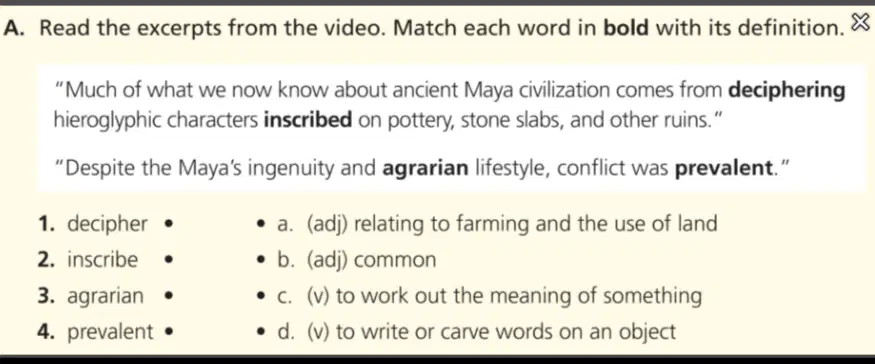
Question no 1 and the meaning is (a/b/c/d/)?
A
B
C
D
Question no 4 and the meaning is (a/b/c/d/)?
A
B
C
D
Question no 3 and the meaning is (a/b/c/d/)?
A
B
C
D
Question no 2 and the meaning is (a/b/c/d/)?
A
B
C
D
The description of Angkor as "the scene of one of the greatest vanishing acts of all time" suggests that:
a) The city was deliberately hidden.
b) The city was destroyed by a natural disaster.
c) The city was mysteriously abandoned.
d) The city was conquered by a foreign power.
A
B
C
D
Given the size and population of Angkor, it can be inferred that the Khmer Empire:
a) Was a small, isolated kingdom.
b) Had a complex society and economy.
c) Was primarily a rural society.
d) Was heavily reliant on agriculture.
A
B
C
D
The fact that Angkor Wat is described as the world's largest religious monument implies that:
a) Religion was not important to the Khmer people.
b) Religion played a central role in Khmer society.
c) The Khmer people were polytheistic.
d) The Khmer people were monotheistic.
A
B
C
D
What is the term for the point in the sky directly overhead?
a) Zenith
b) Meridian
c) Equator
d) Horizon
A
B
C
D
What is the significance of the dates May 23 and July 19 for the Maya people?
a) They are random dates chosen for the experiment
b) They are the dates when the Maya civilization began and ended
c) They are the days when the sun is directly overhead at the well
d) They are the dates of important Maya religious festivals
A
B
C
D
What are the key elements for writing fiction?
Theme, exposition, rising action, denouement
Conflict, point of view, resolution, climax
Plot, setting, characters, theme
Characters, setting, plot, conflict
What is the main purpose of setting in a story?
To provide closure
To reveal something about the main character
To create conflict
To introduce the characters
What is the turning point in a story according to the information of the plot Pyramid?
Falling action
Climax
Rising action
Exposition
What is the struggle between the main character and the antagonist called?
Denouement
Resolution
Conflict
Climax
Which point of view brings readers closer to the story?
Third-person omniscient
Third-person point of view
Third-person limited
First-person point of view
What is the underlying truth being conveyed in a story called?
Setting
Theme
Conflict
Plot
What type of characters are complex, dimensional, and well-developed?
Flat characters
Round characters
Static characters
Developing characters
Which type of conflict involves the main character struggling with natural forces?
Character vs. character
Character vs. nature
Character vs. society
Character vs. machine
What is the purpose of the denouement in a story?
To reveal the theme
To provide closure
To create conflict
To introduce the characters
Which point of view removes readers from the story?
Third-person limited
First-person point of view
Third-person point of view
Third-person omniscient
What is the main force related to place and time that characters encounter in a story?
Conflict
Setting
Theme
Plot
What is the order of events in a story called?
Conflict
Setting
Theme
Plot
Which type of characters do not play important roles in stories?
Developing characters
Flat characters
Round characters
Static characters
What is the struggle between the main character and himself or herself called?
Character vs. society
Character vs. nature
Character vs. himself or herself
Character vs. character
What is the purpose of the rising action in a story?
To introduce the characters
To create conflict
To provide closure
To make the problem more complex
The PLOT of a story is...
the lesson or moral
where the story takes place
when the story takes place
what the story is about
Which of these is NOT a type of conflict?
Character vs. Character
Character vs. Nurture
Character vs. Self
Character vs. Society
True or False: The main character of a story is called the antagonist.
True
False
True or False: The exposition of a story provides background to the characters and setting, and introduces the story.
True
False
The villian of a story is the...
jerk
protagonist
antagonist
weirdo
Which of the following is an example of FIRST PERSON point of view?
Mary told Juan, "I think you dropped your pen."
Jerry is so lazy.
I think my favorite part of school is recess.
"I can't believe you thought I liked Zendaya," she said rudely.
Which is an example of THIRD PERSON point of view?
"Look at her when she's talking to you," I said.
"I can't believe we're in middle school now," she said excitedly.
You will need a measuring cup and a bag a flour.
I told myself not to cry, but the tears came anyway.
The climax of a story is...
when the conflict is resolved
where everything falls into place
the highest emotional point
the ending
TRUE or FALSE: Rising action builds up to the climax.
False
True
TRUE or FALSE: Falling action is when things start to fall apart.
False
True

What is the element of fiction that describes WHEN and WHERE a story takes place?
Characters
Setting
Conflict
Plot

Why is setting important? Select all correct answers.
Setting can affect the characters.
Setting can affect the conflict.
Setting can affect the mood.
Setting is not important to a story

What is the element of fiction that describes the people who carry out the action in the story?
Conflict
Theme
Characters
Setting
What is the element of fiction that describes the problem in the story?
Setting
Characters
Theme
Conflict
When two characters are fighting or arguing, it is called...
Character vs. Character Conflict
Character vs. Self Conflict
Character vs. Nature Conflict
Character vs. Society Conflict
When a character has a problem with themselves that they need to change, it is called...
Character vs. Character Conflict
Character vs. Self Conflict
Character vs. Nature Conflict
Character vs. Society Conflict
When a character has to survive in a difficult environment (like a desert or the snow), it is called...
Character vs. Character Conflict
Character vs. Self Conflict
Character vs. Nature Conflict
Character vs. Society Conflict
When a character has a conflict with an unfair and unjust society or government it is called...
Character vs. Character Conflict
Character vs. Self Conflict
Character vs. Nature Conflict
Character vs. Society Conflict

Which of these are different parts of a plot diagram? (Plot Mountain)
Select all correct answers
Rising Action
Characters
Climax
Conflict
Resolution

introduces the characters?

The correct order of a Plot Diagram is...
exposition, falling action, climax, resolution, rising action
exposition, rising action, climax, falling action, resolution
resolution, falling action, climax, rising action, resolution
rising action, exposition, climax, resolution, falling action


One summer's day, a merry Grasshopper was dancing, singing and playing his violin with all his heart. He saw an Ant passing by working hard to store food for the winter. “Come and sing with me instead of working so hard,” said the Grasshopper. “Let’s have fun together.” “I must store food for the winter,” said the Ant,“ and I advise you to do the same.” “Don’t worry about winter, it’s still very far away,” said the Grasshopper, laughing at him. But the Ant wouldn’t listen and continued to work. When winter came, the starving Grasshopper went to the Ant’s house and humbly begged for something to eat. “If you had listened to my advice in the summer you would not now be in need,” said the Ant. “I’m afraid you will have to go without supper,” and he closed the door.
What is the rising action?
The Ant did not want to join the Grasshopper; The Grasshopper went to the Ant to ask for food; The Ant did not share his food.
The Ant was storing food for the winter; The Grasshopper kept singing, dancing and having fun; The Ant continued to work.
The Grasshopper was worried about winter; The Grasshopper stored his food properly; The Ant helped him.
The Grasshopper and the Ant went singing and dancing; The Ant helped the Grasshopper to store his food for the winter; They were prepared for winter.
A Dog, to whom the butcher had thrown a bone, was hurrying home with his prize as fast as he could go. As he crossed a narrow bridge, he looked down and saw his reflection in the quiet water as if in a mirror. But the greedy Dog thought he saw a real Dog carrying a bone much bigger than his own. If he had stopped to think he would have known better. But instead of thinking, he dropped his bone and sprang at the Dog in the river, only to find himself swimming for dear life to reach the shore. At last he managed to scramble out, and as he stood sadly thinking about the good bone he had lost, he realized what a foolish Dog he had been.
What is the conflict?
The dog doesn't like to swim.
The dog wanted the bigger bone that the other dog had.
The dog couldn't carry his bone.
The dog did not get along with the butcher.
During a baseball game, Tanner tried to tag a player leaving first base. When the umpire called the player out, Tanner immediately informed the umpire that he in fact did not tag the runner. Two weeks later, the very same umpire was at another one of Tanner’s baseball games. Tanner was playing short stop and tagged a runner as they approached third base. When the umpire called the player safe, Tanner didn’t say a word, but the umpire noticed the surprised look on Tanner’s face. “Did you tag the runner?” she asked Tanner. When Tanner told her that he did tag the runner, the umpire changed her decision and called the player out. The coaches and parents were furious, but the umpire stood by her decision.
What is the resolution?
Tanner lied to the umpire and the umpire believed him so Tanner's team won the game.
Tanner's team lost the game because of his honesty and this made the coaches and parents upset.
The umpire trusted Tanner because he had been honest and called the player out, even though it made the parents and coaches upset.
The umpire trusted Tanner and let Tanner make all of the calls in the game so Tanner's team would win.
When Siljo went out of town, he left his bird with his friend Don. Don was supposed to feed it and make sure it got a chance to fly around everyday. One day, Don forgot that the bird was out of its cage and he opened the front door. Siljo’s bird flew away. Don tried to find it but he couldn’t. Don apologized when Siljo came home. Siljo was sad, but he knew it was an accident and wasn’t mad.
Which of the following quotes would be the climax of the story?
"Siljo's bird flew away."
"Don forgot that the bird was out of its cage and he opened the front door."
"Don apologized when Siljo came home."
"Siljo was sad, but he knew it was an accident and wasn't mad."
The exposition includes which of the following
Rising Actions
Climax and Falling Actions
Characters, Setting & Conflict
The Climax is...
when we are introduced to the Protagonist
the highest moment of suspense in a story
when all conflicts or problems are resolved
1. The opposing character or force to the main character
protagonist
antagonist
main character
minor character
A story based on imaginary places, people, and events
Plot
Fiction
Conflict
Characterization
The series of events in a story.
Plot
Conflict
Climax
Fiction
The time, place, and period in which the action takes place.
Plot
Setting
Exposition
Rising Action
The beginning of the plot that introduces the story's main character(s), setting, and situation.
Rising Action
Conflict
Setting
Exposition
A struggle that takes place within a character's mind when he or she is challenged with a choice
Internal Conflict
External Conflict
Man vs. Nature
Man vs. Technology
A struggle between a character and an outside force
Internal conflict
External conflict
Man vs Self
Characterization
The process by which the writer reveals the personality of the character.
Characterization
Conflict
Climax
Exposition
In which the writer tells the audience what the personality of the character is.
Characterization
Conflict
Direct Characterization
Indirect characterization
In which the writer shows things that reveal the personality of the character through speech, thoughts, effects on others, actions, and looks.
Characterization
Conflict
Direct Characterization
Indirect Characterization
The central, or main character in a story.
Protagonist
Antagonist
Characterization
Dynamic character
A character who has a complex personality; often portrayed as a conflicted and contradictory person.
Rounded Character
Flat Character
Dynamic Character
Static Character
A character who is notable for having only one kind of personality trait or characteristic.
Rounded Character
Flat Character
Dynamic Character
Static Character
A character who changes over time, usually as a result of resolving a conflict or facing a major crisis.
Rounded Character
Flat Character
Dynamic Character
Static Character
A character who does not change over time; his or her personality does not transform or evolve.
Rounded Character
Flat Character
Dynamic Character
Static Character
First person or third person are examples of the ____ of a story.
Characters
Setting
Plot
Point of View
Which word matches the definition "Where and when a story takes place"?
Theme
Sensory Details
Setting
Symbol
Which word matches the definition "a narrator who knows about the thoughts and feelings of just one, or a limited number of, character(s)"?
Limited Narrator
Omniscient Narrator
Which word matches the definition "anything that stands for or represents something else"?
Theme
Sensory Details
Setting
Symbol
Which word matches the definition "a narrator who knows about the thoughts and feelings of all characters, as well as all information relevant to the story--all-knowing"?
Limited Narrator
Omniscient Narrator
Which element of plot occurs over "A series of events that builds from the conflict. It begins with the inciting force and ends with the climax."
Exposition/Introduction
Rising Action
Climax
Resolution
Which element of plot occurs at "End of the story where loose ends are tied up."
Exposition/Introduction
Rising Action
Climax
Resolution
Which element of plot occurs at "the beginning of the story where the characters and the setting are revealed and conflict is introduced."
Exposition/Introduction
Rising Action
Climax
Resolution

