
NEW
Font size
 Worksheets
U2 AoS2 DP 3a Visual Perception
Total questions: 15
Worksheet time: 8mins
Which of the following is not a biological factor that influences our visual perception?
Depth cues
Memory
Visual system
Monocular cues
Pamy is getting bored in psych class, so decides to look at the board while covering one of her eyes interchangeably. She notices that each eye sees a slightly different image, but when both eyes are open, the image seems to fuse together. What best explains this?
Convergence: each retina receives a slightly different image, and the brain fuses the two together
Convergence: the eyes are parallel, so each eye sees a slightly different image. If she were to go closer to the board, each eye would see the same thing
Retinal disparity: each retina receives a slightly different image, and the brain fuses the two together
Retinal disparity: the eyes are parallel, so each eye sees a slightly different image. If she were to go closer to the board, each eye would see the same thing

Which cue explains how we are perceiving depth and distance in this image?
Linear perspective
Height in the visual field
Relative size
Accommodation
If someone is unable to focus on objects close to them (within 3m), which cue might be impacted in understanding depth perception?
Monocular cues
Convergence
Pictorial cues
Accommodation
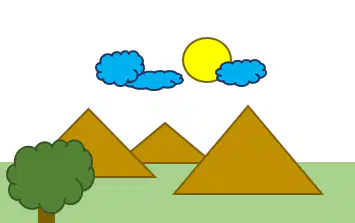
Leonhard found a picture of the pyramids he drew when he was 3. What type of pictorial cue demonstrates his understanding of depth perception?
Relative size
Height in visual field
Linear perspective
Interposition
Which of the following is not a psychological factor that influences visual perception?
Motivation
Visual cortex
Context
Past experience
Which best describes the Gestalt principles?
Organising separate stimuli to create meaningful pattern, or a whole form
Principles that involve: figure-ground, closure, similarity, and proximity
Managing visual changes in the stimuli we are exposed to
Using information that surrounds stimulus to influence our perception of it
Hungry Mia is walking down a street. As she passed by shops, she notices food-related signs or restaurants more quickly than other types of businesses. What psychological factor best explains this heightened visual perception and awareness on food?
Selective attention
Context
Motivation
Memory

Matthew looks at a door as it swings open, the shape projected onto his retina changes from a rectangle to a trapezoid. However, he knows the door is maintaining its rectangular shape. Which visual constancy explains this awareness?
Size constancy
Brightness constancy
Orientation constancy
Shape constancy

Which principle best explains why we are able to make out the object in this image?
Closure: we complete an incomplete image by filling in an imaginary contour line
Figure ground: we use an imaginary contour line to separate features of the image so a part of it stands out as an object
Similarity: we perceive stimuli that has similar visual features as belonging together based on previous experiences
Proximity: we see stimuli close together as belonging together to create a meaningful image
Which of the following is a social factor that influences our visual perception?
Past experiences
Memories
Culture
Context
A study shows that people from different cultural backgrounds tend to interpret ambiguous images differently. This phenomenon is most likely due to:
Social learning
Biological differences
Genetic predisposition
Visual clarity
Which of the following is an example of social factors influencing visual perception?
A person being colourblind and unable to distinguish between red and green
A person misjudging the size of an object due to lighting conditions
A person experiencing visual hallucinations due to lack of sleep
A person perceiving an optical illusions differently after discussing it with a group
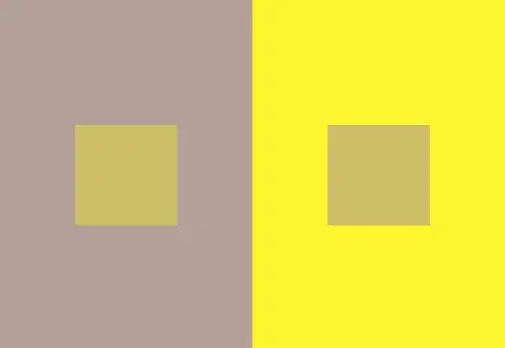
The squares in the centre are the same colour. Which cue explains why we may perceive the colours differently?
Proximity
Shape constancy
Context
Brightness constancy
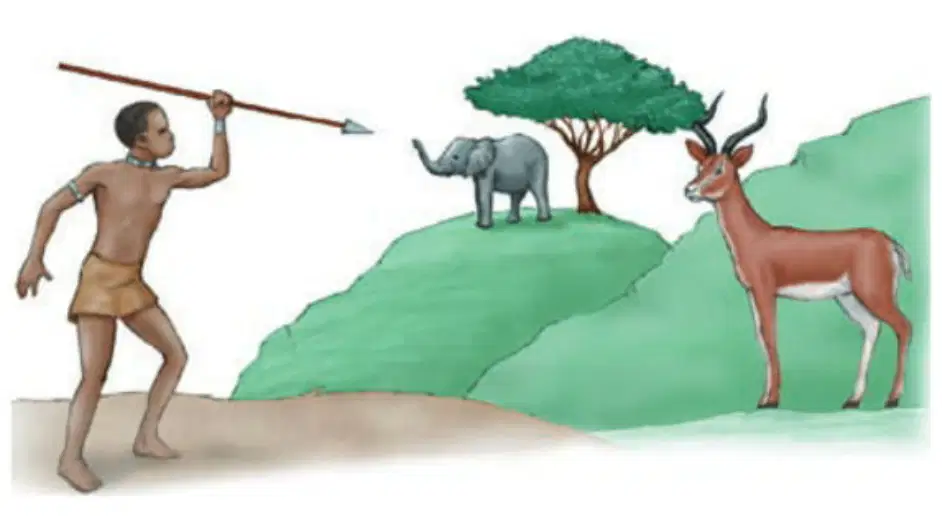
The Hudson test picture demonstrated to researchers that some people of different cultures may not be able to perceive depth in flat 2D images. While this is an example of cultural factors influencing visual perception, which biological depth cue can be used to explain this phenomenon?
Orientation
Relative size
Height in visual field
Proximity

