
 Worksheets
Practice Quiz [Topics 1 and 2]
Total questions: 12
Worksheet time: 10mins
Four physical changes of ethanol are listed.
1 condensation
2 evaporation
3 freezing
4 boiling
In which changes do the particles move further apart?
1 and 2
1 and 3
2 and 4
3 and 4
Rock salt is a mixture of salt and sand. The method used to separate the sand from the salt is listed.
step 1 Crush the rock salt, add to warm water and stir.
step 2 Pour the mixture through a filter paper held in a funnel.
step 3 Evaporate the water to crystallise the salt.
Which statement about the method is correct?
The filtrate in step 2 is pure water.
The residue in step 2 is pure crystals of salt.
The solute is salt.
The solvent is a mixture of salt and water.
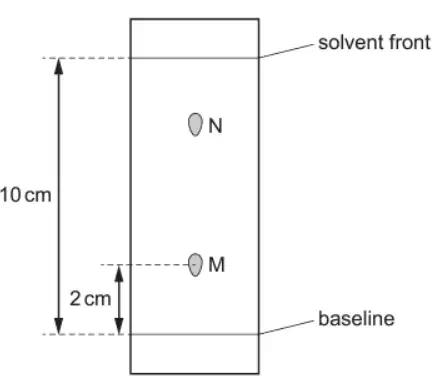
Two compounds, M and N, are dissolved in water and separated by chromatography. The results are shown.
What is the Rf value of M and which compound is most soluble in water?
Rf = 0. 2
Most soluble = M
Rf = 0. 2
Most soluble = N
Rf = 5.0
Most soluble = M
Rf = 5.0
Most soluble = N
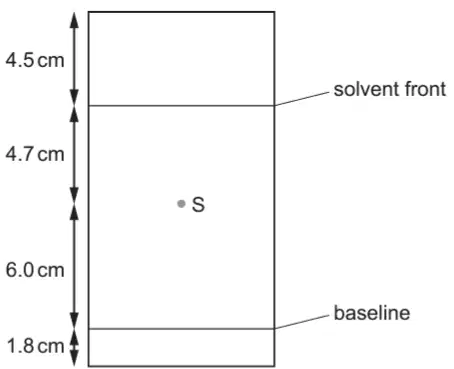
The chromatogram obtained from a chromatography experiment on substance S is shown.
What is the Rf value of S?
0.39
0.46
0.56
0.62
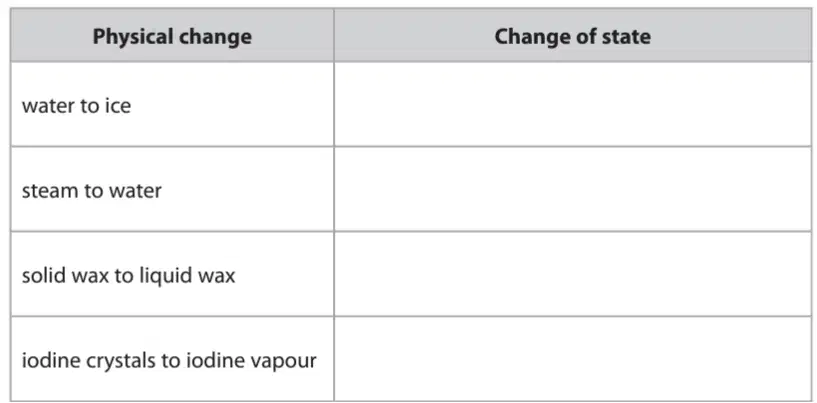
The table lists some physical changes.
Complete the table using words from the box to show the change of state for each physical change.
freezing
boiling
condensation
sublimation
freezing
condensation
melting
deposition
freezing
boiling
melting
deposition
freezing
condensation
melting
sublimation
Identify a method to separate a single food dye from a mixture of food dyes.
(a)
Identify a method to separate gasoline from crude oil.
(a)
Identify a method to separate water from copper(II) sulfate solution.
(a)
State the number of different elements in C3H5N3O9
4
20
1
0
State the name given to the spreading out of gas particles.
(a)
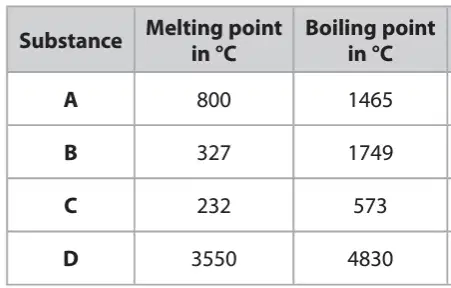
The table shows properties of four substances, A, B, C and D. Which substance is a gas at 600 °C?
Substance A
Substance B
Substance C
Substance D
Describe how the student can obtain pure dry crystals of salt from the salt solution by rearranging the steps below:
A. pour off excess liquid or filter to obtain crystals
B. evaporate some of the water
C. leave / cool the solution to crystallise
D. heat / boil the solution
E. Dry the crystals between sheets of filter paper
A -> B -> C -> D -> E->
D -> B -> A -> C -> E
D -> C -> A -> B -> E
E -> C -> A -> B - D

