Wayground logo

Free Printable Worksheets

Font size

S
M
L
XL
Worksheets

Microscopes and Interpreting Graphs

Total questions: 20

Worksheet time: 7mins

Name
Class
Date
1.
This image shows the detailed structure of the tiny mitochondria organelle.  Which microscope most likely took this image?
a)
Compound Light
b)
Scanning Electron
c)
Dissecting
d)
Transmission Electron
2.

This image shows the a 2D image of the parts of a cell at 200,000x normal size.  Which microscope most likely took this image?

a)
Compound Light
b)
Scanning Electron
c)
Dissecting
d)
Transmission Electron
3.
Which microscope would you use to see a bed bug in 3D, with a magnification of about 500,000X?
a)
Compound Light
b)
Scanning Electron
c)
Dissecting
d)
Transmission Electron
4.

Which microscope is useful for studying details of objects that are already visible?

a)
Compound Light
b)
Transmission Electron
c)
Dissecting
d)
Scanning Electron
5.
Which electron microscope provides details of a cell's internal structures?
a)
Scanning Electron Microscope (SEM)
b)
Transmission Electron Microscope (TEM)
c)
Light Microscope
d)
Dissecting Microscope
6.
Which microscope took a 3D image of this fly's head?
a)
Compound Light
b)
Transmission Electron
c)
Dissecting
d)
Scanning Electron
7.

Which microscope would be used to help generate a 3D model of the spike proteins on a virus, which must be magnified at least 50,000x normal size?

a)

Dissecting

b)

Compound

c)

Scanning Electron

d)

Transmission Electron

8.
Which type of microscope would you use to see the outside of a paramecium at 1000X magnification?
a)
Compound Light
b)
Scanning Electron 
c)
Dissecting
d)
Transmission Electron
9.
Which microscope would you use to see the outside of a bee with a magnification under 100X. 
a)
Compound Light
b)
Scanning Electron
c)
Dissecting
d)
Transmission Electron
10.
What is needed to produce an image for an electron microscope?
a)
Light
b)
A living cell
c)
A vacumn
d)
Favorable weather
11.
Which microscope delivers the highest overall magnification possible?
a)
Scanning Electron (SEM)
b)
Transmission Electron Microscope (TEM)
c)
Light Microscope
d)
Dissecting Microscope
12.

Which of these is a drawback to the usefulness of electron microscopes?

a)

They are very inexpensive

b)

They cannot be used to look at a living specimen

c)

They must be used in a dark room because of their requirement for light

d)

They can only magnify objects 100x or less

13.

Why do electron microscopes such as SEMs and TEMs produce images only in grayscale and not in color?

a)

X-rays are used to produce the image

b)

Visible light is not used to produce the image

c)

Visible light cannot travel in a vacuum

d)

Electron microscopes that produce color images are too expensive

14.
Observation or Inference?
It is a hot summer day
a)
observation
b)
inference
15.
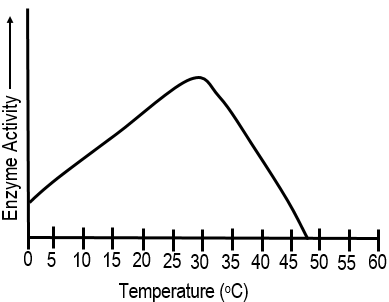
Based on the graph, what is the optimal temperature for this enzyme? 
a)
15oC
b)
40oC
c)
30oC
d)
35oC
16.

The enzyme Pepsin (green) works best under what pH condition?

a)

pH 2

b)

pH 6

c)

pH 8

d)

ph 9

17.

Based upon the graph, which of the following is a reasonable inference about enzymes?

a)

They function at the same pH range

b)

They function around pH 7

c)

They each have their own unique pH range

d)

They function best around acidic conditions (pH 0-6.9)

18.

Which enzyme works at the highest pH region?

a)

Pepsin

b)

Trypsin

c)

Salivary amylase

19.

At roughly what temperature will this enzyme best function?

a)

0 C

b)

62 C

c)

32 C

d)

42 C

20.

True or false? This enzyme will function well at 15 C

a)

False

b)

True