
 Worksheets
Dixon Unit 7 Science
Total questions: 38
Worksheet time: 21mins
Radiation is a measure of the average kinetic energy of the particles in an object.
True
False
Thermal expansion is the increase in volume that results from an increase in temperature.
True
False
A convection current is any movement of matter that results from differences in density.
True
False
Upwelling occurs when warm surface water is replaced by cold, nutrient-rich water from the deep ocean.
True
False
The curving of the path of a moving object as a result of Earth's rotation is called the Coriolis effect.
True
False
a measurement of how hot or cold something is; a measure of kinetic energy
the kinetic energy of a substance's atoms
thermal energy
an increase in the size of a substance in response to an increase in the temperature of the substance
a mixture of the gas that surrounds a planet, moon, or other celestial body
the transfer of energy as electromagnetic waves
the movement of matter due to differences in density; the transfer of energy due to the movement of matter
the transfer of material through heat as a material
the energy transferred between objects that are two different temperatures
temperature
thermal energy
calories
heat
the movement of air caused by differences of air pressure
the curving of a path of a moving object from an otherwise straight path due to earth's rotation
the movement of air over Earth's surface in patterns that are world wide
Global wind
a narrow band of strong winds that blow in the upper troposphere
the movement of air over short distances that occurs in specific areas as a result of certain geographical features
a movement of ocean water that follows a regular pattern
tidal wave
ocean current
a horizontal movement of ocean water that is caused by wind that occurs at or near the ocean's surface
a stream like movement of ocean water far below the surface
any movement of matter that results from differences in density; may be vertical, circular, or cyclical
ocean current
radiation current
kinetic current
convection current
the movement of deep, cold, and nutrient-rich water to the surface
Which of these is not a way in which energy is transferred from Earth to the sun?
conduction
infrared radiaiton
visible light
x-rays
A plastic spoon that has a temperature of 78° F is placed into a bowl of soup that has a temperature of 84° F. Which of these correctly describes what will happen?
energy as heat moves from the spoon to the soup
energy as heat does not move because the spoon is plastic
energy as heat moves from the soup to the spoon
True or false: The Coriolis effect causes the wind to curve because the Earth rotates from left to right.
Fill in the blanks to correctly show the chain of energy transfer that creates surface currents on the ocean. (a) ==> (b) ==> (c)
Which of the following is most responsible for moving bands of air around the Earth?
conduction
convection
Coriolis effect
greenhouse effect
Which of the following describes the general pattern of winds near the equator?
Winds are generally weak near the equator.
Winds are generally strong near the equator because low and high air pressure bands come together.
Winds are generally strong because the equator is mostly high air pressure.

Which type of breeze is illustrated in the picture of a valley between two mountains?
Cloudy nights are often warmer than clear nights. Which explains why cloudy nights tend to be warmer than clear nights?
clouds generate wind
clouds trap heat energy
clouds reflect energy from the sun
Which of the following best describes the atmosphere?
the boundary between Earth's surface and outer space
the boundary between areas of high and low pressure
the boundary between doldrums and horse latitudes
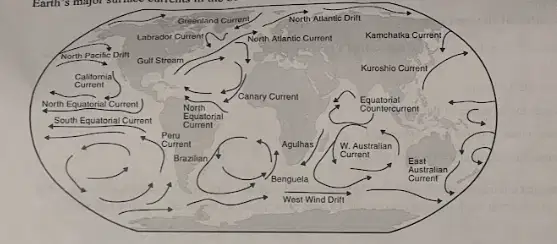
What factor causes surface currents north and south of the equator to move in different directions like in the image shown?
the sun's energy
the Coriolis effect
the density of water
continental deflection
Which term describes tropical winds that blow from east to west?
easterlies
westerlies
jet strems
trade winds
Earth receives energy from the sun. Which of the following is the main form in which electromagnetic radiation reaches Earth's surface?
visible light
radio waves
gamma rays
ultraviolet light
How does the Coriolis effect influence the wind?
it causes the air to move
it changes the direction of the wind
it causes the wind to move in a straight path
What role foes heat play in the formation of convection currents?
when water loses heat, it becomes denser and sinks
when water gains heat, it becomes denser and sinks
when water loses heat to cooler water, the cooler water becomes denser and sinks
Drag and drop the correct type of energy transfer to match the picture. 1: (a) 2: (b) 3: (c)

