
NEW
Font size
 Worksheets
Retake Resource Unit 1 Intro to Biology
Total questions: 14
Worksheet time: 12mins

Are viruses considered dead or alive?
Yes, viruses are alive
No viruses can only be considered alive sometimes
No viruses are not alive
Yes, viruses are alive once they activate
Are viruses considered dead or alive?
Yes, viruses are alive
No viruses can only be considered alive sometimes
No viruses are not alive
Yes, viruses are alive once they activate
Which of the following characteristics is shared by viruses and living cells? Both viruses and living cells –
have a nucleus, as well as a cell wall.
contain nucleic acids such as DNA or RNA
can replicate independently of a host cell.
use organelles to perform life functions.

takes over the cell's functions.
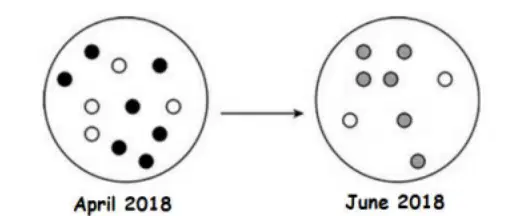
The diagram shows two populations of bacteria. The black circles represent bacteria that are not resistant to antibiotics, the white circles represent bacteria that are slightly resistant, and the gray circles represent bacteria that are very resistant. Starting in April, small concentrations of antibiotics were applied to the bacteria.
Which of the following BEST explains the change observed?
Antibiotics became chemically weaker over time and lost effectiveness.
The antibiotics caused a mutation in the bacteria population. The bacteria survived the antibiotics and reproduced.
The use of the antibiotics caused the bacteria to become tolerant to them in order to survive.
A random mutation caused an individual bacteria to be resistant to antibiotics. This bacterium survived the antibiotics and reproduced.
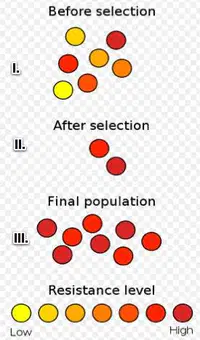
Consider the model of bacterial resistance to antibiotics. Use the Roman numerals (I - III) to guide you through the steps, describe how a scientists would explain how natural selection contributes to antibiotic resistance.
There is a change in the environment when an antibiotic is added. Some of the bacteria adapt to the new environment. They survive and reproduce.
In a population of bacteria that are exposed to antibiotics some bacteria are able to change their genetic make-up and survive. The new genotype is passed on to offspring.
Sexual reproduction of bacteria cause variations. Some bacteria survive antibiotics and some do not. Eventually because of sexual reproduction over time all of the bacteria will become extinct.
In any population variation exists. Most bacteria die when exposed to an antibiotic but some survive because they are resistant. They survive and reproduce.

Which characteristic is shown: A tadpole grows legs and becomes a fully grown frog.
Homeostasis
Grow and Develop
Acquire and Use Energy
Change Over Time

Which characteristic is shown: A plant switches position and follows the sunlight throughout the day.
Grow and Develop
Respond to a Stimulus
Acquire and Use Energy
Reproduce

Bacteria are prokaryotes, meaning they ________.
lack a nucleus
are very large
contain no DNA
have a cytoplasm

