
 Worksheets
Geometry Basics
Total questions: 83
Worksheet time: 7hrs 39mins


Colinear
Intersection
Parallel Planes
Coplanar
Having the same size and shape, (check all that apply)
Congruent
≅
=
Similarity
a straight path that has no thickness and extends forever
point
line
ray
plane
Two rays that have a common endpoint and form a line.
Linear Pair
Opposite Rays
Right Angle
Supplementary Angles
flat surface that has no thickness and extends forever.
point
line
plane
ray
part of a line that starts at an endpoint and extends forever in one direction
line
segment
ray
vertex
A basic figure that is not defined in terms of other figures. (Check all that apply)
Undefined term
Point
Line
Ray
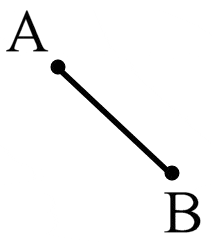


Which of the following is named by a lower case letter?
point
line
segment
ray
plane
Which of the following is named by a single Upper case letter?
point
line
segment
ray
plane
How many noncollinear points are needed to name a plane?
3
1
2
4
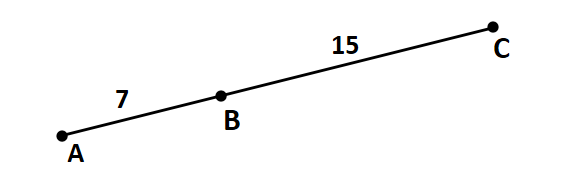

Given the diagram, which is correct?
BC+CD=BD
BD+BC=CD
CD+BC=BD
BC+BD=CD

If T is the midpoint of SU, find x.
3
4
5
2

If RT=36, find the value of x.
3
4
5
6

If DF=9x-39, find EF.
16
58
116
23

If UW=6x-35, find UW.
17
34
67
26

If HJ=7x-27, find the value of x.
4
5
6
7


LJ = 20, find KL


How is the distance formula correctly written:
d = (y1 − y2)2 −(x2 − x1)2
d = (x2 − x1)2 + (y2 − y1 )2
d = (y1 − y2)2 + (x2 − x1)2
d = (x)2− (y)2
A(3,1) B(-2,-1) written correctly is:
(−2−3)2 + (−1−1)2
(1−3)2 + (−1−2)2
(−2−3)2 − (−1−1)2
(−2−3)2 − (−1−1)2

What is the distance between AB
0
8
9
7

What is the distance between AB?
0
undefined
5
4

How is AB written in the distance formula?
d = (5−3)2 + (0−−2)2
d = (2−5)2 + (3 −0)2
d = (5−3)2 − (0−−2)2
d = (4−3)2 − (2−4)2


AB = 5 on the coordinate plane shown. If B(2,1), which point could NOT be another location of A?
(-1,5)
(6,4)
(-2,-2)
(4,-3)
(-3,1)

The distance formula is another way to write which of the following?
quadratic formula
slope formula
Pythagorean theorem
none of these answers
Find the midpoint: (-1,9), (7,-1)
(4,5)
(4,3)
(3,4)
(5,4)
Find the midpoint: (3,9),(−1,−5)
(−1,−2)
(2,7)
(−2,−7)
(1,2)
Find the midpoint: (2,−7),(10,1)
(-3,6)
(6,-3)
(4,4)
none
Which of the following is the correct midpoint formula given two endpoints (x1, y1) and (x2, y2)?
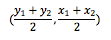
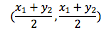
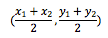

Find the midpoint: (-8,6), (5,-7)
(−23,−21)
(23,21)
(7.5,7.5)
(−2,−1)
Find the midpoint: (7,−7),(−3,−4)
(2,−211)
(5,−23)
(−211,−2)
(−23,5)
Find the midpoint: (9,1),(8,−4)
(29,25)
(25,29)
(217,−23)
(−25,217)
Find the other endpoint of the line segment with the given endpoint A and midpoint M.
A(-4, 2), M(8, 7)
(20, 12)
(-1, 7.5)
(-6, -2.5)
(1.5, -5.5)
Find the other endpoint of the line segment with the given endpoint A and midpoint M.
A(10, -3), M(4, 3)
(3, -3)
(-7.5, 7.5)
(-2, 9)
(3.5, 3.5)
Find the other endpoint of the line segment with the given endpoint A and midpoint M.
A(2, 7), M(-3, 10)
(4.5, 3.5)
(-8, 13)
(4, -2.5)
(2.5, -1.5)
Directed line segment AB is partitioned by point P into a ratio of 1:3. Which of the following represent this relationship?
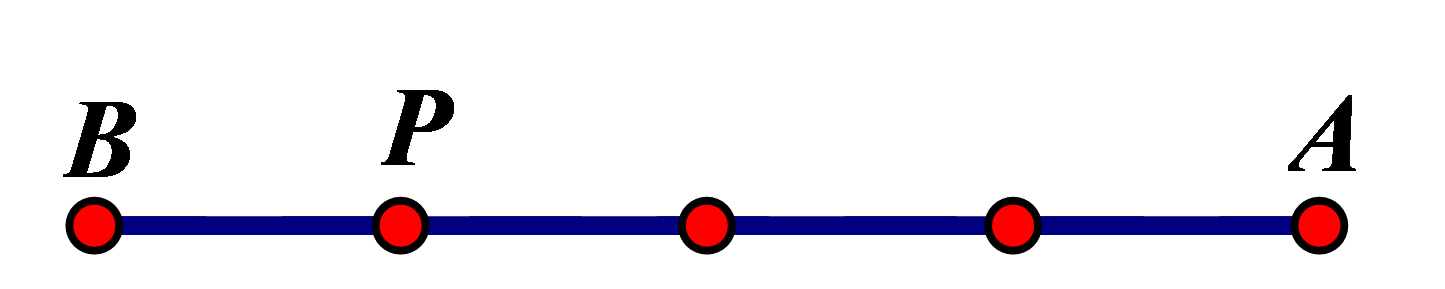

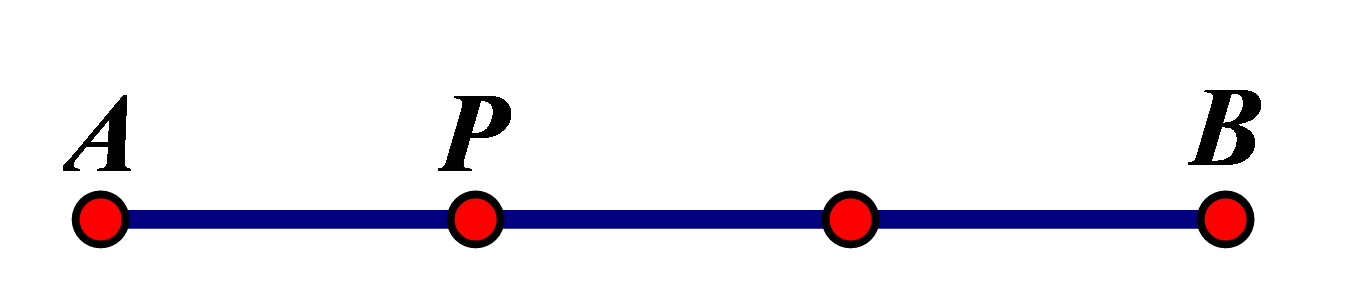
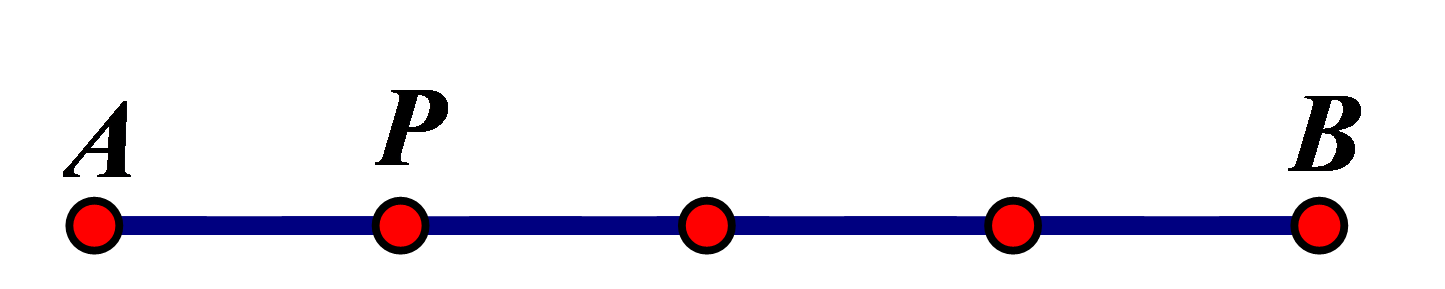
Directed line segment MN partitioned into a ratio of 1:2 is the same as directed line segment NM partitioned into a ratio of 2:1.
True
False
6) The ratio is 3:1. How many parts are there?
2
3
4
5
A (-5, 8) B(9, 3) with the ratio 2:5

Calculate m∠ABC.
45°
60°
105°
15°

Calculate m∠DEF.
180°
60°
120°
80°

If m∠RST = (12x -1)°, m∠RSU = (9x -15)°,
and m∠UST = 53°, find each measure.
x = 13
m∠RST = 155°
m∠RSU = 102°
x = 3
m∠RST = 35°
m∠RSU = 12°
x = 22
m∠RST = 263°
m∠RSU = 183°
x = 8
m∠RST = 95°
m∠RSU = 57°

Solve for x.
2
3
4
5
7.4

What is the value of x?
(a)
∠1 and ∠2 form a linear pair.
If m∠1 = (5x + 9)° and m∠2 = (3x + 11)°, find the measure of each angle.
m∠1 = 110° and m∠2 = 70°
m∠1 = 109° and m∠2 = 71°
m∠1 = 70° and m∠2 = 110°
m∠1 = 71° and m∠2 = 109°
Two angles that share the same side are called
Adjacent Angles
Right Angles
Vertical Angles
Two angles that are opposite each other formed by the crossing of two lines are called
Adjacent Angles
Right Angles
Vertical Angles
An angle that measures 90 degrees is called a
Complementary Angle
Supplementary Angle
Right Angle

< 1 = ?
(a)
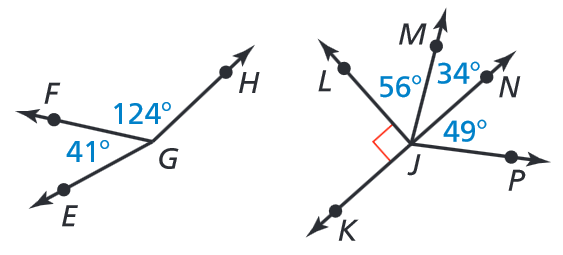
Which angle is complementary to ∠LJM
∠MJN
∠NJP
∠FGE
∠LJK
∠1 and ∠2 form a linear pair.
If m∠1 = (5x + 9)° and m∠2 = (3x + 11)°, find the measure of each angle.
m∠1 = 110° and m∠2 = 70°
m∠1 = 109° and m∠2 = 71°
m∠1 = 70° and m∠2 = 110°
m∠1 = 71° and m∠2 = 109°

Practice 1a: Name a pair of complementary angles
∠1 and ∠2
∠3 and ∠2
∠4 and ∠5
∠3 and ∠5
Practice 1b: Name a pair of vertical angles
∠2 and ∠4
∠3 and ∠2
∠1 and ∠4
∠3 and ∠5
Practice 1c: Name a pair of linear pair angles
∠1 and ∠4
∠3 and ∠2
∠4 and ∠5
∠3 and ∠5

Practice 2: What is the supplement of 74.3 degrees?
105.7°
180°
148.6°
15.7°
Practice 3: check the two angle measurements you chose. Complementary angles should add up to...
(a)
Practice 5a: Linear pair angles are adjacent
sometimes
always
never
Practice 5b:Vertical angles are complementary
sometimes
always
never
Practice 5c : Adjacent angles share a common side and vertex.
sometimes
always
never
Practice 5d : Supplementary angles are adjacent.
sometimes
always
never
Calculate the distance between the points (2,3) and (5,7).
8
7
6
5
Which of the following represents a line segment?
AB
GH
CD
EF
Find the midpoint of the line segment with endpoints (4,2) and (10,6).
(8,5)
(5,3)
(6,4)
(7,4)

