
 Worksheets
SUBW051525
Total questions: 68
Worksheet time: 3hrs 19mins
What is the axis of symmetry?
f(x) = x2 - 8x + 15.
x = -4
x = 4
y = 4
y = -4
What is the axis of symmetry of y=2x2-4x+9?
x = 1
x = -1
x = -2
x = 4
Which expression results in 10?
50 - [ 5 + (8 x 5) ]
(10 ÷ 2) + (10 ÷ 2)
(70 ÷ 7) x 10
30 ÷ [ (20 ÷ 4) + 1 ]
(2x + 3)(x - 4)
2x2 - 5x - 12
2x2 - 8x + 12
2x2 - 5x + 12
2x2 + 5x - 12
Find the product:
(x - 8)(x + 8)
x2 - 64
x2 + 64
x2 - 8x + 64
x2 + 8x - 64
Find the product:
(3x + 2)(2x + 4)
6x2 + 16x + 8
5x2 + 11x + 6
5x2 + 16x + 6
6x2 + 11x + 8
Find the product:
(2x−7)(x+2)
2x2−5x+4
2x2+3x+14
2x2−3x−14
x2+3x−14
Multiply
2x(3x2+4x −6)
6x2+8x−12
14x2−12
6x3+8x2−12
6x3+8x2−12x
Multiply (x - 2) (5x2 + 3x - 1)
5x3 - 13x2 - 7x + 2
5x3 - 10x2 + 7x + 2
5x3 - 7x2 - 7x + 2
5x3 + 13x2 + 7x + 2
Multiply (x2 - 5) (x2 + 3)
x2 - 2x - 15
x4 - 2x2 - 15
x2 - 2x + 15
x4 - x - 15
(3b + 5)(2b2 + 4b + 1)
6b3 + 22b2 + 23b + 5
6b3 + 20b2 + 23b + 5
6b3 + 20b2 + 19b + 5
6b3 + 22b2 + 19b + 5
Factor completely:
18x3y+24x5y3
6(3x3y+4x5y3)
6xy(3x2+4x4y2)
18x3y(6x2y2)
6x3y(3+4x2y2)
Factor completely:
18x4−27x3
9x3(2x−3)
3x3(6x−9)
9x2(2x2−3x)
3x2(6x2−9x)
Factor
2a2 + 5a + 3
(2a+3)(a+1)
Not factorable
(2a+1)(a+3)
(2a-1)(a-3)
Factor: 3n² + 14n + 8
(3n + 2)(n + 4)
(3n + 4)(n + 2)
(3n + 8)(n + 1)
(3n + 1)(n + 8)
Factor: 4x² - 20x + 25
(4x - 25) (x - 1)
(2x + 5) (2x - 5)
(2x - 5)²
(4x - 5) (x - 5)
Factor:
3x2-12x-15
(3x-15)(x+1)
(3x+5)(x-3)
(x-5)(3x+3)
(x+3)(3x-5)
Factor
5x2 - 28x + 32
(3x - 10)(x + 6)
(x - 8)(5x - 4)
(5x - 8)(x - 4)
(5x - 8)(x + 7)
Factor:
x2 - 64
(x + 8)(x + 8)
Prime
(x - 8)(x + 8)
(x - 8)(x - 8)
Which transformation transforms the graph of
f(x) = x2 to the graph of g(x) = (x + 4)2?
a vertical translation 4 units up
a vertical translation 4 units down
a horizontal translation 4 units to the left
a horizontal translation 4 units to the right
How did we transform from y = x2 to y = 2x2?
vertical stretch
horizontal compression
reflection in y-axis
vertical shift up

If the blue graph is
f(x) = x2
the red must be...
g(x) = (x + 3)2
g(x) = (x - 3)2
g(x) = x2 + 3
g(x) = x2 - 2
If the blue graph is
f(x) = x2
the red must be...
g(x) = (x + 3)2
g(x) = (x - 3)2
g(x) = x2 + 3
g(x) = x2 - 2
In the equation g(x)=3/4(x-5)2+2, what happens to the parabola?
Vertical compress by 3/4, right 5, up 2
Reflect, horizontal stretch by 3/4, right 5, up 2
Horizontal stretch by 3/4, left 5, up 2
Vertical stretch by 3/4, right 5, up 2
In the equation f(x)=5(x+3)2-10, what does the 5 do?
Vertical stretch by 5
Horizontal compress by 5
Reflect
Move up 5
Does the graph of this equation widen or narrow from the parent function?
y = 5(x - 5)2 + 3
widen
narrow
neither

If the blue graph is
f(x) = x2
then the red must be...
g(x) = x2 - 5
g(x) = x2 + 5
g(x) = (x - 5)2
g(x) = (x + 5)2
What are the transformations from g(x)=x2 to k(x)=2(x−4)2 ?
Vertical stretch by 2, right 4
Vertical compress by 2, left 4
Vertical stretch by 2, left 4
Vertical compress by 2, right 4
What are the transformations of the following polynomial from the parent function f(x)=x3 ?
g(x)=−2x3+4
Vertical compression by a factor of 2, and shifted left by 4 units
Reflected over the x-axis, vertical stretch by a factor of 2, and shifted up 4 units.
Reflected over the y-axis by a factor of 2, and shifted up by 4 units.
None

Which could be the resulting function?
g(x)=1.5(x−3)3+4
g(x)=0.5(x+2)3+8
g(x)= 2 (x - 3) + 4
g(x)=2(x+3)3+4
Which equation describes the transformation of shifting f(x)=x3 three units left?
x3 + 3
x3 - 3
(x + 3)3
(x - 3)3

What are the transformations of this function compared to the parent function y = √(x)?
Shifted right 5, shifted down 2, and reflected over the x-axis
Reflected over the x-axis, vertical stretch, and shifted right 5
Reflected over the x-axis, vertical stretch, and shifted left 5
Shifted right 5, shifted down 2
g(x) = -f(x)
Describe the transformation to f(x) that results in g(x).
f(x) has been reflected over the x-axis.
f(x) has been reflected over the y-axis.
When you add a constant to y=x2 what happens to the graph? (Eg y = x2 + 2)
Graph moves UP
Graph moves to the RIGHT
Graph moves DOWN
Graph moves to the LEFT
Describe the transformations that map
y = g(x) to y = -g(x + 6) - 10
Reflect over y-axis
Shifted down 10 units
Shifted left 6 units
Reflect over x-axis
Shifted up 10 units
Shifted left 6 units
Reflect over y-axis
Shifted up 10 units
Shifted right 6 units
Reflect over x-axis
Shifted down 10 units
Shifted left 6 units
What are the following transformations:
f(-x) - 4
reflection over the x axis and 4 units right
reflection over the x axis and 4 units down
reflection over the y axis and 4 units right
reflection over the y axis and 4 units down
What are the following transformations?
- f(x+2)
reflection over the y axis and 2 units to the right
reflection over the x axis and 2 units right
reflection over the y axis and 2 units left
reflection over the x axis and 2 units left
Which equation represents a horizontal stretch by a factor of 4 and a vertical translation down 9?
g(x)=41x3+9
g(x)=41x3−9
g(x)=4x3+9
g(x)=4x3−9
Describe the transformation:
f(x+2)Up 2
Down 2
Right 2
Left 2
Describe the transformation:
21f(x)
Vertical Shrink by 1/2
Vertical Stretch by 2
Up 1/2
Right 1/2
Subtract the following polynomials:
(4x³ + 5x² - 2) - (x³ - 3x² + 4)
3x³ + 8x² - 6
3x³ + 2x² + 2
5x³ + 2x² - 6
3x³ + 8x² + 2
Add the following polynomials:
(x³-6x²+3)+(3x³+4x-1)
4x³-2x²+2
4x³-6x²+4x+2
-2x³+2x+2
4x³-2x²-2

What is the relative max?
y = 36 at x = 0
y = -6.55 at x = -2.55
(-∞, ∞)
None

What is the relative max of this function?
x = 5
infinity
there is no relative maximum
2.5 and it occurs at x = 5

The blue dot on this graph represents a(n)...
Absolute Maximum
Absolute Minimum
Relative Maximum
Relative Minimum

What is the x-intercept for the given graph?
1
-2
2
1/2

What is the y-intercept of the line?
y = 1/2
y = 1
y = -1/2
y = -1

What is the y-intercept?
7
0
1
2
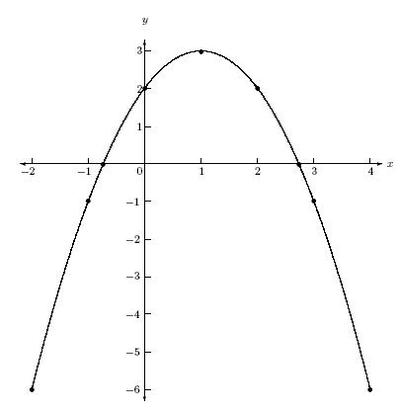
Over what interval does the function increase?
[-2, 1]
[1, 4]
[-6, 3]
(-∞, 1]


There are no arrows on the graph.
x = 2, 4
y = (x - 12)(x - 2) .

Write a quadratic equation given the x intercepts and one other point.
Step 1: Write the factors.
The intercepts of this function are (6, 0) and (8, 0). Write the factors.
(x-6) and (x-8)
(x+6) and (x+8)
(x-6) and (x+8)
(x+6) and (x-8)

On which interval(s) is the given function increasing?
(-∞, 2) U (-2, ∞)
(-2, 2) U (-2, ∞)
(-∞, -2) U (0.5, ∞)
(0, 2) U (0.5, ∞)

Describe the intervals over which the given function is decreasing.
(-∞, 0) U (2, ∞)
(5, -4) U (2, -3)
(-3, 0) U (2, 3)
(5, -4) U (0, -3)

How would you describe the behavior of this function on the domain interval (-1, 1)?
increasing
decreasing
constant

Which coordinate would qualify as the *absolute maximum* of this function?
∞
(0, 4)
3
(4, 0)

Describe the interval over which the given function is decreasing.
(-∞, 4)
(4, 3)
(0, 1)
(0, -∞)

Which coordinate point describes the location of the absolute minimum point of this function?
(-2, -1)
(0, -1)
(-1, -2)
(-5, 3)
Find the average rate of change of f(x)=2x2+3x-1 from 1 to 2.
18
-9
9
3

