
Font size
 Worksheets
Unit 1 Test Practice
Total questions: 13
Worksheet time: 9mins
Based on the selection "By Any Other Name", what inference can you make about the relationship between India and Great Britain in the 1920s?
India was dominated by British rule.
India and Great Britain shared political power.
India was a popular British travel destination.
India and Great Britain had recently fought a war.
Read this quotation from paragraph 3. "The headmistress had been in India, I suppose, fifteen years or so, but she still smiled her helpless inability to cope with Indian names." What does this quotation suggest about English people in India during the time period in which this memoir is set?
English people struggled pronouncing the names of both Indian and British children.
English people generally thought their culture and language were superior to India’s.
The English kept transferring in teachers ever since the headmistress was first stationed there.
The English tried to educate all the British and Indian children during their rule.

The primary purpose of paragraph 5 is —
to describe how the author’s family lived
to describe the school that the children attended
to describe the author’s relationship with her teachers
to describe how the villagers adapted to the rainy season
Which two quotations from the text indicate that it is a memoir?
That first day at school is still, when I think of it, a remarkable one. (paragraph 7)
These, in the tradition of British schools, were painted dark brown and had matting on the floors. (paragraph 8)
The door opened sharply and Premila marched in. (paragraph 28)
But it was nearing the hottest time of day, and the road was almost deserted. (paragraph 34)
I understood it perfectly, and I remember it all very clearly. (paragraph 45)
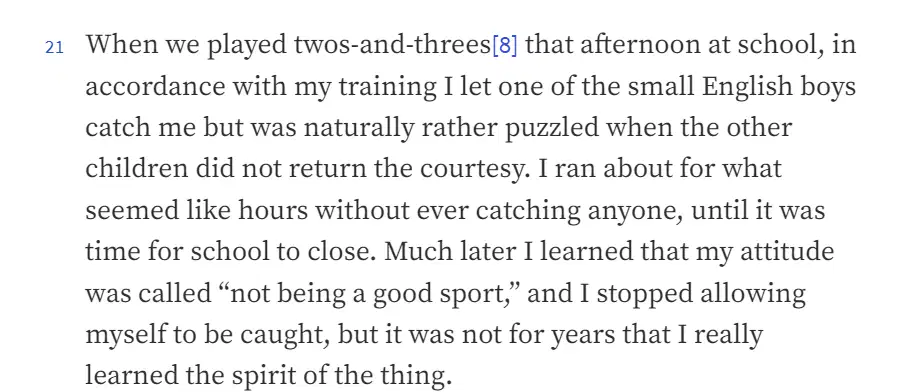
The details in paragraph 21 are significant because they explain —
why the Indian children were treated so harshly
how often children’s games were played in British schools
the differences in school rules that Santha was unfamiliar with
the cultural differences that Santha did not understand
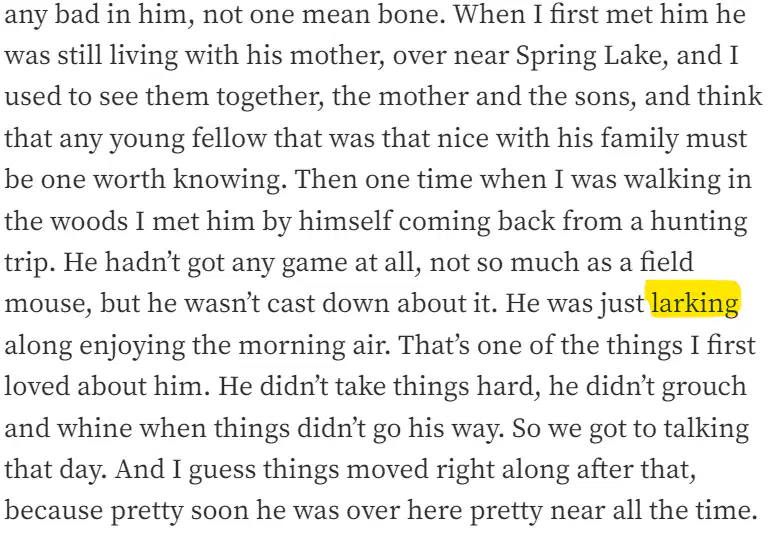
Which phrase helps the reader understand the meaning of the word larking in paragraph 1?
walking in the woods
met by himself
wasn't cast down
things didn't go his way
Read these sentences from paragraph 3.
"It was the moon, that’s what they say. It’s the moon’s fault, and the blood."
With these sentences, the author implies that—
the family of the husband cast him out for the genes he inherited from his father
the narrator lives in a society where unexplainable events are attributed to natural forces
the husband is a deceitful character trying to hurt the narrator and her family
the story takes place in a reality where the moon is sentient and able to control the characters.
In paragraph 16, the author uses it to describe the husband in order to —
Express the narrator's anger
Indicate his new lack of gender
Show the narrator's confusion
Emphasize his transformation
How does the author use irony in “The Wife’s Story” to enhance the narrative?
By initially portraying the husband as a loving and caring partner, only to reveal his true nature later in the story.
By depicting the wife as a villain, even though she is the protagonist of the story.
By creating a peaceful setting that contrasts sharply with the violent events that occur.
By presenting the husband as a human, only to later reveal that he is actually a wolf.
Which type of figurative language is predominantly used in the poem "Magic Island" to convey the dreamlike atmosphere of the island?
Simile
Hyperbole
Metaphor
Oxymoron
How does Brian Patten use figurative language in “Geography Lesson” to impact mood, tone, and meaning?
By using similes to create a calm and reflective mood, emphasizing the simplicity of the world.
By using metaphors to convey a sense of wonder and curiosity about the world, deepening the poem's meaning.
By using personification to give human qualities to the landscape, creating an emotional connection to the earth.
By using hyperbole to exaggerate the vastness of the world, creating a tone of awe and overwhelming complexity.
What is the primary purpose of Emma Watson's UN HeForShe speech?
To criticize those who oppose feminism
To promote a new UN program aimed at empowering men
To encourage men to participate in the fight for gender equality
To discourage men to participate in the fight for gender equality
How does Emma Watson establish her credibility (ethos) in the HeForShe speech?
By sharing her personal experiences with gender inequality
By using statistics to support her argument
By criticizing other speakers for not addressing gender issues
By telling a humorous story to lighten the mood

