
 Worksheets
Unit 1 Intro to Life Test Review F24
Total questions: 111
Worksheet time: 4hrs 42mins

Ava, Grace, and Liam are studying biology. They are discussing the most basic unit of life. What do they conclude is the most basic unit?
cell
tissue
organ
organ system
Aiden observed an organism under his microscope and found that it is made of only one cell. What should Aiden call this organism?
unicellular
multicellular
The combination of chemical reactions through
which an organism builds up or breaks down
materials as it carries out its life processes is called ...
absorption
metabolism
digestion
consumption
Maintaining a stable internal
environment is called
homeostasis
equilibrium
balance
evenness
James, Elijah, and Evelyn went for a winter hike. As they stepped out into the freezing weather, their bodies started to shiver in order to maintain their internal body temperature at 98.6F. Which characteristic of life does this represent?
All living things use energy
All living things contain cells
All living things maintain homeostasis
All living things grow
Green plants produce their own food through the process of photosynthesis. Which characteristic of life does this represent?
All living things use energy
All living things contain cells
All living things maintain homeostasis
All living things grow
Grace and Nora were observing a nest in their backyard. A baby songbird hatched from its egg while both parent songbirds were watching. According to this scenario, which characteristic of life does this represent?
All living things reproduce
All living things maintain homeostasis
All living things use energy
All living things grow
A camel has eyelashes that work to keep the dust and sand out of its eyes. Which characteristic of life does this represent?
All living things adapt to their environment
All living things grow
All living things have cells
All living things use energy
Mia, Aiden, and Olivia are discussing about homeostasis. Aiden says it's about adapting to your environment, Olivia thinks it's the sum of all of your chemical reactions, and Mia believes it's being composed of more than one cell. However, their teacher corrects them and says it's something else. What did their teacher say?
adapting to your environment
maintaining an appropriate respiration rate
the sum of all of your chemical reactions
being composed of more than one cell
Which of the following is a stimulus?
removing your hand from a hot stove
swinging a bat at a baseball
screaming when something scares you
a ball moving from the pitching mound to home plate towards a batter
Oliver, Jackson, and Abigail are in a science lab. Oliver shines a flashlight into Jackson's eye, Abigail pops a rubber band on her hand, and Jackson's pupils constrict when exposed to bright light. Which of these is a response?
Oliver shining a flashlight into Jackson's eye
Abigail popping a rubber band on her hand
Jackson's pupils constricting when exposed to bright light
Abigail's blood glucose levels drop significantly
Over three years, Tim's height has increased from 5'4" to 5'11". Which characteristic of life does this represent?
All living things contain cells
All living things maintain homeostasis
All living things use energy
All living things grow
An adult hydra is producing its offspring through budding. Which characteristic of life does this represent?
All living things use energy
All living things reproduce
All living things contain cells
All living things grow
Over many hundreds of years, a population of rabbits living in the woods adapts to its surrounding with brown fur. Which characteristic of life does this represent?
All living things adapt to their environment
All living things grow
All living things use energy
All living things have cells

Liam, Avery, and Elijah are having a debate. They are trying to determine which element must be present in a substance for it to be considered "Organic" or alive. What do you think?
carbon
oxygen
water
hydrogen
Enzymes are an example of (a)
In a science experiment, Olivia and Benjamin are studying how enzymes work. What is the purpose of an enzyme?
give permission for the reaction
raise activation energy
speed up reactions
control how many reactions occur
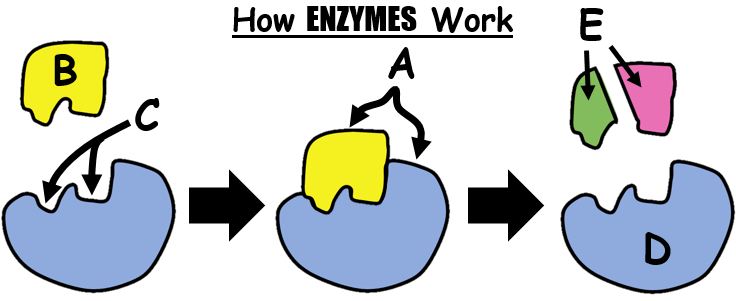
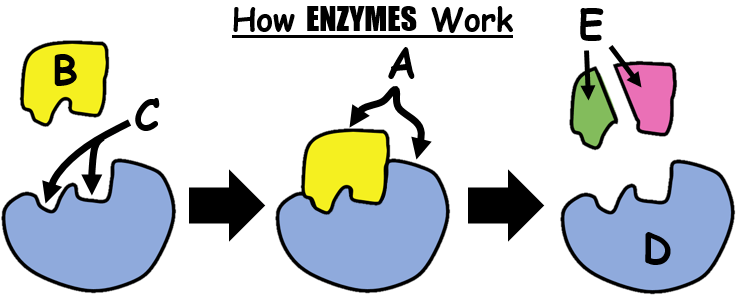
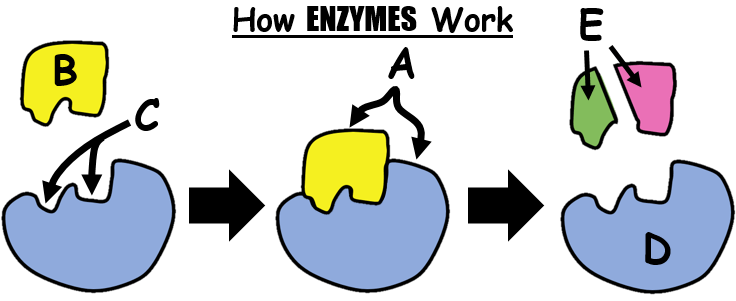
Benjamin is studying how enzymes work in the body. He learns that enzymes bind to a specific molecule to catalyze a reaction. Letter B represents the molecule that the enzyme binds to. What is this molecule called?
active site
enzyme
substrate
products
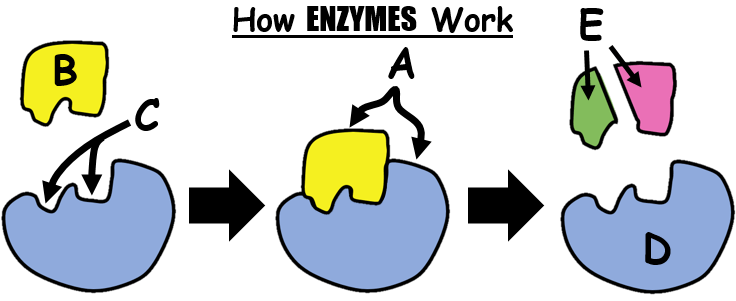
Jackson is studying how enzymes work in the human body. He learns that enzymes bind to a specific part of the molecule they act on. What is this part called?
active site
enzymes
substrate
products
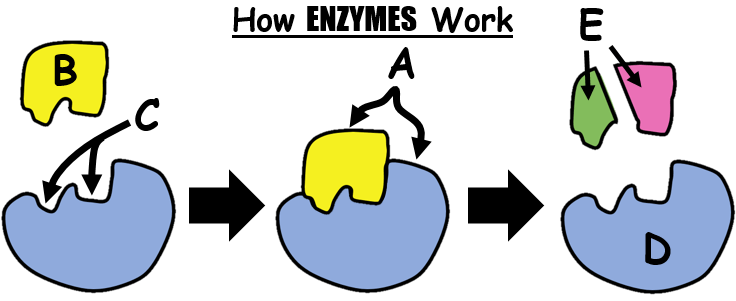
Henry is studying how enzymes work in the body. He learns that the letter E represents a specific component in the process. What does the letter E stand for?
active site
enzyme
substrate
products
Liam and Abigail are working on a science project. They learn that enzymes provide a site where reactants called substrates can be brought together in an enzyme-catalyzed reaction. The site is called the
enzyme substrate complex.
reaction site.
active site.
lock and key.
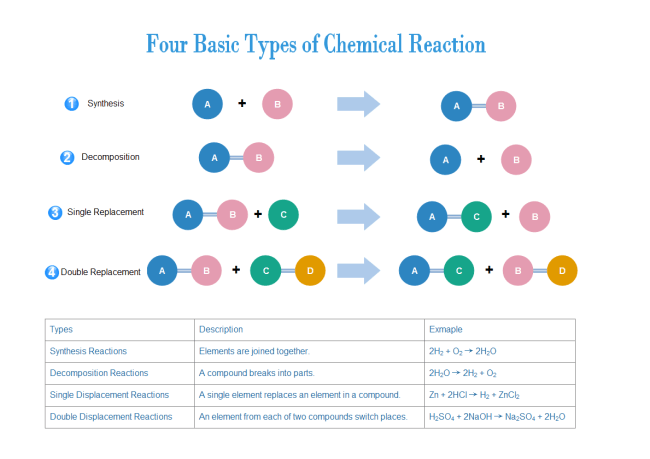
Jackson is trying to unlock a special box that only opens with a specific key. Each key only fits one lock. What is this concept called?
reusablility
denaturation
specificity
fragility
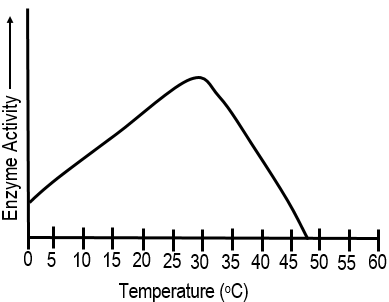
During a science experiment, Scarlett and Arjun measured the activity of an enzyme at different temperatures. Based on the graph, what is the optimal temperature for this enzyme?
15oC
40oC
30oC
35oC
Henry is conducting an experiment in his biology class. He learns that an enzyme speeds up a chemical reaction in the cell but can only be used once. True or False?
true
false
In a lab experiment, Noah observes that an enzyme's activity decreases at very high temperatures. What is the most likely reason for this decrease?
enzyme denaturation
substrate depletion
increased activation energy
product inhibition
Olivia is studying the effect of pH on enzyme activity. She finds that the enzyme works best at a pH of 7. What is this pH level called?
acidic pH
basic pH
neutral pH
optimal pH
Cell membranes are described as selectively permeable.
Four students were asked to explain what this means. Which one is correct?
Student 1: Cell membranes prevent all materials from entering the cell.
Student 2: Cell membranes only provide structural support for the cell.
Student 3: Cell membranes regulate which substances can enter and exit the cell.
Student 4: Cell membranes allow water and water-soluble substances to enter the cell.
Which part of the cell controls the movement of substances?
mitochondria
cell membrane
chloroplast
nucleus
All of the following are functions of a cell membrane EXCEPT
surrounding and protecting the contents of the cell.
releasing waste products from the cell.
producing energy for the cell processes.
allowing gases to enter the cell.
In the cell membrane model demonstration, why were iodine molecules able to enter the bag but the starch molecules were not able to leave the bag?
Starch molecules are too heavy.
The holes of the semi-permeable membrane were too small to let starch molecules through.
Semi-permeable membranes need energy.
Semi-permeable membranes must be under pressure to work.
Which characteristic of a cell membrane allows it to control materials entering and leaving a cell?
A cell membrane is surrounded by fluid.
A cell membrane is semi-permeable.
A cell membrane holds organelles in place.
A cell membrane is found in plant and animal cells.
A child with cystic fibrosis has an altered protein in his cells that stops chloride ions from leaving the cells. This protein most likely affects the functioning of
ribosomes
mitochondria
cell membrane
lysosomes


Explain how the fluid mosaic model of the cell membrane supports its function in regulating the internal environment of the cell. Consider the arrangement and movement of molecules within the membrane.
The model suggests a rigid structure where molecules are fixed, preventing any substance from entering or leaving the cell.
The model depicts the membrane as a dynamic structure with proteins and lipids that move laterally, allowing selective permeability and fluidity.
It proposes that the membrane is completely permeable to all molecules, which helps in the unrestricted exchange of substances.
The model indicates that the membrane is impermeable, enhancing the cell's ability to maintain a stable internal environment by isolation.
Plant and animal cells are examples of
prokaryotic cells
eukaryotic cells
Which of the following structures is ALWAYS found in both eukaryotic and prokaryotic cells?
nucleus
mitochondria
ribosomes
cell wall
Bacteria is an example of a(n)
prokaryotic cell.
eukaryotic cell.
CHALLENGE QUESTION: Which of the following provides evidence for the hypothesis that prokaryotes evolved before eukaryotes.
prokaryotes are more complex
prokaryotes have no nucleus and fewer genes
eukaryotes are multicellular which makes them simpler
prokaryotes grow into eukaryotes

Which type of cell is this?
Prokaryote
Eukaryote
This organelle controls what goes in and out of plant and animal cells.
Cell Wall
Cell Membrane
Chloroplasts
Cytoplasm
The _____________ stores food, water, wastes, and other materials in both plant and animal cells.
Vacuole
Mitochondria
Cytoplasm
Nucleus
The _____________ is a gel-like fluid that fills plant and animal cells. It holds the organelles in place and gives each cell its shape.
Cytoplasm
Cell Membrane
Cell Wall
Chloroplast
What organelle is made of a phospholipid bilayer with embedded proteins?
cell membrane
cell wall
cytoplasm
cytoskeleton
This organelle could be compared to a window screen, because it lets some materials move in and out freely, while others cannot pass through.
cell membrane
cell wall
cytoplasm
cytoskeleton
This organelle is made of cellulose, a type of carbohydrate.
cell membrane
cell wall
cytoskeleton
vacuole
This organelle could be compared to a closet because it is responsible for storing materials for the cell.
cell membrane
cell wall
cytoplasm
vacuole
Plants have one large of these; while animal cells have many small ones.
cell membrane
cytoplasm
cytoskeleton
vacuole
What can only be found in plant cells?
Cell membrane
Vacuole
Chloroplast
Mitochondria


What is the function of a chloroplast?
makes proteins for animal cells
allows materials in and out of the cell
provides structure and support
absorbs sunlight for photosynthesis
cell with no membrane bound structures and no
nucleus
Eukaryote
Prokaryote
Plant
Animal
cell with membrane bound organelles and a
nucleus
prokaryote
eukaryote
bacteria
peroxisome
structure that packages and modifies proteins
smooth ER
golgi apparatus
rough ER
lysosome

Name two organelles that are only found in plant cells.
Cell wall and chloroplasts
Cell wall and nucleus
Chloroplast and mitochondria
Cell membrane and ribosome

All of these statements are part of cell theory, EXCEPT
All living things are composed of cells
Cells are the basic unit of structure and function
New cells come from existing cells
Cells are really small

The liver is an organ that removes and breaks down waste materials from the blood. Which of the following organelles would be found in a higher-than-normal frequency in liver cells?
Golgi apparatus
lysosomes
mitochondria
ribosomes
The hallways at school provide a way of transporting students from class to class. Which organelle performs a similar function?
chloroplasts
endoplasmic reticulum
mitochondria
ribosomes
Which type of solution makes a cell shrink?
Hypotonic
Hypertonic
Isotonic

What type of transport is shown in the diagram?
Ion pump
Facilitated diffusion
Endocytosis
Exocytosis

What type of transport is shown in the diagram?
Protein pump
Facilitated diffusion
Endocytosis
Exocytosis

What type of transport is shown in the diagram?
diffusion
facilitated diffusion
endocytosis
exocytosis
Which of the following are examples of passive transport? Select multiple answers.
Diffusion
Facilitated diffusion
Endocytosis
Exocytosis
Osmosis

phospholipids
main component of the cell membrane
membrane proteins
allows large molecules to pass through membrane
semipermeable
some substances can go through the cell membrane and some can't
passive transport
does not require ATP; molecules move high to low
active transport
requires ATP; molecules move low to high


Which correctly points to the part of the image that is hydrophobic?
A
B
You are alone on an island in the middle of the Atlantic Ocean. You are hot and thirsty, so you want to drink water from the ocean. You think about biology class and you decide:
to drink the ocean water because the extra salt will quench your thirst.
not to drink the ocean water because the extra salt will cause you to dehydrate.
to drink the ocean water because your cells will burn more fat due to the salt intake.
not to drink the ocean water because the extra salt will cause your cells to burst.

Why has water moved into the cell in the hypotonic solution?
The cell was deflated and needed to be inflated.
The concentration of solvent was higher inside than outside the cell.
The concentration of solute (salt) was higher outside the cell than inside.
The concentration of solute (salt) was higher inside the cell than outside.
Transport of water molecules across a cell membrane allows cells to maintain stable internal conditions in an ever-changing environment. This stable internal condition is called _____.
homeostasis
energy transfer
osmosis
carrying capacity

A red blood cell is placed into a solution. The red blood cell has a lower concentration of protein and sugar than the solution, as shown in the diagram. What is most likely to occur?
Water from the solution will move into the red blood cell.
Water from the red blood cell will move into the solution.
Protein and sugar will move from the solution into the red blood cell.
Protein and sugar will move from the red blood cell into the solution.
Hypertonic
The solution contains a high concentration of solute an and low concentration of water
Hypotonic
The solution contains a low concentration of solute an and high concentration of water
Isotonic
The solution has an equal concentration of solute and water compared to the inside of the cell
Simple Diffusion
When molecules passively cross the plasma membrane through the phospholipid bilayer
Facilitated Diffusion
When molecules passively cross the plasma membrane through a channel protein
Osmosis
The movement of water across the cell membrane
Endocytosis
Bringing in large materials through the cell membrane into a vacuole.
Exocytosis
Moving larger amounts or large quantities of materials through the cell membrane

_____ and _____ are organelles that arose from endosymbiosis
nucleus and cell membrane
mitochondria and chloroplasts
cell wall and chloroplasts
mitochondria and nucleus
Which of the following is evidence to support the endosymbiotic theory?
Mitochondria and chloroplasts have their own DNA, which is similar to prokaryotic DNA.
Fossil evidence shows that the first forms of life were prokaryotic cells.
All eukaryotic cells have a double-layered membrane composed of phosplipids and proteins.
Prokaryotes have the same number and types of enzymes as eukaryotes.
The Endosymbiotic Theory explains
the origin of prokaryotes
how bacteria lives
the origin of eukaryotes
how species develop

