
NEW
Font size
 Worksheets
Quiz on Compound Microscope
Total questions: 28
Worksheet time: 14mins

Which part of the compound microscope is used to adjust the height of the condenser?
Coarse adjustment knob
Fine adjustment knob
Condenser knob
Light control

What is the function of the rotating nosepiece on a compound microscope?
To adjust the height of the condenser
To switch between different objective lenses
To control the light intensity
To move the mechanical stage

Which part of the compound microscope is responsible for controlling the light intensity?
Light control
Iris diaphragm lever
Coarse adjustment knob
Mechanical stage controls
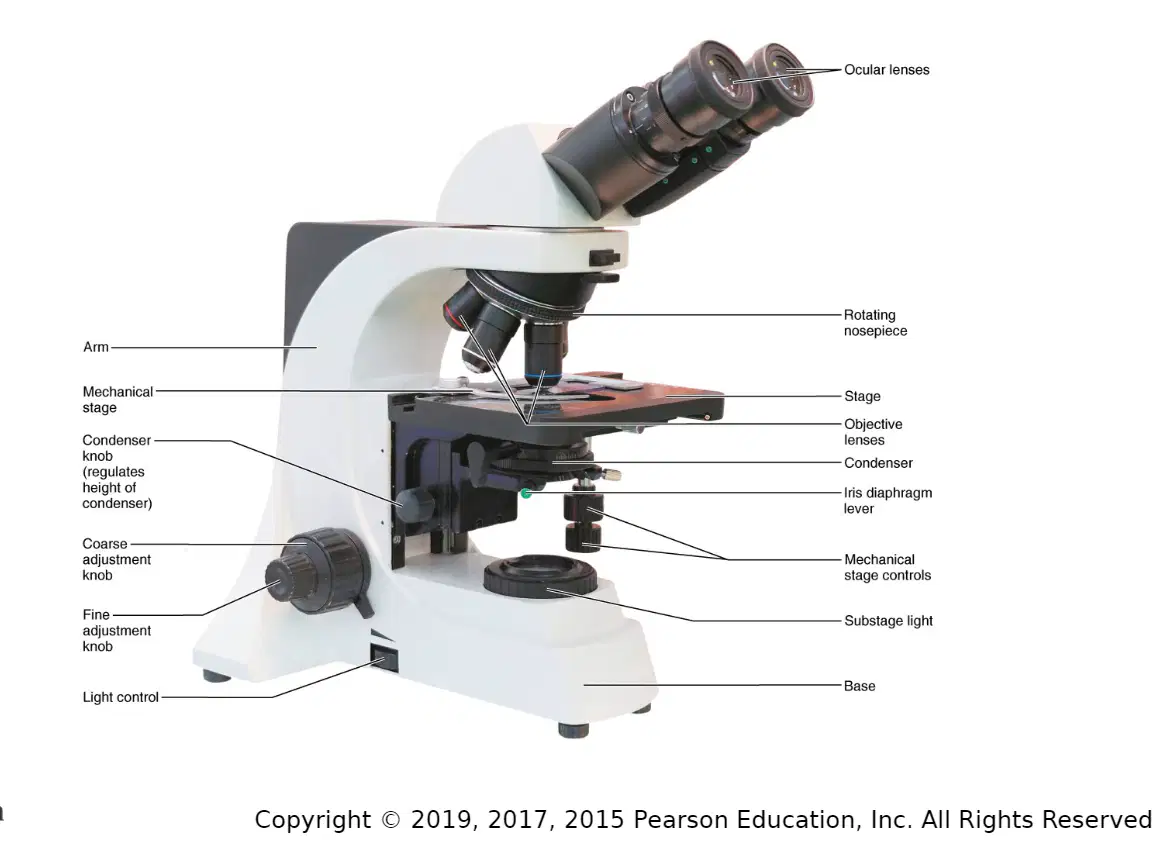
What is the purpose of the coarse adjustment knob on a compound microscope?
To fine-tune the focus
To adjust the height of the condenser
To make large adjustments to the focus
To control the light intensity
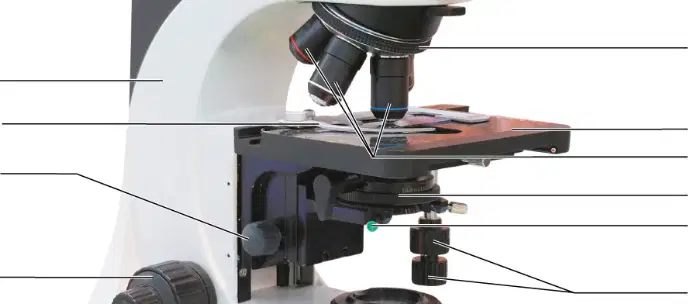
Which part of the compound microscope holds the slide in place?
Arm
Stage
Base
Ocular lenses
What is the function of the base in a microscope?
It holds the slide in position for viewing.
It provides a sturdy flat surface to support and steady the microscope.
It allows you to adjust the intensity of the light passing through the specimen.
It is a small nonmagnifying lens that concentrates the light on the specimen.
Where is the substage light located in a microscope?
On the base or arm.
Beneath the stage.
In the base.
On the stage.
What does the light control in a microscope allow you to do?
Adjust the height of the stage.
Adjust the intensity of the light passing through the specimen.
Hold the slide in position for viewing.
Concentrate the light on the specimen.
What is the function of the stage in a microscope?
It holds the slide in position for viewing.
It allows you to make large adjustments to the height of the stage.
It is the platform that the slide rests on while being viewed.
It is a shutter within the condenser that can be controlled by a lever.
What does the mechanical stage in a microscope do?
It holds the slide in position for viewing and has two adjustable knobs that control the precise movement of the slide.
It allows you to make large adjustments to the height of the stage.
It is a small nonmagnifying lens that concentrates the light on the specimen.
It is a shutter within the condenser that can be controlled by a lever.
What is the function of the condenser in a microscope?
It holds the slide in position for viewing.
It is a small nonmagnifying lens that concentrates the light on the specimen.
It allows you to adjust the intensity of the light passing through the specimen.
It is the platform that the slide rests on while being viewed.
What does the iris diaphragm lever in a microscope control?
The height of the stage.
The intensity of the light passing through the specimen.
The amount of light passing through the condenser.
The position of the slide for viewing.
What is the function of the coarse adjustment knob in a microscope?
It allows you to make large adjustments to the height of the stage to initially focus your specimen.
It holds the slide in position for viewing.
It is a small nonmagnifying lens that concentrates the light on the specimen.
It is a shutter within the condenser that can be controlled by a lever.
What is the function of the fine adjustment knob on a microscope?
It is used for precise focusing once the initial coarse focusing has been completed.
It attaches to the nosepiece to support the objective lens system.
It is the vertical portion of the microscope that connects the base and the head.
It is a rotating mechanism connected to the head.
Which part of the microscope attaches to the nosepiece to support the objective lens system?
Arm
Head
Nosepiece
Objective lenses
What is the function of the arm on a microscope?
It is used for precise focusing once the initial coarse focusing has been completed.
It attaches to the nosepiece to support the objective lens system.
It is the vertical portion of the microscope that connects the base and the head.
It is a rotating mechanism connected to the head.
What is the purpose of the nosepiece on a microscope?
It is used for precise focusing once the initial coarse focusing has been completed.
It attaches to the nosepiece to support the objective lens system.
It is the vertical portion of the microscope that connects the base and the head.
It is a rotating mechanism connected to the head that carries three or four objective lenses.
Which lenses are attached to the nosepiece of a microscope?
Ocular lenses
Fine adjustment knob
Objective lenses
Arm
What is the magnification power of most ocular lenses on a binocular microscope?
4×
10×
40×
100×
What is the correct way to carry a microscope?
With one hand on the base and the other on the arm
With both hands on the base
With one hand on the arm and the other on the eyepiece
With both hands on the eyepiece
Where should you place the microscope's protective cover when not in use?
On the lab bench
In a drawer
On the floor
On top of the microscope
What should you do if the microscope's stage is not at its most inferior position?
Adjust the microscope appropriately
Leave it as it is
Remove the stage
Turn off the microscope
How should you handle a slide when placing it on the stage of the microscope?
By its edges
By its center
By its corners
By its label
What is the first step in focusing a specimen under the scanning objective?
Use the fine adjustment knob
Use the coarse adjustment knob
Adjust the iris diaphragm
Switch to the high power lens
What should you do after focusing the specimen under the scanning objective?
Adjust the light by adjusting the iris diaphragm
Switch to the high power lens
Remove the slide
Turn off the microscope
What should you do when switching to the low power lens?
Use the coarse adjustment knob
Use the fine adjustment knob
Adjust the iris diaphragm
Remove the slide
What should you do when you are done using the microscope?
Lower the stage completely
Switch the scanning objective so it is over the stage
Wind up the electrical cord
All of the above
What should you never use to clean a lens on a microscope?
Kimwipes, paper towels, or tissue
Special lens cleaner
Special lens paper
A clean cloth

