
 Worksheets
Matter in Motion Test Review
Total questions: 24
Worksheet time: 26mins
The collisions of gas particles on the walls of a container are perfectly_______________.
arranged
elastic
aligned
sped
When gas particles collide with the walls of a container or with other gas particles, ________ of the energy is lost.
none
1/3
all
5%
There is/are no ___________________ present between gas particles or the walls of the container the gas is in.
forces of attraction
kinetic energy
helium
mL
According to the KMT, gas particles are much smaller than the distance between particles. Based on this, we can then assume that most of the volume of gas is_______________.
taken up
gas particles
empty
small
Gas particles move in ______________ unless they collide with other gas particles or the walls.
zig-zag formations
straight lines
up and down movements
back and forth movements
The pressure of gas is directly proportional to its ___________.
temperature
volume
amount
moles
The more energy that particles have, the ___ they move.
slower
faster
Gas pressure is caused by ______.
gravity.
gas molecules colliding with each other.
gas molecules colliding with surfaces of the container.
gas molecules reacting with each other.

True or False: Gases can be compressed.
True
False

Thermal energy measures which of the following?
Kinetic energy
Potential energy
Chemical energy
Specific energy
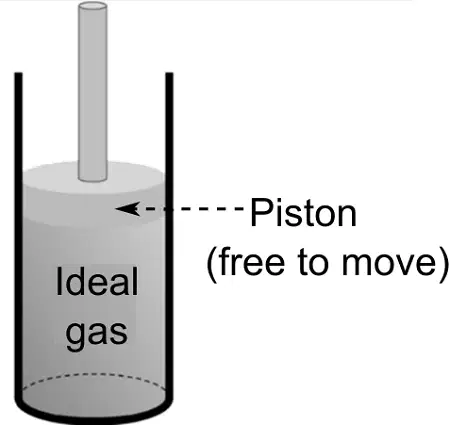
The diagram shows gas in a sealed container with a moveable piston. How can the energy of the gas be increased? Select all that apply.
Place the cylinder on ice.
Push down on the piston.
Pull up on the piston.
Add heat.
What is occurring with molecules of water in a pot that is heated to boiling, changing the water to steam? Select all that apply.
The molecules are moving closer together.
The molecules are moving farther apart.
The molecules are speeding up.
The molecules are slowing down.
One mole of gas contains a volume of 22.4 liters. Match the following number of moles to the equivalent volume.
2.5 moles
56 L
1 mole
22.4 L
4 moles
89.6 L
4.5 moles
100.8 L
1.5 moles
33.6 L
Which of the following describe gas particles? Select all that apply.
Gases can't be compressed.
Gases have a fixed volume.
Gases move in a rapid, straight-line motion.
Gases fill all the space inside a container.
Which of the following explains why a balloon will expand if it's left outside in the sun?
The molecules of air move more quickly.
The molecules increase in size.
The molecules stop hitting the wall of the balloon.
The molecules aren't colliding with each other as much.
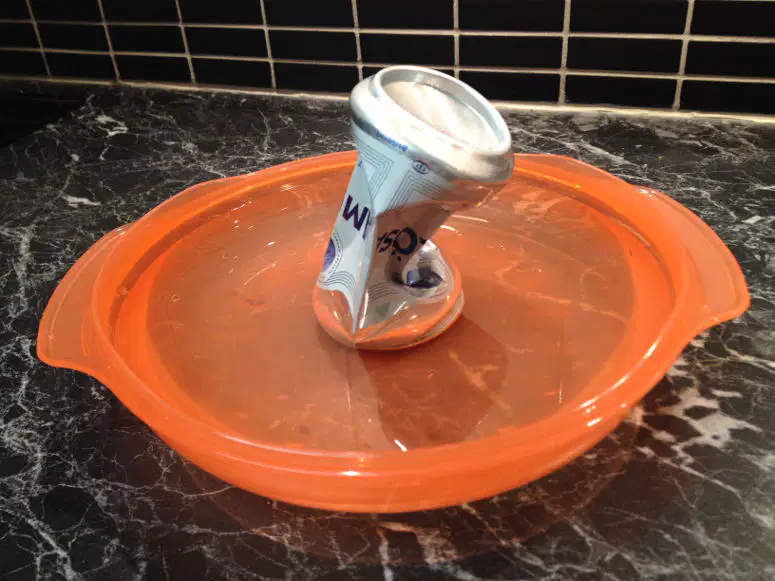
When an aluminum can with boiling water is inverted into cold water, it implodes (or crushes) because the outside pressure is higher than the inside pressure (see photo). This is because the cold water sealed the can, which condensed the gas, which caused the volume to decrease.
True
False
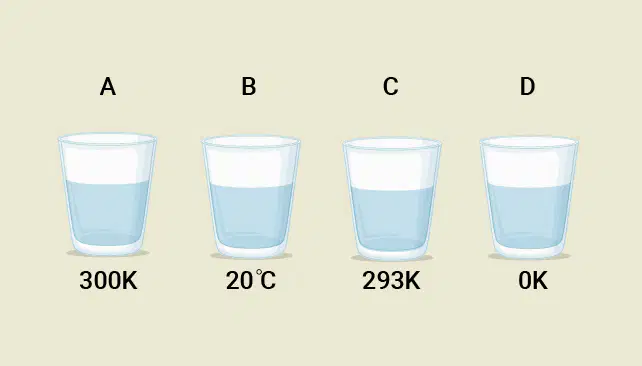
Assuming all of the containers have the same number of particles with the same pressure and volume, which container has the highest average kinetic energy?
Container A
Container B
Container C
Container D
A balloon has an initial volume of 1.9 L at 21 oC. It's heated, causing it to expand to 5.7 L. What is the final temperature?
7 oC
70 oC
699 oC
609 oC
Why are gases easily compressible?
They're in constant, random motion.
They move in a straight line.
They're mostly empty space.
They have no forces of attraction with other gas particles.
223.15
323.15
100.15
50.15
How would you convert 34oC to Kelvin?
K = oC + 273
oC = K + 273
K = oC - 273
oC = K + 273

Calculate the new temperature when 6.00 L at 20.0 °C is compressed to 4.00 L.
195 K
0.00512 K
440 K
0.00228 K
Determine the initial temperature of a random gas when the initial volume is 2.2 L and it is cooled to 88K with a volume of 0.85 L.
0.029 K
0.021 K
227.76 K
34 K

