
 Worksheets
Modeling Population Changes
Total questions: 20
Worksheet time: 40mins
A population of rabbits experiences 500 births in 1 breeding season and 30 rabbits die of disease or predation. This population will ________ because births are ______ than deaths.
increase, greater
decrease, greater
remain constant, equal
decrease, less
A population of wild horse experiences 5 births in 1 breeding season and 15 deaths due to disease, starvation, and natural disaster. This population will ________ because births ________ than deaths.
increase, greater
decrease, greater
remain constant, equal
decrease, less
A population of gray wolves experience 5 births in 1 breeding season and 5 deaths due to disease and starvation. This population will ________ because births ________ deaths.
increase, greater
decrease, greater
remain constant, equal
decrease, less
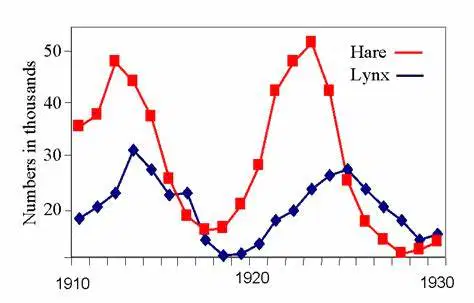
Examine the graph below. During which period of time did the births of lynx exceed the deaths of lynx?
1910-1913
1913-1919
1925-1929
1915-1916
Examine the graph below. During which period of time did the births of lynx equal the deaths of lynx?
1910-1913
1913-1919
1925-1929
1915-1916
Examine the graph below. During which period of time did the deaths of lynx exceed the births of lynx? Select all that apply.
1910-1913
1913-1919
1925-1929
1915-1916
A population of 20 wolves lives on an island and survives by hunting a population of moose. Over a 5 year period they have 20 pups and 11 deaths. What is the population of the wolves after 5 years?
11
29
51
60
A flock of 25 birds lives in a sanctuary. Over a 6-year period, they have 60 chicks and 20 deaths. What is the population of the birds after 6 years?
20
25
60
65
A herd of 30 deer lives in a national park. Over a 4-year period, they have 15 fawns and 40 deaths. What is the population of the deer after 4 years?
0
5
55
70
A group of 15 foxes lives in a woodland area. Over a 5-year period, they have 25 kits and 25 deaths. What is the population of the foxes after 5 years?
0
5
10
15
If more individuals are born than die in a period, the population size will _____.
increase
decrease
remain stable
none of these
If birth rate is equal to death rate, the population will _______.
increase
decrease
remain stable
none of these
If birth rate is less than death rate, the population will _______.
increase
decrease
remain stable
none of these
Which of the following fundamentally determines how a population changes? Select all that apply.
Births
Deaths
Disease
Climate Change
Which of the following best represents a population where the number of births is greater than the number of deaths?


Which of the following best represents a population where the number of births is less than the number of deaths?
Which of the following best represents a population where the number of births is equal to the number of deaths?
Which of the following add to a population size?
Birth & New individuals moving into the population
Birth & individuals leaving the population
Death & individuals leaving the population
Death & New individuals moving into the population
Which will most likely result in a negative growth rate in the human population of a country?
The death rate is higher than the birth rate.
The birth rate is higher than the death rate.
The country has improved economic conditions.
The country has made improvements in sanitation.
Between 1880 and 1930 human population doubled due to
the Industrial Revolution
a combination of high birth rates and lowered death rates.
improvements in societal infrastructure and services.
All of the above

