
 Worksheets
MI Unit 1.1 Quiz Review
Total questions: 8
Worksheet time: 4mins
Name
Class
Date
1.
Which of the following would be considered a medical intervention?
a)
Cosmetic surgery
b)
Immune response
c)
Antibiotics
d)
All of these
2.
Which of the following is a medical intervention that could be used to address the outbreak of disease?
a)
Sequence the DNA of the pathogen and use the BLAST database to identify it.
b)
Calculate attack rate to determine the likely source of the outbreak.
c)
Develop a cohort study to determine risk factors for the outbreak.
d)
Interview those that are ill to identify their family members.
3.
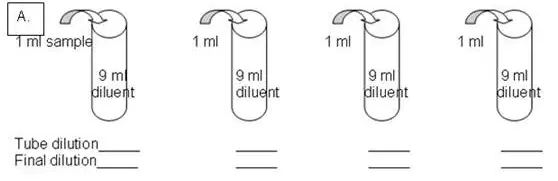
Lily has 10 mL of a patient’s sample in the first tube. She has determined that the antigen concentration in the patient’s sample is 2,000 ng/mL. If she performs the dilutions indicated in the diagram below, what is the final concentration of the last tube?
a)
2 ng/mL
b)
50 ng/mL
c)
10 ng/mL
d)
24.7 ng/ml
4.
Ebony is working in a cancer biology lab performing an ELISA to test for the presence of cancer antigens in a patient. Natalie calls her because she too is working in a cancer biology lab and likes to collaborate. The phone call distracts Ebony and she cannot remember if she added the secondary antibody. She continues with the ELISA and adds substrate. If she forgot the secondary antibody, what will the results of her ELISA be?
a)
The substrate will change color, but because there’s no difference in secondary antibody between wells, it will be the same in each well, regardless of the concentration of antigen present.
b)
There will be no color change because the primary antibody is blocked and cannot oxidize the substrate.
c)
There will be no color change because there is no enzyme present to catalyze the oxidation of the substrate.
d)
The substrate will change color, but it will be more difficult to see because there is no enzyme-linked secondary antibody to amplify the effect.
5.
What do you label a nucleotide when there are multiple peaks over lapping?
a)
A
b)
T
c)
Nothing, you leave a blank space
d)
N
6.
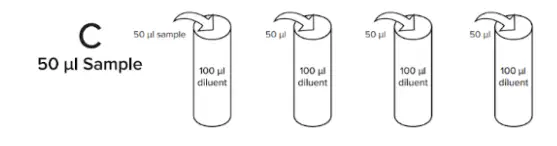
What is the tube dilution of Tube 1?
(a)
7.
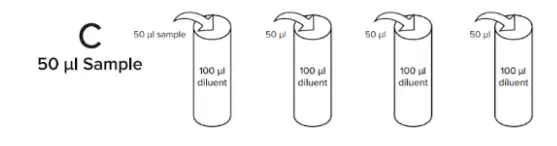
What is the final dilution of Tube 3?
(a)
8.
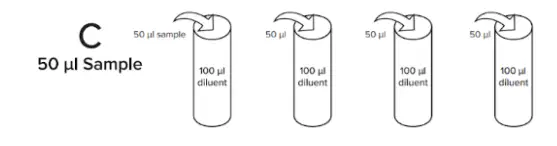
What is the concentration of Tube 2? When the concentration of tube 1 was 20microl/ml
(a)
100 %

