
Font size
 Worksheets
Unit 2 Review
Total questions: 51
Worksheet time: 26mins
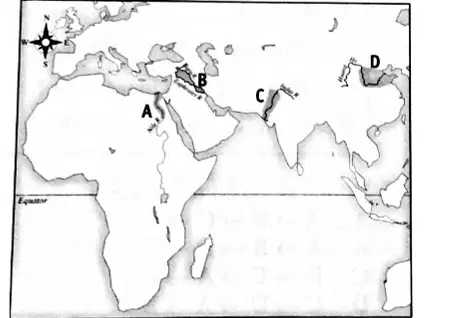
An archaeologist discovered a preserved mummy, hieroglyphics written on stone walls, and an embalmed pharaoh. At which location on the map was this site most likely found?
Site A
Site B
Site C
Site D
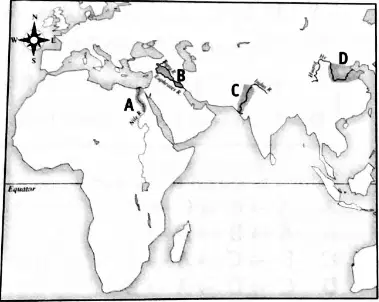
According to the map, what did each of the ancient civilizations indicated by the letters on the map have in common?
They first began along river valleys.
They farmed wheat and barley.
They buried their rulers in large pyramids.
They were ruled by a pharaoh.
The Neolithic Revolution occurred when people discovered how to:
grow food and domesticate animals
trade with others in the same river valley
fight wars using metal weapons
make stone temples for religious ceremonies
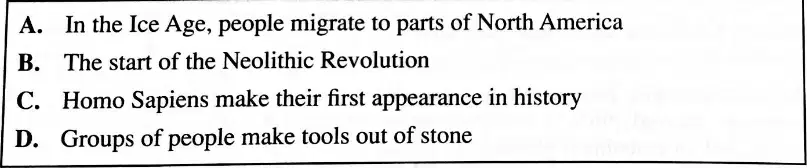
Four events related to early world history are listed below. Which of the following is the correct chronological order of these events?
- A. In the Ice Age, people migrate to parts of North America
- B. The start of the Neolithic Revolution
- C. Homo sapiens make their first appearance in history
- D. Groups of people make tools out of stone
C->D->A->B
A->B->C->D
A->B->D->C
D->C->A->B
Archaeological discoveries suggest that:
The Sumerians in Mesopotamia invented the sailboat.
Farming societies developed before hunting and gathering societies.
All the continents were settled at the same time.
The wheel was first used in ancient China.
The river valleys of the Tigris-Euphrates, the Nile, and the Indus were centers of civilization because they
had fertile soil, fresh water, and warm climates
were easy to defend from invasion
had rich deposits of iron ore and coal
were isolated from other cultural influences
Which of the following is a major characteristic of Judaism?
belief in a single, just, and all-powerful God
praying five times a day
following the Eightfold Path
worshipping many gods
Which development led to the other three?
domestication of plants and animals
complex civilizations
surplus of food
division of labor
The Code of Hammurabi was a major contribution to the development of civilization because it:
established written laws
rejected the principle of filial piety
treated citizens and slaves equally
ended all physical punishment
The (a) was the first dynasty in Chinese history.
The (a) runs from south to north into the Mediterranean Sea.
The (a) was the Jewish law code that God gave to Moses.
There were (a) kingdoms in Egypt: Old, Middle, and New.
A person who is interested in studying the ruins left by ancient civilizations.
paleontologist
pediatrician
archaeologist
anthropologist
Which factor was most important in the development of early civilizations?
Access to water sources
Availability of metal resources
Proximity to mountains
Isolation from other cultures
What was a significant result of the Neolithic Revolution?
Increase in nomadic lifestyles
Development of permanent settlements
Decline in trade activities
Reduction in population
Which of the following best describes a characteristic of early river valley civilizations?
They had advanced sewer systems.
They practiced monotheism.
They developed writing systems.
They were located in mountainous regions.
The Neolithic Revolution is also known as the _______________.
Agriculture Revolution
Nomad Revolution
Fertile Crescent Change
The Neolithic Revolution refers to the time when early humans:
mastered fire.
developed agriculture.
migrated from Africa.
organized governments.
Label the locations accurately
Which of the following is considered a wonder of the Ancient World?
The Great Wall of China
The Colosseum in Rome
The Pyramids of Giza
Machu Picchu
Which civilization is known as the "Cradle of Civilization"?
Indus Valley Civilization
Ancient Egypt
Mesopotamia
Ancient China
What is the Jewish day of rest and the seventh day of the week called?
Ramadan
Sabbath
Diwali
Easter
Moses, the Ten Commandments, and the Torah are part of
Islam
Judaism
Christianity
All the above
A Jewish temple is known as:
a mosque
a Jewish church
a synagogue
a Bar Mitzvah
Who received the Ten Commandments, according to the Bible?
Jesus
Muhammad
Moses
Abraham

The belief in many gods and goddesses.
Polytheism
Monotheism
Maxitheism
Atheism
Which of the following best explains why early humans began to form larger communities?
To improve hunting techniques
To defend against wild animals
To explore new continents
To manage agricultural production and surplus
Which ancient civilization developed cuneiform as a system of writing?
Indus Valley
Ancient China
Mesopotamia
Ancient Egypt
What was a major impact of the development of irrigation systems in early river valley civilizations?
Increased migration to mountainous regions
Decline in agricultural productivity
Ability to support larger populations
Reduction in trade with neighboring societies

The writing system in Mesopotamia is called
Cuneiform
Chinese
Mesopotamian
Art

Which of the following represents Chinese Calligraphy?
1
2
3
4

"F" represents which country?
Britain
Gaul
Spain
Carthage

Which term refers to the transition (change) of human societies from nomadic/ hunting and gathering to farming?
Paleolithic Revolution
Agricultural Revolution
Industrial Revolution
Neolithic Revolution
Neolithic societies led to the development of civilizations by --
creating settled communities
mastering fire and using oral language
changing early farmers to hunters and gatherers
creating cave art
Prehistory is divided into three periods. In order, they are...
Paleolithic, Neolithic, Metal Ages
Neolithic, Paleolithic, Metal Ages
Metal Ages, Paleolithic, Neolithic
Metal Ages, Neolithic, Paleolithic

Number the events in chronological order
Hunter-gatherer groups settled in Mesopotamia.
People learned to plant crops to grow their own food.
Farm settlements formed in Mesopotamia.
Villages formed.
Civilization developed.
An Abbreviation for Before the Common Era used to tell when something occurred.
BC
BCE
ABC
BCE and ______ represent the same era of time on a timeline.
BC
CE
AD
DC
Nile River, hieroglyphics, pyramids = (a)
Indus River Valley, urban planning, sewer system = (a)
Tigris and Euphrates River, zigguerats, Hammurabi's Code = (a)
Judaism, Jerusalem, 10 Commandments = (a)
How long is a century?
1 year
10 years
100 years
1000 years
What does "decade" refer to?
A period of 100 years
A period of 50 years
A period of 10 years
A period of 20 years
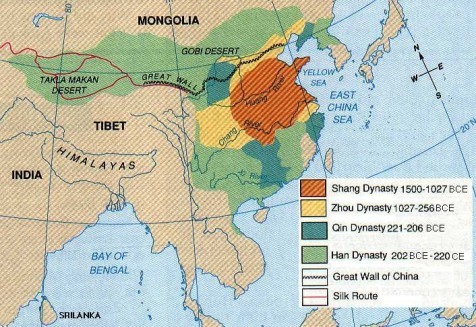
Yellow River, characters, silk clothing, ceremonial vessels, superior swords, Dynasties = (a)

