
 Worksheets
FCE UNIT 2 TEST
Total questions: 46
Worksheet time: 2hrs 51mins
Correct any incorrect prepositions in a–h. a. The TV series is based in the book of the same name.
OBS.: If there is any mistake, write the correct preposition, on the contrary write the word "nothing".
Correct any incorrect prepositions in a–h. b. Penguins are slow on land but very good in swimming.
OBS.: If there is any mistake, write the correct preposition, on the contrary write the word "nothing".
Correct any incorrect prepositions in a–h. c. When watching wildlife, it helps to dress in dark clothes.
OBS.: If there is any mistake, write the correct preposition, on the contrary write the word "nothing".
Correct any incorrect prepositions in a–h. d. Your exam result will depend of how hard you study.
OBS.: If there is any mistake, write the correct preposition, on the contrary write the word "nothing".
Correct any incorrect prepositions in a–h. e. We arrived to our hotel just before it started snowing.
OBS.: If there is any mistake, write the correct preposition, on the contrary write the word "nothing".
Correct any incorrect prepositions in a–h. f. Climate change has had a big effect on the plants here.
OBS.: If there is any mistake, write the correct preposition, on the contrary write the word "nothing".
Correct any incorrect prepositions in a–h. g. The local fishermen’s nets are all made with hand.
OBS.: If there is any mistake, write the correct preposition, on the contrary write the word "nothing".
Correct any incorrect prepositions in a–h. h. TV wildlife programmes seem to be popular all over the world.
OBS.: If there is any mistake, write the correct preposition, on the contrary write the word "nothing".
2. Replace the words in italics in a–e with one of these words and the correct preposition.
WORRIED / RISK / REASON / FULL / HOOKED
a. My brother seems addicted to computer games.
(a)
2. Replace the words in italics in a–e with one of these words and the correct preposition.
WORRIED / RISK / REASON / FULL / HOOKED
b. In spring, these fields are covered with wild flowers.
(a)
2. Replace the words in italics in a–e with one of these words and the correct preposition.
WORRIED / RISK / REASON / FULL / HOOKED
c. Caroline is never frightened of walking home alone.
(a)
2. Replace the words in italics in a–e with one of these words and the correct preposition.
WORRIED / RISK / REASON / FULL / HOOKED
d. Some species of animal are in danger of disappearing.
(a)
2. Replace the words in italics in a–e with one of these words and the correct preposition.
WORRIED / RISK / REASON / FULL / HOOKED
e. We’re not sure what the cause of the illness is.
(a)
3. Complete sentences a–e with a suitable collective noun.
a. We saw a of sheep on the hillside.
(a)
3. Complete sentences a–e with a suitable collective noun.
b. Mike gave Julie a of flowers on her birthday.
(a)
3. Complete sentences a–e with a suitable collective noun.
c. There was a of dogs on the street corner.
(a)
3. Complete sentences a–e with a suitable collective noun.
d. I always take a of cards on holiday with me.
(a)
3. Complete sentences a–e with a suitable collective noun.
e. What a noise! It sounds like a of elephants in the corridor!
(a)
4. Match the groups of people with sentences a–f.
a. ‘We only lost the match because our best player was injured.’
CAST
TEAM
STAFF
AUDIENCE
CROWD
4. Match the groups of people with sentences a–f.
b. ‘When the band come on the stage we all cheered.’
CAST
TEAM
STAFF
AUDIENCE
CROWD
4. Match the groups of people with sentences a–f.
c. ‘We only get 20 days holiday a year in this company.’
CAST
TEAM
STAFF
AUDIENCE
CROWD
4. Match the groups of people with sentences a–f.
d. ‘Our ship is often away at sea for three months at a time.’
CAST
TEAM
STAFF
AUDIENCE
CROWD
4. Match the groups of people with sentences a–f.
e. ‘Hundreds of us waited outside the store for the sales to begin.’
CAST
TEAM
STAFF
AUDIENCE
CROWD
4. Match the groups of people with sentences a–f.
f. ‘All of us enjoyed performing the last play at that theatre.’
CAST
TEAM
STAFF
AUDIENCE
CROWD
5 Match these words with definitions a–j.
a. a small area of fresh water, e.g. in a garden
LAKE
JUNGLE
BEACH
LAGOON
PLAIN
5 Match these words with definitions a–j.
b. a row of bushes along the edge of a garden
LAKE
JUNGLE
BEACH
LAGOON
PLAIN
5 Match these words with definitions a–j.
c. a hill of sand near a beach or in a desert.
LAKE
JUNGLE
BEACH
LAGOON
PLAIN
5 Match these words with definitions a–j.
d. an area of salt water cut off from the sea.
LAKE
JUNGLE
BEACH
LAGOON
PLAIN
5 Match these words with definitions a–j.
e. a large area of fresh water.
LAKE
JUNGLE
BEACH
LAGOON
PLAIN
5 Match these words with definitions a–j.
f. part of a country near or next to the sea.
LAKE
JUNGLE
BEACH
LAGOON
PLAIN
5 Match these words with definitions a–j.
g. a large area of flat land.
LAKE
JUNGLE
BEACH
LAGOON
PLAIN
5 Match these words with definitions a–j.
h. low ground between hills or mountains.
LAKE
JUNGLE
BEACH
LAGOON
PLAIN
5 Match these words with definitions a–j.
i. thick tropical forest.
LAKE
JUNGLE
BEACH
LAGOON
PLAIN
5 Match these words with definitions a–j.
j. an area of sand next to the sea.
LAKE
JUNGLE
BEACH
LAGOON
PLAIN
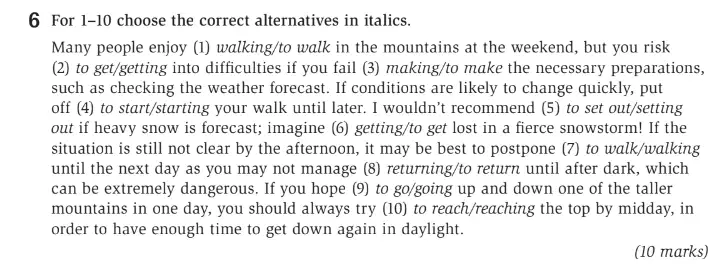
For 1–10 choose the correct alternatives in italics.
OBS.: You should answer like A-is B-are...
7. Complete sentences a–f using the correct form of the verb in brackets.
a. I remember (visit) a safari park when I was a child.
7. Complete sentences a–f using the correct form of the verb in brackets.
b. If your feet often get cold, try (wear) an extra pair of socks.
7. Complete sentences a–f using the correct form of the verb in brackets.
c. I’m tired so I’m to going to stop (have) a short rest.
7. Complete sentences a–f using the correct form of the verb in brackets.
d. Did you remember (switch off) the lights when you left?
7. Complete sentences a–f using the correct form of the verb in brackets.
e. I wish my sister would stop (take) things from my room.
7. Complete sentences a–f using the correct form of the verb in brackets.
f. After performing some new songs, the band went on (play) their best-known hits
8. Complete each conversation in a–e using the correct form of these phrasal verbs.
BRING UP / COME ACROSS / COME UP TO / KEEP UP / TAKE AWAY
a.)
Q: Why have you stopped running? The race isn’t over yet.
A: I couldn’t _______ with the others; they’re too fast for me.
8. Complete each conversation in a–e using the correct form of these phrasal verbs.
BRING UP / COME ACROSS / COME UP TO / KEEP UP / TAKE AWAY
b.)
Q: How did you meet that boy?
A: He _______ me and asked me to dance.
8. Complete each conversation in a–e using the correct form of these phrasal verbs.
BRING UP / COME ACROSS / COME UP TO / KEEP UP / TAKE AWAY
c.)
Q: Didn’t you live with your parents when you were a child?
A: No, they were abroad. I was ______ here by my grandparents.
8. Complete each conversation in a–e using the correct form of these phrasal verbs.
BRING UP / COME ACROSS / COME UP TO / KEEP UP / TAKE AWAY
d.)
Q: Where’s my car? I left it here!
A: It was badly parked. I think it’s been ______ by the police.
8. Complete each conversation in a–e using the correct form of these phrasal verbs.
BRING UP / COME ACROSS / COME UP TO / KEEP UP / TAKE AWAY
e.)
Q: Where did you find that lovely scarf?
A: I _____ it in clothes section of the street market.

