
 Worksheets
Enzymes
Total questions: 13
Worksheet time: 2hrs 10mins
Name
Class
Date
1.
Enzymes are
a)
nucleic acids
b)
proteins
c)
lipids
d)
carbohydrates
2.
Which of the following binds to the active site of an enzyme?
a)
substrate
b)
product
c)
codon
d)
none of the above
3.

Based on the graph, what temperature does this enzyme work best?
a)
15 C
b)
40 C
c)
30 C
4.
What happens when enzymes are heated to a high temperature?
a)
The enzymes die.
b)
The shapes of the enzyme are altered or denatured
c)
The enzymes' amino acid sequence changes.
d)
The enzymes remain the same
5.

Which of the following conclusions can be drawn from this graph?
a)
The optimum pH of the enzyme is 6.6.
b)
The optimum pH of the enzyme is 5.8
c)
The enzyme’s activity increases as pH increases 5.0 to 9.0
d)
The enzyme’s activity is greater around pH of 8.0 .
6.
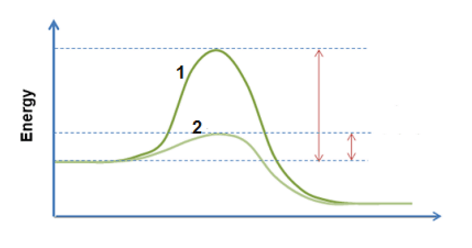
Which line represents an enzyme-catalyzed reaction?
a)
Line 1
b)
Line 2
7.
The "lock and key hypothesis" attempts to explain the mechanism of?
a)
Vacuole formation
b)
Pinocytosis
c)
Sharing of electrons
d)
Enzyme specificity
8.
What is a Cataylst?
a)
A substance that speeds up a rate of chemical reaction.
b)
Molecules that make enzymes work harder and faster
c)
reaction of an enzyme
d)
A substance that slows down a rate of chemical reaction.
9.
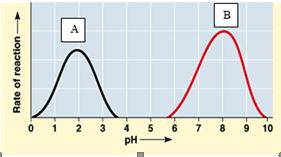
What is the optimal pH of enzyme A?
a)
8
b)
2
c)
5.7-10
d)
10
10.
With what 3 letters do enzymes typically end?
a)
-ose
b)
-ase
c)
-ese
d)
-tic
11.
Which of these is NOT true?
a)
Enzymes can denature (change shape) when the temperature gets too high.
b)
Enzymes can only be used once in a chemical reaction.
c)
Extreme pH can denature enzymes.
d)
Enzymes speed up chemical reactions.
12.
Enzymes will make a reaction go _______ and use ______ energy.
a)
faster, less
b)
faster, more
c)
slower, less
d)
slower, more
13.

The amount of energy needed to start a chemical reaction.
This is significantly lowered by enzymes, speeding up chemical reactions so life can exist.
a)
Induction Energy
b)
Products
c)
Active Site
d)
Activation Energy
100 %

