
Font size
 Worksheets
12. Basic Chemistry: Chemical Kinetics
Total questions: 25
Worksheet time: 2hrs 9mins
Which of the following is NOT a factor affecting reaction rate?
Polarity of the reactants
The catalyst alters the rate of a chemical reaction by .......................
changing the products formed in the direction of the reaction
providing an alternative pathway with a lower Ea
increasing the frequencies of collisions between molecules
providing a surface on which the molecules react
Which of the following are true about reaction rates?
The overall rate law is determined by the fastest step of a reaction.
The presence of a catalyst will increase the number of molecules entering the transition state.
An increase in temperature will increase the rate of a reaction.
Decreasing the particle size will make particles move faster.
Decreasing the concentration of reactants will increase the rate at which products yield.
To measure rate of reaction, we can monitor change in which of the following?
concentration reactants or products
colour of products
mass product
pH level of reactant
temperature product
The rate of reaction is the change in the ............ of a reactant or product per unit of ...............
temperature, pressure.
mass, concentration.
pressure, time.
concentration, time.
mass, temperature.
2N2O5(g) → 4NO2(g) + O2(g)
rate of following reaction is ........................
rate =−21×ΔtΔ[N2O5]=41×ΔtΔ[NO2]=ΔtΔ[O2]
rate =−1×ΔtΔ[N2O5]=2×ΔtΔ[NO2]=21ΔtΔ[O2]
rate =−41×ΔtΔ[N2O5]=21×ΔtΔ[NO2]=1×ΔtΔ[O2]
rate =−21×ΔtΔ[NO2]=41×ΔtΔ[N2O5]=1×ΔtΔ[O2]
rate =−21×ΔtΔ[O2]=41×ΔtΔ[N2O5]=1×ΔtΔ[NO2]
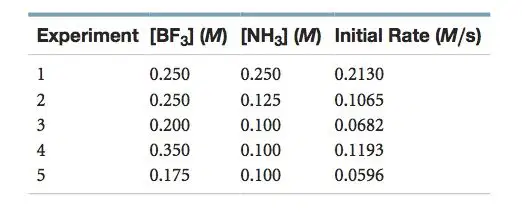
The following data were measured for the reaction
BF3(g) + NH3(g) ⟶ F3BNH3(g)
What is the order in [BF3] ?
1
0
3
4
2
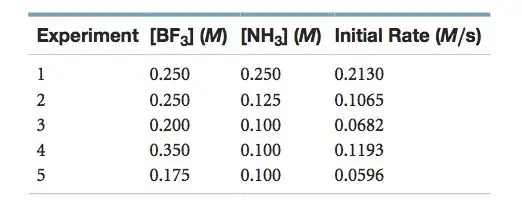
The following data were measured for the reaction
BF3(g) + NH3(g) ⟶ F3BNH3(g)
What is the order in [NH3] ?
4
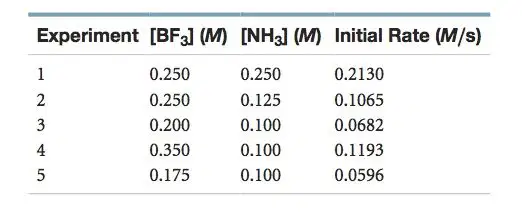
The following data were measured for the reaction
BF3(g) + NH3(g) ⟶ F3BNH3(g)
What is the rate constant (k) of the reaction?
0.625
0.213
2.596
3.408
1.193

The following data were measured for the reaction
BF3(g) + NH3(g) ⟶ F3BNH3(g)
What is the rate when [BF3] = 0.100 M and [NH3] = 0.500 M ?
0.1704 M/s
0.852 M/s
0.0625 M/s
0.3125 M/s
0.0852 M/s
A reaction is found to be second order with respect to carbon monoxide. If the concentration of carbon monoxide is doubled, the rate of reaction ...........
Given the following rate law, rate = k[A]2[B]. If [A] were doubled, what must happen to [B] to keep the rate constant?
Rate = k[A]. The rate constant in the rate law above is 0.5 L/mol·s. If the initial concentration of A is 0.1 M, how long will it take for [A] to drop to 0.025 M?
Given the following balanced equation :
2NO(g) + Cl2(g) → 2NOCl(g)
If the rate of disappearance of Cl2 is 4.84 x 10⁻² Ms-1, what is the rate of disappearance of NO?
1.22 x 10⁻¹ M/s
4.84 x 10⁻² M/s
9.68 x 10⁻² M/s
2.42 x 10⁻² M/s
8.00 x 10⁻² M/s
The first order rate constant for the decomposition of 0.5 M compound A at 100oC is 0.03 min-1. Calculate the half-life of A.
In the reaction 2O₃ (g) → 3O₂ (g), what is the relative rate expression for O₃?
2 x (Δ[O₃]/Δt)
-3 x (Δ[O₃]/Δt)
-1/3 x (Δ[O₃]/Δt)
-1/2 x (Δ[O₃]/Δt)
1/2 x (Δ[O₃]/Δt)
In the reaction 2O₃ (g) → 3O₂ (g), what is the relative rate expression for O₂?
Which of the following statements is true regarding the order of a reaction?
The order of a reaction must be determined experimentally.
The order of a reaction is always equal to the stoichiometric coefficients in the balanced equation.
A reaction is found to have an activation energy of 108 kJ/mol. If the rate constant for this reaction is 4.60×10⁻⁶/s at 275 K, what is the rate constant at 366 K? R = 8.314 J/mol.K. 1 kJ = 1000 J
0.580 /s
For first order reaction A → product, the initial concentration of A is 0.1 M. After 40 minutes, the concentration of A becomes 0.025 M. What is the rate of reaction at reactant concentration 0.01 M?
1.25 x 10⁻⁴ M/min
5.00 x 10⁻⁴ M/min
3.47 x 10⁻⁴ M/min
6.93 x 10⁻⁴ M/min
1.73 x 10⁻⁴ M/min
For the reaction 2N2O5(g) → 4NO2(g) + O2(g), the concentration of NO2 increase by 2.4 x 10⁻² M in 6 seconds. What will be the average rate of appearance of NO2 and the average rate of disappearance of N2O5?
2.0 x 10⁻³ M/s and 4.0 x 10⁻³ M/s
2.0 x 10⁻³ M/s and 1.0 x 10⁻³ M/s
4.0 x 10⁻³ M/s and 2.0 x 10⁻³ M/s
2.0 x 10⁻³ M/s and 2.0 x 10⁻³ M/s
6.0 x 10⁻³ M/s and 2.0 x 10⁻³ M/s
The rate of a reaction is approximately doubled for every 10°C rise in temperature. If temperature rise by 50°C, the reaction rate increase by about ......................

The iodide ion reacts with hypochlorite ion in the following way:
OCl- + I- ⟶ OI- + Cl-.
This rapid reaction gives the rate data shown. What is the rate law?
rate = k[OCl-][I-]
rate = k[OCl-][I-]2
rate = k[OCl-]2[I-]

What would the rate constant of the reaction be given the following set of experiments?
k = 0.517 /Ms
k = 0.138 /Ms
k = 0.179 /Ms
k = 0.275 /Ms
k = 0.266 /Ms

An addition of a catalyst to the following reaction would have what effect?
A would be increased
B would be increased
C would be increased
B would be decrease
No change

