
 Worksheets
ENTERPRISE COMPUTING WITH ADVANCED JAVA
Total questions: 18
Worksheet time: 14mins
Purpose of J2EE is_____
to provide a platform for developing and running enterprise applications
to enhance desktop application and Enterprise performance
to provide a platform for running only enterprise applications
______ is used to find and fix bugs in Java programs
JDM
JDB
What does JDK stand for in Java programming?
Java Development Kit
Java Data Kit
Java Deployment Kit
Java Design Kit
What are the key differences between List and Set in the Java Collection Framework?
List Maintains order
List allows duplicates and Set does not allow duplicates
Which method is used to check if a specific element exists in a collection?
has()
find()
exists()
contains()
The retainAll() method of Java Collection Interface keeps only those elements in this queue that are present in the specified collection.
TRUE
FALSE
The addAll(Collection c) method adds all elements of the specified collection to the current collection from index 1.
In the J2EE architecture, which tier is responsible for handling the business logic?
Middle Tier
EIS tier
The client request is processed by the (a)
S______C______ object is used to store data that is accessible to all servlets in a web application?
(a)
Which of the following best describes the init() method in a servlet?
It is called once for each request.
It is called when the servlet is first loaded
It is called every time a servlet is destroyed.
It is called to handle client requests
(a) Method in HTTP partially updates a resource on the server
What does the <%-- --%> syntax represent in JSP?
An HTML comment.
A JSP comment.
A Java code block.
Which of the following are valid elements in a JSP page? (Select all that apply)
Directives
Scriptlets
Expressions
Declarations
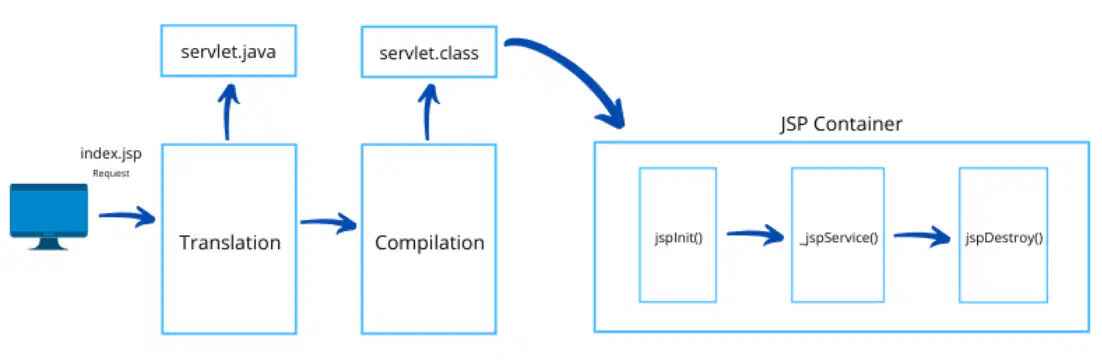
What concepts are depicted in the image?
JSP Elements
JSP LifeCycle
JSP Compilation
Servlet Lifecycle
What is the primary purpose of the Java Virtual Machine (JVM)?
To compile Java code
To execute Java bytecode
To manage memory
To provide a user interface
(a) Method is used to send data to a server to create or update a resource
Which of the following are the most appropriate features of Servlet?
Platform Independence
Portable
Efficient and scalable
Containerless Sever

