
 Worksheets
8.01-8.11 Spiral Review HW 4
Total questions: 189
Worksheet time: 3hrs 44mins
Which of the following statement about Pocahontas is INCORRECT?
She warned settlers of an attack from her own tribe.
She was the daughter of Powhatan.
She married John Rolfe.
She married John Smith.
How did John Rolfe contribute to the success of Jamestown?
He forced settlers to work.
He capitalized on high demand for tobacco in Europe.
He stopped trading with the Powhatan.
He sold the settlement to the French.
How is an indentured servant different from a slave?
Indentured servants only work for a specific period of time.
Indentured servants were forced into labor.
Indentured servants had no hope for freedom.
Indentured servants did not desire freedom.
How did John Rolfe contribute to the success of Jamestown?
He forced settlers to work.
He capitalized on high demand for tobacco in Europe.
He stopped trading with the Powhatan.
He sold the settlement to the French.
Which of the following is considered a cause for the "starving time?"
Powhatan stopped providing food.
Wild game was very scarce in the region.
A severe drought occurred in the area.
Chesapeake Bay and the James River flooded the settlement.
The joint-stock company that received a charter to settle at Jamestown was the ______________ company.
Maryland
James River
Virginia
Massachusetts
Which leader at Jamestown convinced the settlers to work in order to survive?
John Rolfe
John Smith
Rebecca Rolfe
Virginia Dare
Which of the following best describes the leader of the Powhatan Confederacy?
Settlers referred to him as "Powhatan" as well.
He provided food for the settlers.
He was the father of Pocahontas.
All of these.
Which of the following was a motive for English colonization of the New World?
The rise of the middle class
England wanted to spread Christianity, but later became financial.
Revenge against the Spanish
England wanted to avoid attacks from the French
What was the significance of Bacon's Rebellion?
It showed that the government must listen to the demands of the people.
It ended the system of indentured servants.
It gave freedom to Native Americans.
It ended English colonization in the New World
Which of the following best describes a "joint-stock company?"
Investors buy shares of ownership in exchange for a portion of the profit.
Native Americans have equal rights.
The goal was not to make money.
Cotton production was the primary way of making money.
What was the significance of the Virginia House of Burgesses?
It gave women the right to vote.
Members voted to stay out of Native American territory
It was the first legislature to allow African-Americans to run for office.
It was the first representative legislature in the New World to be elected by the people.
Because it became less and less profitable, Virginia became a __________ colony.
Royal
Theocratic
Democratic
None of these
What was the primary cash crop that helped Jamestown thrive economically?
Cotton
Tobacco
Rice
Indigo
Who was the English monarch that granted the charter for the establishment of Jamestown?
Queen Elizabeth I
King James I
King Charles I
Queen Mary I
What was the main reason for the high mortality rate among the early settlers of Jamestown?
Native American attacks
Lack of food and clean water
Harsh winters
Disease and poor sanitation
What was the primary reason for the establishment of Jamestown?
To find a new trade route to Asia
To establish a base for religious freedom
To search for gold and other resources
To create a penal colony for convicts
Which of the following was a major challenge faced by the settlers of Jamestown?
Frequent earthquakes
Hostile relations with Native Americans
Lack of interest in farming
Overpopulation
What role did Pocahontas play in the Jamestown settlement?
She was a translator and intermediary between the settlers and Native Americans.
She led attacks against the settlers.
She was the first female governor of Jamestown.
She introduced new agricultural techniques to the settlers.
Which of the following statements is correct based on the content of the primary source below? (MULTIPLE SELECT-CHOOSE MORE THAN ONE).
"Likewise tobacco...which there thriveth so well that no doubt but after a little more trial and experience in the curing thereof it will compare with the best in the West Indies."
It was written by John Rolfe.
Tobacco was grown in response to high demand in Europe.
Tobacco crops helped ensure the survival of the people of Jamestown.
Tobacco farming was stopped by the Powhatan.
A colony that is under the complete control of the king was known as a ___________.
proprietary
joint-stock
royal
religious

What was the Mayflower Compact?
a covenant agreeing to obey the laws of the colony & the king
a covenant agreeing to obey only the laws of the colony
an agreement between the Pilgrims and the Native Americans for peace
an agreement between England and the Pilgrims that allowed them to worship freely
Which of the following statement about Pocahontas is INCORRECT?
She warned settlers of an attack from her own tribe.
She was the daughter of Powhatan.
She married John Rolfe.
She married John Smith.
How is an indentured servant different from a slave?
Indentured servants only work for a specific period of time.
Indentured servants were forced into labor.
Indentured servants had no hope for freedom.
Indentured servants did not desire freedom.
How did John Rolfe contribute to the success of Jamestown?
He forced settlers to work.
He capitalized on high demand for tobacco in Europe.
He stopped trading with the Powhatan.
He sold the settlement to the French.
The joint-stock company that received a charter to settle at Jamestown was the ______________ company.
Maryland
James River
Virginia
Massachusetts
Which leader at Jamestown convinced the settlers to work in order to survive?
John Rolfe
John Smith
Rebecca Rolfe
Virginia Dare
Which of the following best describes the leader of the Powhatan Confederacy?
Settlers referred to him as "Powhatan" as well.
He provided food for the settlers.
He was the father of Pocahontas.
All of these.
Which of the following was a motive for English colonization of the New World?
The rise of the middle class
England wanted to spread Christianity, but later became financial.
Revenge against the Spanish
England wanted to avoid attacks from the French
What was the significance of Bacon's Rebellion?
It showed that the government must listen to the demands of the people.
It ended the system of indentured servants.
It gave freedom to Native Americans.
It ended English colonization in the New World


Mayflower Compact
Signed between the Natives and the Colonists on the shores of Cape Cod
Signed by the settlers of Jamestown to create a formal government in Virginia
created a civil body politic or government by the voyagers on the Mayflower to make sure everyone followed the laws for the general good of the colony
A letter for men and women to sign when coming onto the boat
Persecution
the process that someone accused of a crime has to go through
treating someone cruelly and unfairly due to their beliefs
cutting something into exact pieces
occurred only in the New World
Dissent
to agree
to disagree
to sail
to create
Who was arrested, put on trial for heresy, and banished to Rhode Island for speaking out against the church in Massachusetts Bay Colony?

Against which colony's government did Bacon's Rebellion revolt?
Pennsylvania
Maryland
Georgia
Virginia
True/False: Bacon's Rebellion helped the government to realize that they can't ignore the demands of the people.
True
False
What was the significance of the Mayflower Compact?
It established trade with other European colonists.
It created a system to collect taxes for the colony.
It provided a basis for self-government in the colony.
It established boundaries between European colonies.
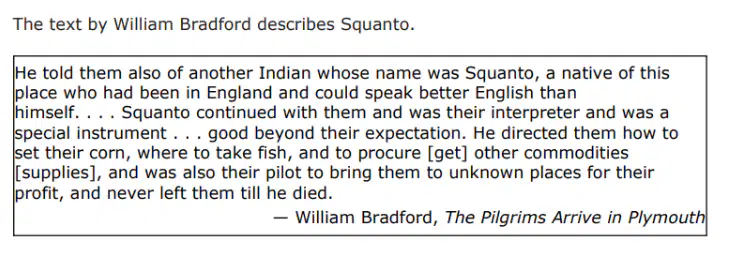
According to this excerpt, Squanto was important to the Pilgrims because he...
understood the language and helped the Pilgrims to survive.
taught the Pilgrims how to resist certain diseases.
had lived in England and knew about Pilgrim traditions.
made peace between the Pilgrims and French traders.
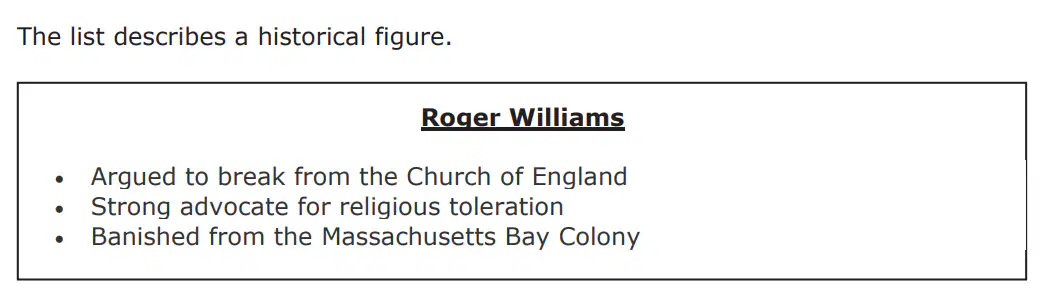
Which phrase could be added to this list?
Converted beliefs of many American Indians
Founded a colony for Quaker settlers
Established the colony of Rhode Island
Escaped from captivity in Plymouth

Based on the source, which statement best supports the idea that the Massachusetts Bay Colony was a theocracy?
Anne Hutchinson was banished from the colony for believing in salvation by human effort.
Thomas Hooker often gave sermons instructing people how to act.
Roger Williams left the colony to form a new settlement that practiced religious tolerance.
John Winthrop consulted Puritan ministers before making political decisions.
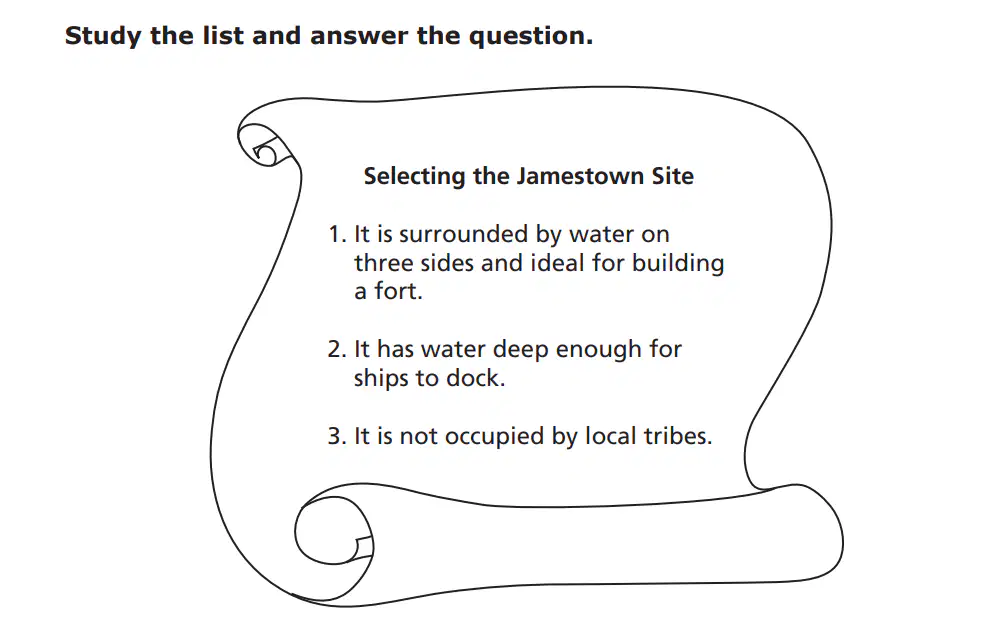
What statement describes the purpose of this list?
locate an area with many precious metals
find land that would avoid conflict with native people
locate an island free from wild vegetation
find land situated along buffalo migratory routes
Which city was the primary settlement in New Netherland?
Jamestown
Plymouth
New Amsterdam
Fort Oglethorpe
Which of the following best describes a "dissenter?"
one who disagrees with church officials
one who protests the sale of tobacco
one who leave the Society of Friends
one who agrees with church officials
In the early 17th century, the Dutch started the colony of New Netherland in the area now known as New York. What was the major goal of the Dutch who settled in this colony?
to convert Native Americans to Christianity
to escape political persecution
to have religious freedom
to earn a profit from trading and farming
Which of the following statements describes Massachusetts Bay as a "theocracy?"
Settlers were allowed to own slaves
Religious leaders were the policy makers of the colony
Women were allowed to vote
Tobacco was the primary cash crop of the colony
How does the city of Philadelphia reflect the beliefs of William Penn and the Quakers?
the name of the city means "city of brotherly love"
the city did not accept Native Americans
city officials did not allow women to speak at religious meetings
none of these
Patroons can be described as wealthy landowners who ruled like _______
Kings
Dictators
Governors
Presidents
Someone who owed more money to creditors than they had is called _____
yeoman
philanthropist
teacher
debtor


What 1701 document gave Pennsylvania colonists the right to elect legislative representatives?
Charter of Privileges
Charter of Pennsylvania
Charter of Colonists
Penn Charter

The people who settled in Pennsylvania belonged to which group?
Catholics
Puritans
Protestants
Quakers

Who founded the Pennsylvania colony?
King Charles
the Swiss
the Dutch
William Penn
What was New York City's original name?
New Amsterdam
New Holland
New Norway
New Netherland
The Dutch colony was diverse. What does that mean?
It included it many people from many places with many different views
It was separated into many sections
Diverse is another word for equal
The Dutch colony was very big
The Dutch West India Company's goal was to ____.
trade for furs to make money
find the Northwest Passage
find gold in the rivers
set up schools for Native Americans
What was the purpose of the colony of New Netherland?
to create a beautiful place for people to live
to create a place that would make money for the country called the Netherlands
to create long-lasting friendships with Native Americans
to allow people of the Netherlands to get exciting metal tools
How did the English take New Netherland from the Dutch?
The English won a war.
The Dutch governor surrendered the colony.
The Dutch ran away.
The English paid the Dutch for the colony.
Who settled New Netherland in 1621?
The English
The Spanish
The Dutch
The Americans

What was the name of the settlement in present-day Manhattan?


In the end New Amsterdam became known as ______.
Albany
Fort Orange
Jersey City
New York City

The list below describes a leader who came to the New World in 1620.
Which term completes the list?
John Winthrop
James Oglethorpe
Peter Stuyvesant
William Bradford
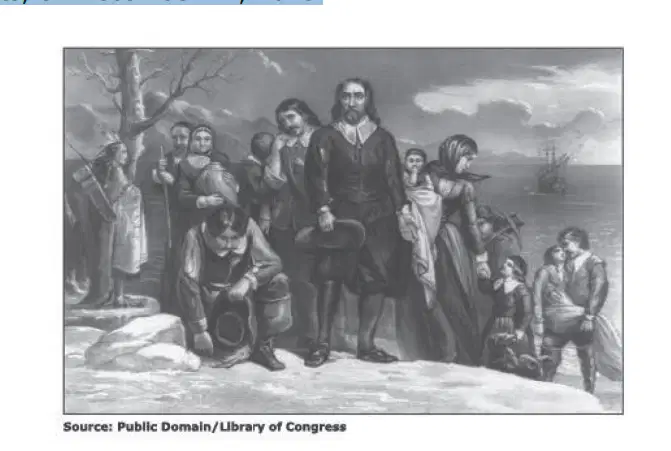
The image below from 1876 shows the Pilgrims landing at Plymouth, Massachusetts, on December 22, 1620.
Based on this image and your knowledge of the Pilgrims, which statement contrasts the lifestyle of these colonists to those of other early settlers?
The Pilgrims once had a more peaceful interaction with American Indians.
The Pilgrims soon formed diverse Protestant congregations.
The Pilgrims were soon hampered by a lack of leadership.
The Pilgrims were prepared to farm the fertile soil.
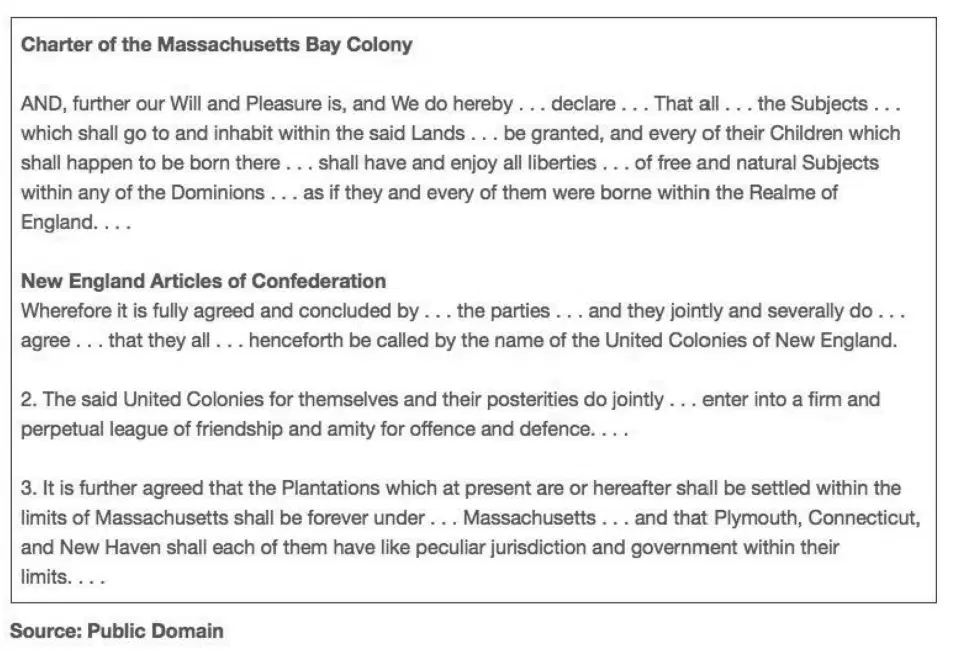
The excerpts below are from the Charter of the Massachusetts Bay Colony, 1629, and the New England Articles of Confederation, 1643.
Which idea in these documents was most responsible for future problems?
the granting to colonists the rights and privileges of British citizens
the focus on plans for the New England colonies to work together for defense
the ruling that local governments will have the power to execute and oversee local laws
the requirement that settlements remain under the jurisdiction of the colonies where they originated
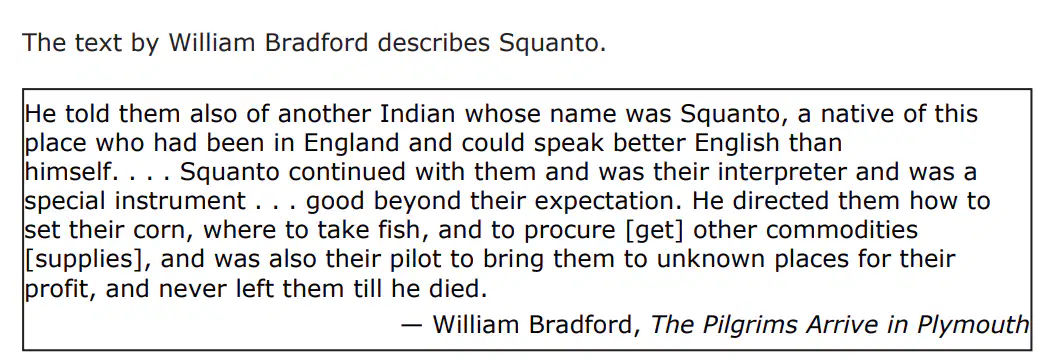
According to this excerpt, Squanto was important to the Pilgrims because he...
understood the language and helped the Pilgrims to survive.
taught the Pilgrims how to resist certain diseases.
had lived in England and knew about Pilgrim traditions.
made peace between the Pilgrims and French traders.
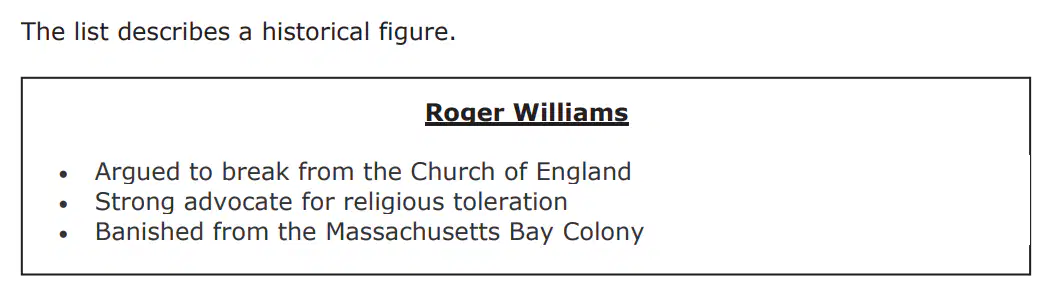
Which phrase could be added to this list?
Converted beliefs of many American Indians
Founded a colony for Quaker settlers
Established the colony of Rhode Island
Escaped from captivity in Plymouth
Which action resulted in New Netherland being renamed New York?
The Dutch left the area in exchange for the release of captives held by American Indians.
The Dutch renamed the area after the Duke of York bought the land in exchange for gold.
The English landed with many troops and offered the Dutch fair treatment if they would surrender.
The American Indians ended all trade with the Dutch merchants and forced them to leave the area.

How did the adoption of this document influence the development of colonial self-government?
It enabled colonists to establish trade treaties with other nations.
It allowed colonists to create their own laws for the area.
It allowed colonists to practice freedom of religion.
It enabled colonists to protect their land from native peoples.
Georgia was considered a "buffer" colony because it acted as a military barrier between South Carolina and Spanish controlled __________________.
North Carolina
New York
Mississippi
Florida
Which colony was created by James Oglethorpe as a way to give debtors a fresh start?
Virginia
Georgia
Pennsylvania
Florida
Why was Georgia referred to as a "debtor colony"?
It was founded as a place where people who were poor or in debt could make a fresh start in life.
It was founded as a prison colony for people who were too deeply in debt to ever pay their bills.
It was so successful that its founder was able to pay off a debt he owed the king.
It was so poorly run that its founder was soon hopelessly in debt to the king.
When Georgia was founded in 1732, settlers in the British colonies to the north hoped that it would serve as a "buffer colony" to protect them from...
slaves escaping from Haiti and Barbados
criminals from Jamaica and the Bahamas
the French in Louisiana & the Spanish in Florida
the Shawnee to the west and the Creek to the south.
Which of the following people is known for settling the colony of Georgia?
James Oglethorpe
Peter Stuyvesant
William Penn
Roger Williams
In the early 17th century, the Dutch started the colony of New Netherland in the area now known as New York. What was the major goal of the Dutch who settled in this colony?
to convert Native Americans to Christianity
to escape political persecution
to have religious freedom
to earn a profit from trading and farming
Which individual established the colony of Georgia as a place for debtors to receive a fresh start? (8.07)
William Penn
James Oglethorpe
John Winthrop
William Bradford
In addition to being a debtor’s colony, Georgia also served as a “buffer” between the English colonies and ___________ territory. (8.07)
Dutch
French
Portuguese
Spanish
Georgia was considered a "buffer" colony because it acted as a military barrier between South Carolina and Spanish-controlled __________.
North Carolina
New York
Mississippi
Florida

The list below describes one of the English colonies in America
Which phrase describes another purpose of the colony described by the information on the list?
to offer land to indentured servants
as a barrier from Spanish expansion
as a financial investment for the English king
to protect colonists against American Indian conflicts
Which statement is best described by the phrases in the box below?
1. religious intolerance
2. high rents on land
3. scarcity of resources
reasons English settlers came to colonies in America
reasons the colonists in America created a national religion
reasons the Puritans returned to England
reasons Spanish colonies in America were abandoned
Which country respected Native American customs and had a successful fur trading business with Native Americans?
England
France
Germany
Switzerland
Which colonial region had the best farmland?
New England colonies
Middle colonies
Southern colonies
Western colonies
How did colonists in the New England colonies make money?
indigo
iron
tobacco
ship-building
Which of these is consider a "cash crop"?
tobacco
corn
apples
tomatoes
Which of these best describes farming in New England?
Only enough crops were grown to support the family
Crops were sold in large quantities.
Crops like tobacco were common.
Cash crops were common.
Plantation owners controlled the economy and politics in the ____________.
Southern colonies
Middle colonies
New England colonies
Western colonies
Which colonial region was the most diverse?
Southern colonies
New England colonies
Middle colonies
None of these
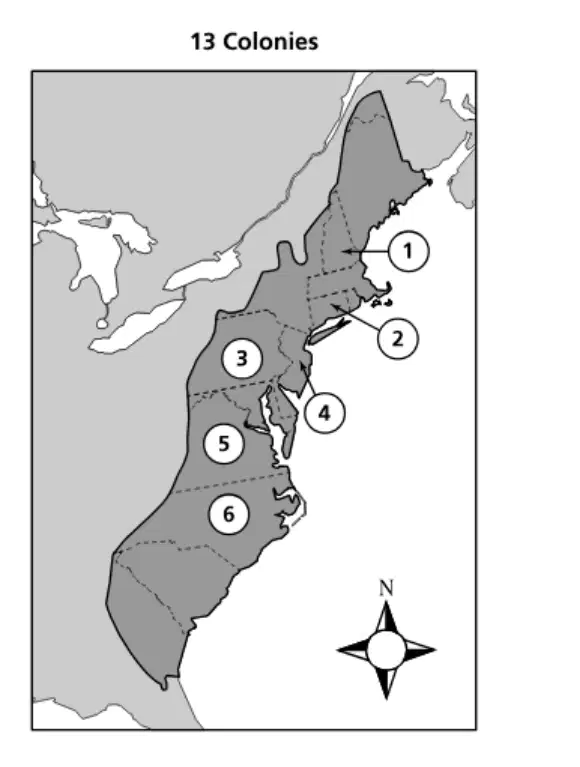
The map displays a region of North America.
Which numbers on the map identify Connecticut and Virginia?
1 & 6
2 & 5
3 & 4
1 & 3
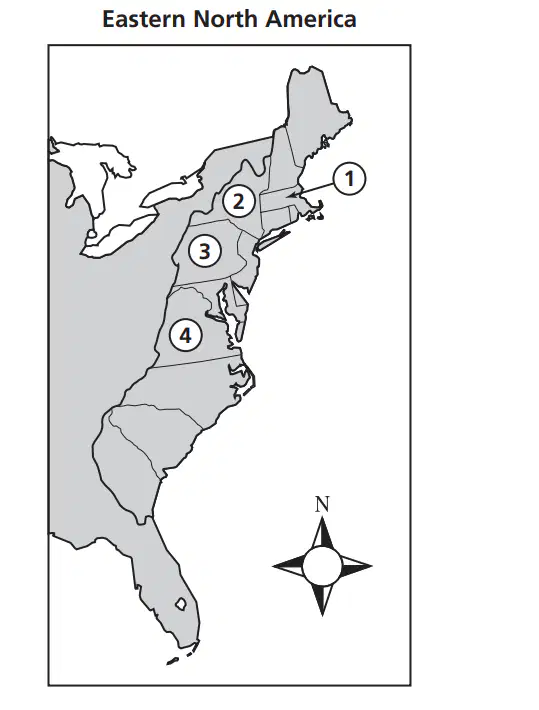
Look at the map and answer the question.
Which number on this map shows the location of colonial New York?
1
2
3
4
Which of these best describes farming in New England?
Only enough crops were grown to support the family
Crops were sold in large quantities.
Crops like tobacco were common.
Cash crops were common.

The number 12 labels which colony?
Georgia
North Carolina
Virginia
Maryland

What number represents the colony of Massachusetts?
2
6
9
3

Delaware is labeled with which number?
7
2
13
12

Which colony does the number 6 represent?
Connecticut
Massachusetts
Rhode Island
Delaware

Which colonial region's society is best described by the phrases in the box?
Southern
New England
Northwestern
Middle Atlantic
The different environments of colonial North America contributed to a wide variety of...
self-government
settlement patterns
educational institutions
religious conversions

On the map used here, Georgia is labeled with the number...
4
2
11
5

Which colonial region is best described by the phrases in the box?
Pacific
Middle Atlantic
Southern
New England
Which of these best describes the climate in the Southern colonies?
Cold and harsh winters
Mild and rainy
Hot and humid
Dry and arid

This colony was created as a place for debtors to make a fresh start.
Maryland
Virginia
Carolina
Georgia
Vocab Review- Which definition below correctly describes a buffer colony?
The location of the first settlement on Yamacraw Bluff
A fort built to protect Jamestown from the French
The location/purpose of the Battle of Bloody March
Protect the English colonies from the Spanish in Florida

Which colony is labeled with the number 8?
Massachusetts
Vermont
Rhode Island
New Hampshire

The environmental conditions listed in the box best describe which colonial region?
New England
Middle Atlantic
Canadian
Southern
The list below describes one of the English colonies in America
Which phrase describes another purpose of the colony described by the information on the list?
to offer land to indentured servants
as a barrier from Spanish expansion
as a financial investment for the English king
to protect colonists against American Indian conflicts
The image below from 1876 shows the Pilgrims landing at Plymouth, Massachusetts, on December 22, 1620.
Based on this image and your knowledge of the Pilgrims, which statement contrasts the lifestyle of these colonists to those of other early settlers?
The Pilgrims once had a more peaceful interaction with American Indians.
The Pilgrims soon formed diverse Protestant congregations.
The Pilgrims were soon hampered by a lack of leadership.
The Pilgrims were prepared to farm the fertile soil.
The excerpts below are from the Charter of the Massachusetts Bay Colony, 1629, and the New England Articles of Confederation, 1643.
Which idea in these documents was most responsible for future problems?
the granting to colonists the rights and privileges of British citizens
the focus on plans for the New England colonies to work together for defense
the ruling that local governments will have the power to execute and oversee local laws
the requirement that settlements remain under the jurisdiction of the colonies where they originated
Which country respected Native American customs and had a successful fur trading business with Native Americans?
England
France
Germany
Switzerland
Which colonial region had the best farmland?
New England colonies
Middle colonies
Southern colonies
Western colonies
How did colonists in the New England colonies make money?
indigo
iron
tobacco
ship-building
"You are called here as one of those that have troubled the peace of the commonwealth and the churches here; you are known to be a woman that hath had a great share in the promoting and divulging of those opinions that are causes of this trouble..." --John Winthrop
Which dissenter is Winthrop addressing in the primary source above?
Pocahontas
Anne Hutchinson
Roger Williams
Thomas Hooker
Which of these best describes farming in New England?
Only enough crops were grown to support the family
Crops were sold in large quantities.
Crops like tobacco were common.
Cash crops were common.
Which colonial region relied on plantation agriculture? (8.08)
New England colonies
Middle colonies
Southern colonies
Western colonies
Geographically, where were the English colonies located? (8.09)
The modern Southwestern United States
The Atlantic Coast
West of the Appalachian Mountains
Near the Mississippi River
Which of the following was a goal of the French colonies? (8.09)
A thriving fur trade business
Spreading Puritan ideals among Native Americans
Taking land away from Native Americans
The development of tobacco plantations
The different environments of colonial North America contributed to a wide variety of...
settlement patterns
educational institutions
self-government
religious conversions
Which country respected Native American customs and had a successful fur trading business with Native Americans?
England
France
Germany
Switzerland
Which colonial region had the best farmland?
New England colonies
Middle colonies
Southern colonies
Western colonies
How did colonists in the New England colonies make money?
indigo
iron
tobacco
ship-building
Which of these is consider a "cash crop"?
tobacco
corn
apples
tomatoes
Which of these best describes farming in New England?
Only enough crops were grown to support the family
Crops were sold in large quantities.
Crops like tobacco were common.
Cash crops were common.
Plantation owners controlled the economy and politics in the ____________.
Southern colonies
Middle colonies
New England colonies
Western colonies
Which of these best describes the "Old Lights?"
traditional worship
emotional worship
in favor of revivals
none of these
Which colonial region was the most diverse?
Southern colonies
New England colonies
Middle colonies
None of these
________________ was the trip from West Africa to the Americans. On this trip, slaves experiences horrible living conditions.
The Middle Passage
First Great Awakening
The Enlightenment
Triangular Trade
The number 12 labels which colony?
Georgia
North Carolina
Virginia
Maryland
What number represents the colony of Massachusetts?
2
6
9
3
Which colony does the number 6 represent?
Connecticut
Massachusetts
Rhode Island
Delaware
Which colony is labeled with the number 8?
Massachusetts
Vermont
Rhode Island
New Hampshire

Which number labels North Carolina?
11
7
12
13
Which colonial region's society is best described by the phrases in the box?
Southern
New England
Northwestern
Middle Atlantic
The environmental conditions listed in the box best describe which colonial region?
New England
Middle Atlantic
Canadian
Southern
Which of the following statements best explains the religions practiced by the settlers of New France & New England?
Settlers of New France were Catholic, while people in New England were Huguenots.
Settlers in New France were Catholic, while settlers in New England were Puritan.
Settlers of New France were not religious, while colonists in New England were Anglican.
Settlers of New France were pilgrims who wanted religious freedom, while colonists in New England were Puritans.
How did the First Great Awakening influence the movement for independence in the colonies?
The push for economic freedom led colonists to also want religious freedom.
The push for economic freedom led colonists to also want political freedom.
The push for religious freedom led colonists to also want political freedom.
The push for political freedom led colonists to also want economic freedom.
New France and the English colonies engaged in different economic activities based on available resources. While the English grew cash crops such as tobacco, New France profited greatly from
beaver pelts
tea leaves
deer hides
precious metals
What type of work did slaves usually do in the American colonies?
worked in mines
worked in factories
worked on ships
worked on plantations
It is now thought that at least 20 percent of the enslaved Africans transported by way of the Middle Passage died during the voyage. What conclusion can be drawn from this?
There was no way to keep all the enslaved Africans fed on such a long voyage.
The enslaved Africans were badly mistreated by the slavers during the voyage.
There was no way to prevent illness among the enslaved Africans on such a long voyage.
The enslaved Africans refused to care for themselves during the voyage.
In colonial America, slaves replaced which type of worker?
paid servants
hourly workers
sharecroppers
child workers
"In 1739, a slave revolt that began at the Stono River near Charles Town, South Carolina, led to the deaths of at least 20 white people and the burning of seven plantations. The Stono Rebellion eventually involved about 100 slaves who had planned to march to Spanish Florida, where they believed they would be free. The South Carolina militia put down the revolt, and nearly all of the participants either died in the fighting or were captured and executed."
How did slave owners respond to slave revolts such as the Stono Rebellion?
They asked Parliament to send troops to protect them from slave uprisings.
They passed laws that restricted where slaves could travel and whom they could meet.
They asked Parliament to send troops to protect the importation of slaves.
They passed laws that restricted who could buy slaves and how many they could buy.
Many enslaved Africans were transported across the Atlantic Ocean to the Americas in slave ships. Which statement best describes the conditions faced by the enslaved Africans during the Middle Passage?
The slave ships were overcrowded and the Africans were not treated like human beings.
The slave ships were designed to be efficient and the enslaved Africans were treated fairly well.
The slave ships were large enough and tried to get the enslaved Africans to the Americas quickly.
The slave ships were poorly built and the enslaved Africans were not allowed outside during the voyage.
Both Spain and England tried to colonize parts of North America that later became the United States, and both unsuccessfully tried to find gold there. What is one reason that the English stayed after the Spanish left?
They established a thriving fur trade with American Indians.
They signed a mutual defense agreement with the French.
They found other precious metals, such as silver.
They discovered profitable crops, such as tobacco.
Which of the following best describes how most Africans came to the American colonies?
They were brought as slaves against their will.
They chose to serve in the colonial army.
They came as workers like most other immigrants.
They chose to come as servants paid servants.
Ways Enslaved Africans Passively Resisted Slavery
worked slowly
damaged equipment
?
Which of the following most likely completes the list?
refused to obey instructions
pretended to misunderstand instructions and/or faked illness
pretended to be freed slaves
refused to get out of bed in the morning
Great Britain had many colonies in North America. What was the purpose of these colonies according to the ideas of mercantilism?
to produce raw materials for Great Britain
to trade with countries other than Great Britain
to increase wealth for colonial merchants
to create manufactured products
Which of the following most likely completes the list?
Ways Enslaved Africans Passively Resisted Slavery
1. worked slowly
2. damaged equipment
3. ????
pretended to misunderstand instructions
refused to obey instructions
refused to get out of bed in the morning
pretended to be freed slaves
It is now thought that at least 20 percent of the enslaved Africans transported by way of the Middle Passage died during the voyage. What conclusion can be drawn from this?
The enslaved Africans were badly mistreated by the slavers during the voyage.
There was no way to prevent illness among the enslaved Africans on such a long voyage.
There was no way to keep all the enslaved Africans fed on such a long voyage.
The enslaved Africans refused to care for themselves during the voyage.

According to the map, which statement about slavery is true?
Slaves were brought to Europe in large numbers.
Slaves were brought to the British colonies and then taken to South America.
Slaves were brought to America and then taken back to Africa.
Slaves were brought to many different places in the Western Hemisphere.
Millions of Africans were transported to the Americas via the Middle Passage because...
Africans wanted to trade them for sugar, tobacco, and cotton.
many colonists did not want to pay for labor.
Africa was overpopulated and needed some to leave.
many colonists wanted to free them from slavery.
What type of work did slaves usually do in the American colonies?
factory work
mines
ships
plantations
Why were slaves forced to perform labor in the American colonies?
Plantation owners did not want to pay for their labor.
People would not work for the low wages paid by the plantations.
Paid servants could not stand the hot climate of the plantations.
There were not enough skilled workers to do the jobs on the plantations.
What was the primary cash crop that slaves were forced to cultivate in the American colonies?
Cotton
Tobacco
Sugar
Rice
What was the impact of the slave trade on African societies?
It led to the development of advanced societies.
It led to the depopulation and destabilization of African societies.
It had no significant impact.
It led to the spread of Christianity.
What was the primary cash crop that slaves were forced to cultivate in the British colonies?
Cotton
Tobacco
Sugar
Rice
Which of the following most likely completes the list?
Methods Used by Slave Owners to Control Slaves
1. Physical punishment
2. Restriction of movement
3. ????
Providing education
Allowing slaves to earn money
Instilling fear through threats
Encouraging slaves to form families
What was the primary reason for the establishment of the 'slave codes' in the American colonies?
To provide slaves with basic rights.
To regulate the behavior of slaves and provide a legal framework for their treatment.
To encourage the importation of more slaves.
To discourage the practice of slavery.
Which of these best describes the "Old Lights?"
traditional worship
emotional worship
in favor of revivals
none of these
Which of the following best describes a "dissenter?"
one who disagrees with church officials
one who protests the sale of tobacco
one who leave the Society of Friends
one who agrees with church officials
How did the First Great Awakening influence the movement for independence in the colonies?
The push for economic freedom led colonists to also want religious freedom.
The push for economic freedom led colonists to also want political freedom.
The push for religious freedom led colonists to also want political freedom.
The push for political freedom led colonists to also want economic freedom.
The First Great Awakening can best be described as a period of increased...
religious excitement.
support for ending slavery
intellectual thought.
influence of classical ideas
Who wrote sinners in the hands of an Angry God
John Machon
Jonathan Edwards
Will Friday
Steve Petit

How did the Great Awakening change America?
It brought people from all over the colonies together for the first time
It led to people denying God and leading secular lives
It spread abolitionism throughout the land and led to the end of slavery
It brought French rule to America
Ministers of The Great Awakening preached ___________
God was angry
people were not equal
colonists should not be independent
colonists could be saved
Which of these best describes the "New Lights"?
emotional worship
boring worship
quiet worship
the new lights did not believe in worship at all
Which of these would be a result of the First Great Awakening?
More religious tolerance
Less religious tolerance
More scientific thought
Less colonial unity
The ________________ was a movement centered around scientific thinking.
First Great Awakening
Enlightenment
Mayflower Compact
Predestination
Which traveling minister used emotional styles of preaching during the First Great Awakening?
George Whitefield
William Penn
Ben Franklin
Nathaniel Bacon
The First Great Awakening was a movement that involved a greater emphasis on ____________.
science
religion
slavery
violence
Which minister was famous for preaching the first sermon of the First Great Awakening? He was also famous for his sermon, "Sinners in the Hands of an Angry God."
William Berkeley
Jonathan Edwards
William Penn
Nathanial Bacon
Which of the following were leaders of the First Great Awakening?
George Whitefield
John Wesley
Jonathan Edwards
all of these
Which movement was started by the Wesley Brothers and George Whitefield?
Baptist
Enlightenment
Methodist
Presbyterian
Read the source and answer the question.
Amendment I (1) Congress shall make no law respecting an establishment of religion, or prohibiting the free exercise thereof; (2) or abridging [limiting] the freedom of speech, (3) or of the press; or the right of the people peaceably to assemble, and (4) to petition the Government for redress [correction] of grievances.
Which section of the 1st Amendment did the leaders of the First Great Awakening most influence?
1
2
3
4