
 Worksheets
AS Physics Mega Quiz
Total questions: 500
Worksheet time: 125hrs 0mins
The equation below is dimensionally correct. P and v represent pressure and velocity respectively. the unit of a is similar to that of?
P + av2 = bMass
Volume
Density
Force
2. What do scalar and vector have in common?
Scalar and vector both have magnitude and direction
Scalar and vector both have direction
Scalar and vector both have magnitude
Scalar and vector are not physical quantity
3. The rate at which velocity changes with time
Speed
Velocity
Acceleration
Free fall
4. How fast an object is moving and in which direction is the definition of
Speed
Acceleration
Velocity
Free Fall
5.Which of the following is a vector
length
volume
velocity
work
6.An example of scalar quantity is
Displacement
Speed
Velocity
Torque
Dimensions for acceleration due to gravity is
MLT−1
LT−1
LT−2
MLT−2
Dimension below refer to which quantity?
LT−1acceleration
velocity
momentum
energy
11.Which one of the following is NOT regarded as a basic quantity in Physics?
Length
Mass
Time
Weight
The dimension of force is
MLT−1
MLT−2
ML−1T
ML−1T2
Suppose A = BC, where A has the dimension L/M and C has the dimension L/T. Then B has the dimension:
T/M
L2/TM
L2TM
ML2T
Select the list which contains only SI basic units
liter, meter, second, watt
joule, kelvin, kilogram, watt
kilogram, kelvin, meter, second
joule, newton, second, watt
All of the following are base units of the SI system except:
kilogram
kelvin
meter
volt
The base SI unit of time is
Hour
Minute
Second
Millisecond
How many basic units does the SI system have?
Four
Five
Seven
Ten
Which of the following is a derived quantity:
Force
Mass
Length
Time
If vector A is acting along y-axis, its y-component is:
A
A cos θ
A sin θ
Zero
A force of 10 N is acting along x-axis, its component along y-axis is
10 N
5 N
8.66 N
Zero
The base SI unit of mass is the
Microgram
Miligram
Kilogram
Gram
10mm is equal to
1cm
1m
1dm
10cm
direction

Resolve the vector into its vertical component (y-component)
-20 m
(-20 cos 70) m
(20 cos 70) m
(-20 sin 70) m

Resolve the vector into its horizontal component (x-component)
20 m
0 m
(20 cos 70) m
(20 sin 70) m

Resolve the vector into its horizontal component (x-component)
8 N s
-8 N s
0 N s
-8 N

Resolve the vector into its horizontal component (x-component)
0 N
20 N
-20 N
10 N


If a boomerang is thrown 20 m in a straight line and returns exactly to the spot it was thrown what is its displacement?
20
0
40
-20
What equation is used to find the direction of vector?
Rx2 +Ry2
tan θ = RyRx
tan θ =RxRy
sin θ = Ry Rx

Resolve the vector into its x-component
14cos(30)
14sin(30)
-14cos(30)
-14sin(30)

Resolve the vector into its y-component
14cos(30)
14sin(30)
-14cos(30)
-14sin(30)

What is the direction of the resultant force?
Above negative x-axis
Below negative x-axis
Above positive x-axis
Below negative x-axis

State the direction of the vector shown
Above positive x-axis
Below positive x- axis
Above negative x-axis
Below negative x-axis

State the direction of the vector shown
Above positive x-axis
Below positive x-axis
Above negative x-axis
Below negative x-axis
1. Dimension can be defined as
a physical quantity
a technique or method which the physical quantity can be expressed in terms of combination of basic quantities
algebraic quantities through the procedure of dimensional analysis
a combination of basic quantities
The uses of dimensional analysis are as below, EXCEPT
to determine the unit of the physical quantity.
to determine whether a physical equation is dimensionally correct or not by using the principle of homogeneity
to derive/construct a physical equation.
to resolve vector
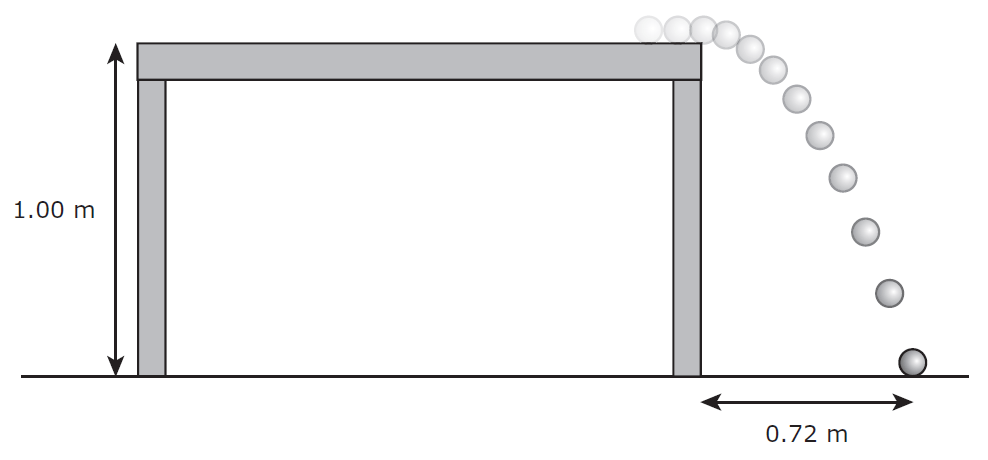
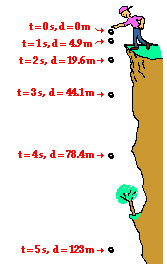

A car is traveling at a velocity of 35.0 miles per hour. The car runs off a cliff that has an unknown height. The car 'lands' 50.0 meters from the base of the cliff.
How long would it take the car to 'land' after exiting the rim of the cliff?
Vy=9.72 m/s
Vy=20.8 m/s
Vy=19.72 m/s
Vy=9.72 m/s
Which topic(s) should we prioritize reviewing together?
Finding variables from a problem
Selecting kinematic equations
Algebra. Just the algebra.
Graphs
Vectors & Triangles
Match each term with its formal physics definition
Displacement
The position of an object relative to its starting location
Velocity
The rate of change of displacement
Acceleration
The rate of change of velocity
Vector
A quantity with a magnitude and a direction
Scalar
A quantity with magnitude, but no direction
At the top of a projectile's path, its vertical velocity is:
Positive
Zero
Negative
A cat starts running across the room. She starts from rest, and reaches her top speed of 12 m/s in 0.4 seconds. What is the cat's acceleration? [include units; write seconds squared as s2]
(a)
An object starts its motion at rest. This means that its initial velocity is:
(a)
Usain Bolt's world record is 100m in 9.69 seconds, set at the Beijing Olympics. What was his average velocity while running this race? [Round to two decimal places, include units]
(a)
A car pulls onto the highway. It accelerates at 2 m/s2, merges over a distance of 100 m, and ends with a velocity of 28 m/s. What was its initial velocity? (Round to two decimal places and use correct units.)
(a)
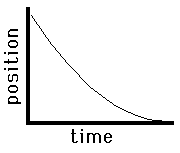
On the d vs t graph below, circle areas of positive acceleration in green, zero acceleration in yellow, and negative acceleration in red

Suppose I want to determine my cat's acceleration. What experiment could I run to find this out? Describe (briefly) what I would do, what data I should collect, and how I could use that data to calculate her acceleration.
Attach a sketch if desired.
A projectile is launched with an initial velocity of 10 m/s at an angle of 40 degrees above the horizontal. What is its initial y-velocity? (Round to two decimal places, include units)
(a)
A projectile is launched with an initial vertical velocity (y-component) of 6 m/s. How long will it take to hit the ground? (Use g=9.81 m/s2, round your answer to 2 decimals, and include units)
(a)
A projectile is launched with an initial horizontal velocity of 4 m/s. It hits the ground 3 seconds later. What is its range?
(a)
A projectile is launched with an initial velocity of 12 m/s at an angle of 60 degrees above the horizontal. How far away does it land?
(Hint: resolve your vector into its components, find the time in the air, then find the range).
Round your answer to two decimals, and include units!
(a)
A ball is thrown straight into the air with an initial upward velocity of 19.62 m/s. Gravity applies an acceleration of -9.81 m/s2 to the ball. 4 seconds later, it hits the ground. Sketch the velocity versus time graph describing the object's motion over those 4 seconds below. [Reminder: this is velocity versus time, not displacement versus time.]

A boat needs to travel 100 m East to cross a river. The boat moves at 6 m/s due East, and the river flows at 1.5 m/s due South. How far downstream does the boat end up? [To the nearest meter] [Hint: find the time first!]
(a)
A boat needs to travel 100 meters East to cross a river. The river flows South at 4.5 m/s. The boat moves at 6 m/s, and angles upstream to counter the river, so that the resultant velocity is purely East.
How long does it take the boat to cross the river?
[Hint: draw a triangle!]
[Round to two decimal places, and include units]
(a)
A driver takes a trip from Binghamton to New York City. While leaving the city, he drives at 15 m/s. While on the highway, he drives at 30 m/s. While arriving in NYC, he drives at 12 m/s. He arrives 222,000 m (138 miles) away after 12,000 seconds (3 hours 20 minutes).
What was the driver's average velocity? [To one decimal place, include units]
(a)
Invent a 1-D kinematics question, and write it below. Start by picking three values to be your knowns, and one to be your unknown, then make a physical description of what's happening.




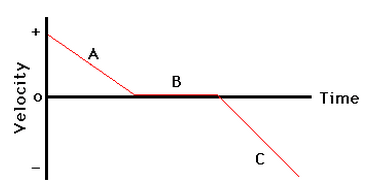
What is happening between 4 and 5 seconds?
The object is slowing down in a negative direction.
The object is slowing down in a positive direction.
The object is speeding up in a positive direction.
The object is speeding up in a negative direction.

Find the displacement in the first 5 seconds.
8 centimeters
4 centimeters
2 centimeters
5 centimeters

Find the total displacement in the 7 seconds of motion.
1 centimeter
0 centimeters
9 centimeters
12 centimeters


A person walking along a straight line moves such that her velocity as a function of time can be represented by the graph above. At what time does the person have the same position as she had at time t = 0?
At t = 5 s
During the interval 5 s < t < 8 s
At t = 8 s
During the interval t > 8 s


If the sum of all the forces acting on a moving object is zero, the object will _____.
slow and stop
immediately stop
accelerate uniformly
continue with a constant velocity
Acceleration is _____.
inversely proportional to mass
inversely proportional to force
directly proportional to mass
directly proportional to momentum
How does a rocket fly?
The rocket pushes against the air.
Gas expelled from the rocket pushes the rocket.
both a and b
magic
An object can enact a force on itself.
True
False
Three arrows with different masses are flying through the air without air resistance. How does the horizontal force acting on each arrow compare to one another?
The largest arrow has the greatest force.
The force depends on the speed of the arrows.
The arrows experience the same force.
Cannot be determined
Which object has the most inertia?
A 5kg tennis ball traveling at 10m/s.
A 30kg book resting on a desk.
A 0.2kg leaf falling from a tree.
A 20kg brick thrown at 15m/s.

A block of weight W is pulled along a horizontal surface at constant speed v by a force F, which acts at an angle Θ with the horizontal, as shown. The normal force exerted on the block by the surface has magnitude_____.
greater than W
greater than 0 but less than W
equal to W
0
Taylor wants to test the effect of friction. She places a block on a plank and raises one end so that the plank is inclined. What is the maximum angle that incline can have before the block begins to accelerate if the coefficient of friction is 0.7?
46°
10°
35°
44°
An object falling through the air at terminal speed experiences ______.
a net force of 0
equilibrium
no acceleration
all of the above
How many categories of forces are there?
1
2
5
7

Rank the tensions experienced by the strings.
TA > TB > TC
TB > TA = TC
TB > TC > TA
Cannot be determined
An object sliding across a surface will experience ______ friction.
static
potential
kinetic
no
Terry enacts an applied force on a wall. The wall will enact a(n) ______ force on Terry.
tension
normal
electromagnetic
applied
Luis is an antique collector and bought a grandfather clock at a great deal! At the top of every hour, the pendulum of the clock begins swinging to the right in order to ring its bell. What is the acceleration of the bob (20kg) when the pendulum is at an angle of 30° with the vertical? Assume the bar is massless.
ax = 5.78m/s2
ax = 3.24m/s2
ax = 7.78m/s2
ax = 4.67m/s2
Luis is an antique collector and bought a grandfather clock at a great deal! At the top of every hour, the pendulum of the clock begins swinging to the right in order to ring its bell. What is the tension in the bar when the pendulum is at an angle of 30° with the vertical and if the bob has a mass of 20kg ? Assume the bar is massless.
FT = 185N
FT = 0N
FT = 231N
FT = 328N

Refer to the picture to answer the following question. If M = 1kg, what is the acceleration of the masses? Assume the surface is frictionless.
a = 4.67m/s2
a = 6.67m/s2
a = 2.67m/s2
a = 1.33m/s2
Refer to the picture to answer the following question. If M = 1kg, what is the tension in the rope? Assume the surface is frictionless.
FT = 20.0N
FT = 0.67N
FT = 10.7N
FT = 13.3N

As the angle of the incline increases, what happens to the normal force?
The normal force increases
The normal force decreases
The normal force is not affected by the incline
The normal force is only dependent on the force due to gravity

Given the FBD, which of the following must be true?
The frictional force must be accelerating the system to the left.
The box must be accelerating to the right.
The box must be moving to the right.
The FBD is incorrectly drawn. This situation isn't possible


Camille launches has a catapult that changes the velocity of a ball (m= 2 kg) from 0 to 10 m/s in one sec. What is the average force that is exerted on the ball during launch?
20 N
5 N
8 N
0.2 N

Which of the following statements is true about the image above?
The accelerations of the blocks will vary according to their mass
The net force acting on each block is the same
The blocks will experience the same acceleration
The 3m box will eat the 2m and the m boxes

Which of the following is not true about the system?
T3 is equal to the scalar sum of the magnitudes of T2 and T1
T3 is equal in magnitude to Fg
The x- components of the T1 and T2 and equivalent but in opposite directions
The system is in equilibrium.

Sam is hover boarding down they hall at a constant velocity. Assuming there is friction, which of the following must be true?
The force applied by the board must be greater than the frictional force
The frictional force must equal the force applied by the board
The force applied must equal zero
There is not enough information

If μk = 0.65 and μs = 0.7, acceleration would be equal to
0 m/s/s
9.8 m/s/s
3.35 m/s/s
-2.63 m/s/s

If there is no friction, then the acceleration would be equal to
mg
sin(θ)mg
g
sin(θ)g

A man standing on a scale in an elevator notices that the scale reads 40 newtons greater than his normal weight. Which type of movement of the elevator could cause this greater-than-normal reading?
accelerating upward
accelerating downward
moving upward at a constant speed
moving downward at a constant speed
A man weighing 800 Newtons is standing in an elevator. If the elevator rises with an acceleration of 0.5 meters per second2, the force exerted by the elevator on the man will be
400 N
800 N
1200 N
1000 N
A car travels up a hill at constant speed. Which of the following diagrams best represents the forces acting on the car at this instant?


Three forces of equal magnitude act on the box shown. One force is upward, one downward, and one rightward. Which of the following statements must be true based on this information? Select two answers.
The box must have a rightward component of velocity.
The box has no vertical component of velocity.
The acceleration of the box is directed to the right.
The velocity of the box is changing with time.

A net force of 36 N acts on a mass of 9 kg. The resulting acceleration is _____.
6 m/s2
9 m/s2
4 m/s2
0 m/s2
A mass of 15 kg is acted on by two forces, one of which is 15 N due east while the second one is 10 N due north. The acceleration of the mass is
1.67 m/s2, 56.3o north of east.
1.2 m/s2, 33.7 o north of east.
1.67 m/s2, 56.3o north of east.
1.67 m/s2, 33.7 o north of east.
A force accelerates an object of mass M. The same force applied to a second body produces half the acceleration. What is the mass of the second body?
2 M
0.5 M
3 M
4 M
Is it possible for the normal force to be equal to the gravitational force?
Yes. If the surface is horizontal and Fg is perpendicular to the surface.
Yes. If the surface is vertical and Fg is parallel to the surface.
No. FN will always be less than Fg
No. Fg will be less than FN.
Is it possible for the normal force to be zero?
Yes. If the surface is horizontal.
Yes. If the surface is vertical
No. FN will always be less than Fg
No. Fg will be less than FN.

An object of mass 10 kg is released from rest above the surface of a planet such that the object’s speed as a function of time is shown by the graph above. The force due to gravity exerted on the object is most nearly
3.5 N
7 N
35 N
70 N

Two bricks are stacked on a floor. A student draws the force diagram for brick 2, as shown above. The forces are an upward normal force, a downward force exerted by brick 1, and a downward gravitational force. How many of the forces, if any, in the force diagram are contact forces caused by microscopic interactions?
Zero
Only one
Only two
All three
A cart with an unknown mass is at rest on one side of a track. A student must find the mass of the cart by using Newton’s second law. The student attaches a force probe to the cart and pulls it while keeping the force constant. A motion detector rests on the opposite end of the track to record the acceleration of the cart as it is pulled. The student uses the measured force and acceleration values and determines that the cart’s mass is 0.4 kg. When placed on a balance, the cart’s mass is found to be 0.5 kg. Which of the following could explain the difference in mass?
The track was not level and was tilted slightly downward.
The student did not pull the cart with a force parallel to the track.
The wheels contain bearings that were rough and caused a significant amount of friction.
The motion sensor setting was incorrect. The student set it up so that motion away from the sensor would be the negative direction.
A tennis ball is thrown against a vertical concrete wall that is fixed to the ground. The ball bounces off the wall. How does the force exerted by the ball on the wall compare with the force exerted by the wall on the ball?
The force exerted by the ball is greater.
The forces exerted by the ball and the wall have the same magnitude.
The force exerted by the ball is smaller.
The relative magnitudes of the forces cannot be determined without knowing how long the ball and the wall are in contact.

The diagram above represents the forces exerted on a box that a child is holding. FN represents the force applied by the child’s hand, and Fg represents the weight of the box. The child begins to raise the box with increasing speed. Which of the following claims is correct about force Fh that is exerted by the box on the child’s hand as the box is being raised?
Fh=FN, where FN does not change as the child raises the box.
Fh=FN, where FN is larger as the box is being raised than when it was being held.
Fh=Fg, where Fg does not change as the child raises the box.
Fh=Fg, where Fg is larger as the box is being raised than when it was being held.

Students work together during an experiment about Newton’s laws. The students use a setup that consists of a cart of known mass connected to one end of a string that is looped over a pulley of negligible friction, with its other end connected to a hanging mass. The cart is initially at rest on a horizontal surface and rolls without slipping when released. The inertia of the cart's wheels is negligible. Students have access to common laboratory equipment to make measurements of components of the system.
The students double the mass that hangs from the string. They also replace the original cart with a new cart that has double the mass. By doubling both masses, how will the tension in the string and the acceleration of the cart change?
The tension and the acceleration will double.
The tension will double, but the acceleration will stay the same.
The tension will stay the same, but the acceleration will double.
The tension and the acceleration will stay the same.
A student uses both hands to push a door such that it moves and swings open after the force has been applied. The student then makes the following claim: “I can use both of my hands to apply a constant force on my body so that my body falls backward.” Which of the following statements correctly justifies the student's claim?
The claim is correct because the situation is the same as if another person’s hands applied a force on the student.
The claim is correct because the student’s hands will exert a net force on the student’s body.
The claim is not correct because the student’s hands cannot exert a force on the student’s body.
The claim is not correct because the student’s body will exert a force of equal magnitude back on the student’s hands as a result of Newton’s third law of motion.

Blocks A and B, of masses m and 2m, respectively, are connected by a light string and pulled across a surface of negligible friction with a constant force F1, as shown above. The acceleration of the blocks is a. The force of the string pulling block B forward has magnitude F2. Which of the following claims correctly describes the relationship between the magnitude of the forces acting on the blocks?
F1 is equal to F2.
F1 is greater than F2.
F2 is equal to 3ma.
F2 is greater than 3ma.

The force diagram above shows a box accelerating to the right on a horizontal surface of negligible friction. The tension T is exerted at an angle of 30° above the horizontal. If μ is the coefficient of kinetic friction between the box and the surface, which of the following is a correct mathematical equation derived by applying Newton’s second law to the box?


A block is pulled along a surface of negligible friction by a spring scale that exerts a force F on the block. The mass of the block is 4kg, and the spring scale reads 10N. Which of the following free-body diagrams can be used to show the magnitude and direction of all the forces exerted on the block as it is pulled along the surface?


An Atwood’s machine is set up by suspending two blocks connected by a string of negligible mass over a pulley, as shown above. The blocks are initially held at rest and then released at time t0=0 s. The speed of the 3 kg block at time t1=2.0 s is most nearly
2 m/s/s
4 m/s/s
7 m/s/s
10 m/s/s

Two blocks, with masses indicated in the figure above, are at rest on a horizontal surface and connected by a string of negligible mass and a compressed spring. There is negligible friction between the blocks and the surface. The string is cut, and the spring pushes the blocks away from each other. Which of the following statements are true about the motion of the blocks immediately after the string is cut? Select two answers
The velocity of the center of mass of the two-block system is zero.
The velocity of the center of mass of the two-block system is directed toward the right.
The magnitude of the acceleration of the left block is equal to that of the right block.
The magnitude of the acceleration of the left block is greater than that of the right block.

The diagram above shows the forces exerted on an object. Which of the following dot diagrams best represents the position of the object at equal time intervals?


A 2kg object is initially at rest at time t=0s. It then slides across a rough, horizontal surface under the influence of only the four forces shown in the table above. What is the speed of the object at time t=3s?
12 m/s
14 m/s
24 m/s
36 m/s

Three blocks are connected by strings and pulled to the right by a force with magnitude F0, as shown in the figure above. All frictional forces are negligible. The tension in the right and left strings have magnitudes T1 and T2, respectively. Taking the positive direction to be toward the right, which of the following is a correct equation of motion for the block of mass m2?
T1 + T2 = m2a
T1 - T2 = m2a
T1 + F0 - T2 = m2a
T1 = m2a
What is the SI unit of force?
Kilogram
Second
Meter
Newton
What is the formula to calculate density?
Density = Mass / Volume
Density = Mass x Volume
Density = Mass + Volume
Density = Mass - Volume
What is the pressure exerted by a force of 100 N on an area of 5 m²?
20 N/m²
50 N/m²
200 N/m²
10 N/m²
What is the weight of an object with a mass of 10 kg?
10 N
98 N
50 N
100 N
What is the relationship between force, mass, and acceleration?
force = mass - acceleration
force = mass / acceleration
force = mass + acceleration
force = mass * acceleration
What is the density of an object with a mass of 50 kg and a volume of 10 m³?
0.5 kg/m³
5 kg/m³
50 kg/m³
500 kg/m³
What is the pressure at the bottom of a swimming pool that is 3 meters deep?
29400 Pa
32000 Pa
28000 Pa
30000 Pa
What is the density of an object that has a mass of 100 g and a volume of 50 cm³?
5 g/cm³
10 g/cm³
0.5 g/cm³
2 g/cm³
What is the pressure exerted by a force of 50 N on an area of 2 m²?
10 Pa
100 Pa
50 Pa
25 Pa

0.88 m
1.13 m
8.7 m
9.1 m

A
B
C
D

A
B
C
D

A
B
C
D

A
B
C
D

47000 N
190000 N
310000 N
620000

Buoyancy is the tendency for objects to float in a fluid. We consider buoyancy the...
Un-gravity force
The upward force
Gravitational pull
Downwards pull on an object
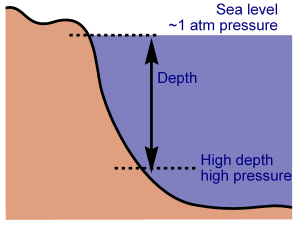
When you increase your depth under water, the water pressure on your body
increases
decreases
stays the same

What is the unit for pressure?
Nm2
Pascals
Joules
None of the
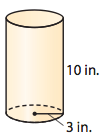


Why does the egg not sink or float?
it is more dense than the water
it is less dense than the water
it has the same density as the water
it is light
A cuboid made of iron has a width of 12 cm,a length of 10 cm,a mass of 0.5 kg,and a density of 7.9 g/cm3.What is its height?
0.53 cm
0.2 cm
0.3 cm
2 cm

A rock of irregular shape sinks to the bottom of water when placed in it. Which two of the following, when used together, could be used to determine its density?
Measure the mass of the rock on a scale
Measure the mass of the beaker of water on a scale
Place the rock in a beaker and measure the change in height of the water
Place the rock in a beaker and measure the height of the water above it
You fill a glass with ice and water until the the water level is exactly at the glass's rim. As the ice melts, the water level...
rises and water spills out of the glass
remains the same
drops at first and then rises until a little water spills out

A simple U-tube or manometer has a side filled with water and another with an unknown blue fluid. Which side has the larger absolute pressure at the bottom of its column?
left
right
equal
In the same system, which fluid has the greater density?
water
unknown fluid
both have the same density

Rank the fluids in order from most dense to least dense.
Fluid A, oil, water, mercury
oil, water, Fluid A, mercury
mercury, oil, water, Fluid A
mercury, Fluid A, water, oil

A hydraulic lift has a left and right column of different areas. Which side has the greater pressure?
A1
A2
Same
A hydraulic lift has a left and right column of different areas. Which side should a car be placed on to be lifted by the system with the least input force?
A1
A2
Same

A personal submarine is spherical and can reach depths of up to 1 mile below the surface of the water. Which statement is true?
The pressure is equal on all sides of the sphere
The pressure is slightly larger on the bottom of the sphere than the top
The pressure is slightly larger on the top of the sphere than the bottom
Two spheres have equal volume in the air. One is a balloon and the other is a solid wood sphere. When brought into the water, the balloon's radius is ________ the wood's radius.
less than
greater than
equal to
Now the same two spheres are made to be equal volume in the water. The moment you release them, which experiences the greater buoyant force?
wood
balloon
same buoyant force
Hot air is less dense than cold air. Could a hot air balloon be flown on Mars where there is no functional atmosphere?
yes, warm air always rises, especially in its weak gravitational field
yes, but the ballon woould have to be filled with helium instead of hot air
no, there is no cold air to displace so no buoyant force would excist

Students are competing to build the best cardboard boat. While they are in the water, the water level is marked on the side of the pool. If a third student jumps into the boat, the water level will ________.
rise
fall
stay the same

Now the students jump from the boat into the water. When this happens, the water level will ______ from its original height.
rise
fall
same

Finally, the students and boat are removed from the water. The water level will ______ from its original height.
rise
fall
same

Four blocks are suspended in water as shown. Which blocks experiences the greatest buoyant force?
A
B
C
D

Which string will have the largest tension?
A
B
C
D

Which block has the largest buoyant force when floating?
A
B
C
D

Which block has the smallest buoyant force?
A
B
C
D
Which block has the largest normal force?
A
B
C
D
Kinetic energy is energy that is (a)
stored
destroyed
created
moving
A 20 kg object is sitting on top of a table that is 1.3 m high. What type of energy does it have?
kinetic
potential
chemical
electrical

The diagram shows a ball swinging at the end of a string. At which point(s) would the ball have the greatest potential energy (PE)?
A and D
B and C
B
C
Which of the following have kinetic energy:
A - cookie,
B - Truck racing down the street,
C - Person on an afternoon run,
D - Rubber band stretched but not released.
B and C
A and D
A and B
C and D
When calculating potential energy, the mass should be in which units?
grams
kilograms
milligrams
pounds
The diagram shows a ball swinging at the end of a string. At which point(s) would the ball have the greatest kinetic energy (KE)?
A and D
B and C
B
C
The diagram shows a ball swinging at the end of a string. At which point(s) would KE and PE be basically equal?
A and D
B and C
B
C
A 20 kg object is sitting on top of a table that is 1 m high. How much energy does it have? (PE = m g h where g = 10 m/s^2)
200 J
200 N
200 watts
200 kg
A car accelertes from 0 to 10 m/s and gains 50,000 J of kinetic energy. How much work was done to the car?
50,000 Watts
5,000 watts
500,000 watts
50,000 J
The work energy theorem says that: Work =ΔKE
True
False
The measurement unit for potential energy is the...
Joule (J)
watt
kilogram
m/s
An object moving at 3 m/s has a mass of 4 kg. What kind of energy does it have?
kinetic
potential
electrical
chemical
An object moving at 3 m/s has a mass of 4 kg. How much energy does it have?
KE = 21mv2
18 watts
6 J
9 J
18 J
The measurement unit for kinetic energy is the...
Joule (J)
watt
kilogram
m/s
The measurement unit for work is the...
Joule (J)
watt
kilogram
m/s
The measurement unit for power is the...
Joule (J)
watt
kilogram
m/s
The measurement unit for mass is the...
Joule (J)
watt
kilogram
m/s
The measurement unit for velocity is the...
Joule (J)
watt
kilogram
m/s
An airplane is flying at 500 miles per hour at an altitude of 30,000 feet. What forms of energy does the airplane have?
Kinetic
Potential
Both
Neither
Assume that a microwave oven does 24,000 J of work in 24 seconds. What is the power of the microwave? P = tW
1000 J
1000 watts
1000 N
2000 watts
How much work is done using a 60 watt bulb for 10 seconds? W = Power x time
600 watts
600 J
600 N
6 J
A person weighing 500 N gets in an elevator. The elevator lifts the person 10 m in 10 seconds. How much work was done? How much power was used?
W = Fd P = tW
5000 J, 500 J
500 J, 5000 watts
5000 N, 500 watts
5000 J, 500 watts

What is the equation for work?
Ep= mgh
W = F x d
F = mg
F = ma

Bob (80 kg) uses 180 N of force to get him up the slope. The vertical distance is 2 m and the diagonal is 10 m. Calculate the work he does.
1600 J
160 J
3600 J
1800 J

A
B
C
D

A
B
C
D

A
B
C
D

A
B
C
D

A
B
C
D

A
B
C
D
During the Powerhouse lab, Jerome runs up the stairs, elevating his 102 kg body a vertical distance of 2.29 meters in a time of 1.32 seconds at a constant speed. Determine the power generated by Jerome.
1.73 x 10³ W
1.48 x 10³ W
1.91 x 10³ W
1.27 x 10³ W
The Taipei 101 in Taiwan is a 1667-foot tall, 101-story skyscraper. The skyscraper is the home of the world’s fastest elevator. The elevators transport visitors from the ground floor to the Observation Deck on the 89th floor at speeds up to 16.8 m/s. Determine the power delivered by the motor to lift the 10 passengers at this speed. The combined mass of the passengers and cabin is 1250 kg.
2.06 x 10⁵ W
6.19 x 10⁶ W
2.10 x 10⁴ W
3.45 x 10⁵ W
The area under a force vs. displacement graph tells you the
mass of the object
momentum of the object
work done on the object
impulse of the object
Which equations do you need to be able to derive?
Work done
GPE
KE
Efficiency
Tick all the parts that should be written if asked to define "work done"
Force
Displacement in direction of force
Time
Distance moved
Define power
Watt are you talking about
Work done per unit time
Total energy transferred
Work done x time

Mike and Ian move 50 m on a snow lift which uses 750 N of force to move them in 75 seconds. Calculate the power of the lift.
750 W
500 W
7500 W
2812500 W
Which phrase best defines the term energy?
Energy is the ability to do work.
Energy is the force and object can exert.
Energy is the amount of matter present in an object.
Energy is the amount of heat an object can give off.
Which phrase best defines the term energy?
Energy is the ability to do work.
Energy is the force and object can exert.
Energy is the amount of matter present in an object.
Energy is the amount of heat an object can give off.
Which is the best definition of the term kinetic energy?
Kinetic energy is the energy due to motion.
Kinetic energy is the work that an object does.
Kinetic energy is the energy due to temperature.
Kinetic energy is the energy stored in an object due to vertical position (height).
What factors does the kinetic energy of an object depend upon?
mass and volume
mass and height
force and distance
mass and speed
Which is the best definition of the term gravitational potential energy?
Potential energy is the energy due to motion.
Potential energy is the work that an object does.
Potential energy is the energy due to temperature.
Potential energy is the energy stored in an object due to vertical position (height).
What does the gravitational potential energy of an object depend upon?
The object mass and speed.
The object mass and force.
The object height and velocity.
The object mass and height above the ground.
An object is moving horizontally at a constant speed. Which one of the following statements is true of the object?
Its potential energy is constant.
Its potential energy is increasing.
Its potential energy is decreasing.
An object is moving uphill at a constant speed. Which one of the following statements is true of the object?
Its potential energy is constant.
Its potential energy is increasing.
Its potential energy is decreasing.
Drag and drop the terms that accurately complete this statement: Work is a (a) acting upon an object for a given (b) of the object. The amount of work done is equal to the change in (c) of the object.
An object possesses 55 J of total energy until a net work of -25 J of work is done to the object. How much energy will the object now possess?
25 J
30 J
40 J
55 J
The total mechanical energy possessed by a system is equal to ____.
potential energy
kinetic energy
potential + kinetic energy
sum of all types of energy
An object has 50 J of kinetic energy and 20 J of potential energy. What is the total energy possessed by the object?
20 J
30 J
50 J
70 J
Suppose that an object slows down while moving horizontally. In this situation, the object's kinetic energy would (a) , its potential energy would (b) , and its total mechanical energy would (c) .
drag and drop terms to complete the statement. Terms may be used more than once or not at all.

Consider the kinetic energy and potential energy of a car at various locations shown in the diagram. The total mechanical energy of the car at position B is ______ Joules.
1000
0
13000
12000
25000

Consider the motion of the car shown in the diagram. The kinetic energy (KE) and potential energy (PE) values are shown for various locations. In this example, ______.
kinetic energy is conserved
potential energy is conserved
total mechanical energy is conserved
None of the above are true
Power is defined as ______.
the rate at which the force applied to an object is increased
the rate at an object's velocity changes
the rate at which energy of a system is changed
the amount of work which is done upon object
A horizontal force of 80 Newton is applied to a 10-kg cart to move it horizontally a distance of 4 meters across a concrete floor at a constant speed of 2 m/s. The task requires 2 seconds. The power rating for the person applying the force is approximately ______ W.
160
1600
320
80
The standard metric unit of power is a ______.
Newton
Joule
Watt
Newton * meter
Newton * second
In a physical lab, a 60-kg student runs up a 10-meter tall flight of stairs in 15 seconds. The student's power rating is approximately ______ W.
6000
400
40
9000
Mac and Tosh run up the same hill. Mac has twice the mass as Tosh. Tosh climbs up the hill in one-half the time as Mac. In this situation, ______.
Mac and Tosh do the same amount of work, but Tosh has a greater power rating
Mac does more work than Tosh, but they have the same power rating
Mac and Tosh do the same amount of work, but Mac has a greater power rating
Mac does more work than Tosh, but Tosh has a greater power rating
Tosh does more work than Mac, but Mac has a greater power rating
Julie pulls a wagon 15.00 m horizontally with 325.0 N of force. The wagon handle makes an angle of 35.00o with the horizontal. How much work does Julie do on the wagon?
(give answer in FOUR significant figures)
(a)
A cylindrical rod of cross-sectional area A experienced pressure p due to a compressive force F. If the force applied is reduced to one-third what happens to pressure?
also reduced to one-third
tripled
remains the same
What relationship exists between applied force and strain?
direct
indirect
none at all

What is the correct label for A and B shown in the figure below?
A - Tension; B- Compression
A - Compression; B - Tension
A - Torsion; B - Tension
A nylon string, has a diameter of 2mm, is pulled by a force of 100N. Determine the stress.
315 MPa
31.5 MPa
3.15 MPa
A 1-m long cord is pulled by a force causing its length to change by 2mm. Determine the strain.
0.2
0.02
0.002
A concrete has a height and unit area of 5 m and 3sq.m., respectively. If it supports a mass of 30,000 kg and its height changes by 0.025mm, what is its modulus of elasticity of this concrete?
2.00 GPa
19.6 GPa
2.00 MPa

Which is the correct equation to find the change in length of a cylindrical metal rod the experience a tensile stress?
A
B
C
stress
the process by which the shape of a rock changes because of stress
the amount of force per square unit area on a given material
stress that occurs when an object is stretched
stress that occurs when an object is squeezed
What is the deformation of materials in response to stress?
Stress
Strain
Elastic Deformation
Plastic Deformation
Fault
What is the process when stress causes a material to strain, but afterward the material returns to its original shape?
Stress
Strain
Elastic Deformation
Plastic Deformation
Fault
What is the process when stress causes a material to strain past the elastic limit and material has permanent deformation?
Stress
Strain
Elastic Deformation
Ductile Deformation
Fault

Which letter is pointing to the elastic limit?
A
B
C
D
Which letter points to the section that shows elastic deformation?
A
B
C
D
Which letter points to the section that shows ductile deformation?
A
B
C
D
Which letter is pointing to where the material will break?
A
B
C
D
Which section reversible ?
A
B
C
D
deformation
the process by which the shape of a material changes because of stress
the amount of force per square unit area on a given material
stress that occurs when an object is stretched
stress that occurs when an object is squeezed
compression
the process by which the shape of a rock changes because of stress
the amount of force per square unit area on a given material
stress that occurs when an object is stretched
stress that occurs when an object is sqeezed
tension
the process by which the shape of a rock changes because of stress
the amount of force per square unit area on a given material
stress that occurs when an object is stretched
stress that occurs when an object is squeezed
What is a weak region in the crustal rock where movement of the Earth occurs?
Stress
Strain
Elastic Deformation
Ductile Deformation
Fault
What happens when stress exceeds strain?
Nothing happens, the material stays as is
The material will go back to normal
The material will stay deformed
The material will break
Another term for breaking is
stress
strain
failure
deformation
What is the correct unit for strain?
Pa
Nm-2
No unit
Nm2
Select all the correct units for stress.
Pa
Nm-2
Nm2
No unit
The Young's Modulus is defined as...
The gradient of a stress strain graph
The energy required to stretch a material.
Stress/Strain
Force/Extension.
Tensile Strain is
original lengthIncrease in length
original lengthdecrease in length
original volumechange in volume
all of the answer
If the material recovers the original dimensions, when an external load is removed, this deformation is known as ______ deformation
plastic
permanent
elastic
reversible
Hooke's law states that
the extension is proportional to the load when the elastic limit is not exceeded
the extension is inversely proportional to the load when the elastic limit is not exceeded
the extension is independent of the load when the elastic limit is not exceeded
load is dependent on extension

X- Glass, Y- Copper, Z- Rubber
X- Glass, Y- Rubber, Z- Copper
X- Rubber, Y- Copper, Z- Glass
X- Rubber, Y- Glass, Z- Copper

A
B
C
D

A
B
C
D

A
B
C
D

A
B
C
D

A
B
C
D

A
B
C
D

A
B
C
D

A
B
C
D

A
B
C
D

A
B
C
D

A
B
C
D

A
B
C
D

A
B
C
D

A
B
C
D

A
B
C
D

Harder Q
Hint: the two extensions, xp + xn < 3mm
And can use equation x = (stress x l)/E
A
B
C
D

Tough one.
HINT: write stress equation. F is constant. How could you estimate A.
A
B
C
D

Standing waves are created by
Two identical waves reflecting off each other
Two identical waves being diffracted together
Two identical waves move through each other in opposite directions
Two identical waves are diffracted from two identical sources
Do standing waves carry energy from one area to another?
Yes
No
In the diagram which letters represent the nodes
A B C
A C 3
B D
B D E
A C D
Which statement is correct about the half wave A B C
All particles in this half wave are in phase with each other as they all move in the same direction
The particles A B C are in phase with the next half wave C D E because they all move in the same direction
All particles in this part of the wave are out of phase with each other as they all move in different directions
All particles in A B C have carried energy from one area to another

Standing waves created in strings, pipes and closed pipes have specific wavelengths that fit into the length of those instruments
True
False
Even numbered harmonics do not form in a closed pipe because
the pipe “fits” only an odd number of quarter wavelengths
the pipe “fits” only an even number of quarter wavelengths
the pipe cannot put an anti-node at the open end
the pipe cannot get enough air to vibrate in the pipe at these lengths
What number harmonic is shown in C
1
2
3
4
What number harmonic is shown in A
1
2
3
4
What number harmonic is shown in D
1
2
3
4
What number harmonic is shown in B
1
2
3
4
What is the fist harmonic also called?
First harmonic
First Overtone
The fundamental
The resonant frequency

If a sound wavelength gets smaller what do you hear?
A louder sound
A quieter sound
A higher pitch sound
A lower pitch sound
If a sound Amplitude gets smaller what do you hear?
A louder sound
A quieter sound
A higher pitch sound
A lower pitch sound

A wave with a wavelength of 5m is traveling with a velocity of 2.5 m/s. Calculate its frequency.
12.5 Hz
0.5 Hz
2 Hz
15 Hz
In the diagram which letters represent where a sound wave will be at its loudest?
A B C
A C 3
B D
B D E
A C D
If you walk along the line of the standing wave what will you hear?
The sound loudness stays the same from A to E
The pitch of the sound changes as you move from A to B to C
The loudness of the wave changes from no sound / quietest at B to loudest at C
The loudness of the wave changes from no sound / quietest at C to loudest at D

The pipe length of C is 0.25 m. What is the wavelength of the sound produced?
0.25 m
0.5 m
0.75 m
1 m
The pipe length of B is 0.25 m. What is the wavelength of the sound produced?
0.25 m
0.5 m
0.75 m
1 m
The pipe length of A is 0.18 m. Sound travels at 343 ms-1 Calculate the frequency of the sound produced.
686 Hz
1905.56 Hz
343 Hz
1429.17 Hz
The pipe length of D is 0.65 m. The frequency of the sound produced is 1200 Hz. Calculate the wave velocity.
120 m/s
600 m/s
343 m/s
780 m/s
The distance traveled by a wave in one period is called?
Frequency
Period
Speed of wave
Wavelength
Amplitude
Which of the following is the speed of a wave traveling with a wavelength λ, frequency f, and period T?
v=fλ
v=λf
v=λ⋅f
v=f⋅T
v=Tf
The frequency of a wave is doubled when the wavelength remains the same. What happens to the speed of the wave?
It doubles
It quadruples
Remains unchanged
It is cut to one-half
It is cut to one-fourth
The frequency of a wave increases when the speed remains the same. What happens to the distance between two consecutive crests?
It increases
It decreases
Stays unchaged
It increases first and then decreases
It decreases first and then increases
Which of the following statements is true about transverse waves?
They always have the same frequencies
They always have the same velocities
They always have the same wavelengths
They always travel through a dense medium
The particles vibrate in perpendicular direction with respect to the wave motion
Which of the following statements is true about longitudinal waves?
They always have the same frequencies
They always have the same velocities
They always have the same wavelengths
They always travel through a dense medium
The particles vibrate along the same direction as the wave motion
A wave travels on a string of length L, linear density µ, and tension T. Which of the following is true?
The wave speed is inversely proportional to the tension T
The wave speed is directly proportional the linear density µ
The wave speed increases with increasing tension T
The wave speed increases with increasing linear density
The wave speed only depends on the length of the string

A wave pulse travels a long a thin part of a horizontal cord and reaches another part of the cord which is much thicker and heavier. Which of the following is true about the reflected and transmitted pulse by the boundary in the cord
Reflected Pulse: Upright; Transmitted Pulse: Upright
Reflected Pulse: Inverted; Transmitted Pulse: Inverted
Reflected Pulse: Upright; Transmitted Pulse: Inverted
Reflected Pulse: Inverted; Transmitted Pulse: Upright
Reflected Pulse: Zero Amplitude; Transmitted Pulse: Zero Amplitude

A wave pulse travels a long a heavy part of a horizontal cord and reaches another part of the cord which is much thinner and lighter. Which of the following is true about the reflected and transmitted pulse by the boundary in the cord
Reflected Pulse: Upright; Transmitted Pulse: Upright
Reflected Pulse: Inverted; Transmitted Pulse: Inverted
Reflected Pulse: Upright; Transmitted Pulse: Inverted
Reflected Pulse: Inverted; Transmitted Pulse: Upright
Reflected Pulse: Zero Amplitude; Transmitted Pulse: Zero Amplitude

Two wave pulses with equal positive amplitudes travel on a cord approaching each other. What is the result of the oscillations when the pulses reach the same point?
It is constructive interference with twice the amplitude
It is destructive interference with zero amplitude
It is constructive interference with slightly greater amplitude
It is constructive interference with the negative amplitude
The standing wave is produced

Two wave pulses one with a positive amplitude the other with equal negative amplitude travel on a cord approaching each other. What is the result of the oscillations when the pulses reach the same point?
It is constructive interference with twice the amplitude
It is destructive interference with zero amplitude
It is constructive interference with slightly greater amplitude
It is constructive interference with the negative amplitude
The standing wave is produced

What is the amplitude of oscillations?
0.5 cm
1 cm
2 cm
5 cm
20 cm
What is the wavelength of the wave?
0.5 cm
1 cm
2 cm
5 cm
20 cm

What is the amplitude of oscillations?
1 cm
2 cm
4 cm
6 cm
8 cm
What is the wavelength of the wave?
1 cm
2 cm
4 cm
6 cm
8 cm

A stretched string of length L = 2 m resonates in two loops. What is the wavelength of the wave?
1m
2m
3m
4m
6m

A stretched string of length L = 6 m resonates in three loops. What is the wavelength of the wave?
1m
2m
3m
4m
6m

A stretched string of length 8 m vibrates at a frequency of 50 Hz producing a standing wave pattern with 4 loops. What is the speed of wave?
50 m/s
100 m/s
150 m/s
200 m/s
250 m/s

A guitar string resonates at a frequency of 500 Hz forming a standing wave pattern with 5 loops. What is the fundamental frequency?
100 Hz
200 Hz
300 Hz
400 Hz
500 Hz
A guitar string resonates at a fundamental frequency of 300 Hz. Which of the following frequencies can set the string into resonance?
30 Hz
100 Hz
400 Hz
500 Hz
600 Hz
The highest point on a transverse wave is:
the crest
the trough
the top
the coast
A wave has frequency of 5 Hz and a speed of 25 m/s. What is the wavelength of the wave?
25 m
125 m
5 m
25 m/s


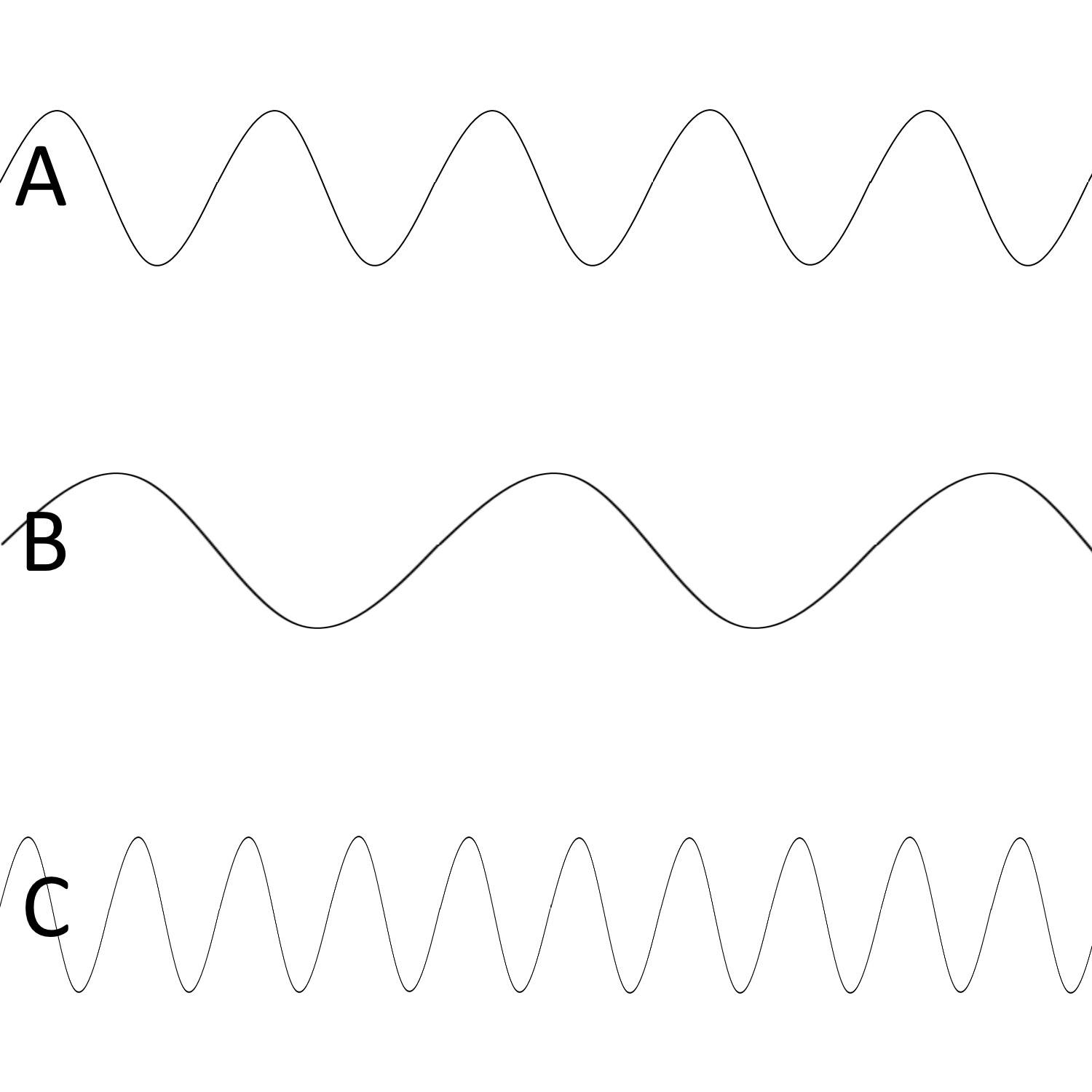
Which wave has the shortest wavelength?
1
2
3
4

Which wave has highest frequency?
A
B
C
D

Which of these waves has the smallest amplitude?
P
Q
S
T

Which statement is correct about the wave shown in the diagram?
It is a transverse wave because the particles are moving perpendicular to the motion of the wave.
It is a transverse wave because the particles are moving parallel to the motion of the wave.
It is a longitudinal wave because the particles are moving perpendicular to the motion of the wave.
It is a longitudinal wave because the particles are moving parallel to the motion of the wave.
The wavelength can be correctly measured as...
the distance from crest to consecutive crest
the distance between two consecutive points of equilibrium
the horizontal distance from crest to trough
The vertical distance from crest to trough
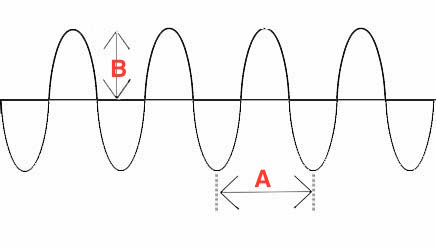
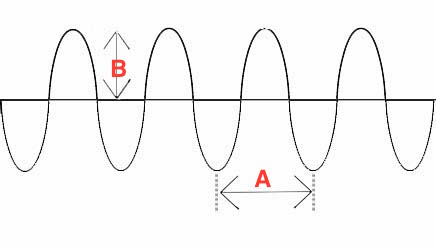
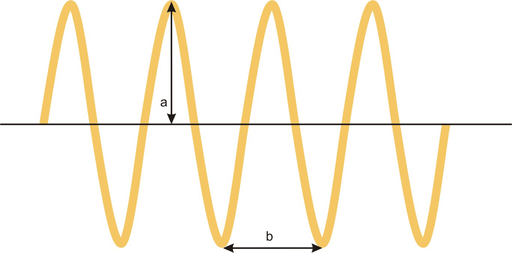
A guitar string vibrates with a frequency of 320 hz. If the wavelength of the vibration is 0.23 meters what is the speed of the wave?
320.23 m/s
1391.3 hz
73.6 m/hz
73.6 m/s
Which of the following waves cannot be polarized?
Visible light
Radio waves
Ultrasonic
Gamma
2 points on a progressive wave are 1/3 of a wavelength apart. The distance between the two points is 2cm. If the speed of the wave is 10 ms-1 what is the frequency of the wave?
5Hz
20Hz
167Hz
1500Hz

What is the approximate phase difference between the waves shown?
2π
3 π/2
π
π/2
When comparing X rays with visible light, which statement is correct?
X-rays travel faster in a vacuum
X rays have a higher frequency
Only X rays can be polarised
X rays do not show diffraction effects
Which of the following describes the type of wave produced on a stretched guitar string after it has been plucked?
Stationary, longitudinal, electromagnetic
Stationary, transverse, mechanical
Progressive, longitudinal, electromagnetic
Progressive, transverse, mechanical
Two light wave sources with the same frequency and with a constant phase difference are said to be ….
Polarised
Diffracted
Coherent
Longitudinal
The product of the frequency of a wave and its period is always equal to
π
1
2 π
3 π
Longitudinal waves
travel fastest in solids.
travel fastest in a vacuum.
travel more rapidly in gases than liquids.
vibrate perpendicular to the medium through which they pass.
are similar to waves of the electromagnetic spectrum.
v = 10 m/sec
Determine the frequency.

Which wave has the shortest wavelength?
1
2
3
4
Which statement is correct about the wave shown in the diagram?
It is a transverse wave because the particles are moving perpendicular to the motion of the wave.
It is a transverse wave because the particles are moving parallel to the motion of the wave.
It is a longitudinal wave because the particles are moving perpendicular to the motion of the wave.
It is a longitudinal wave because the particles are moving parallel to the motion of the wave.
Do waves carry energy or matter?
Energy
Matter
I'm not sure
ex. police car siren sounding lower pitch after the car passes



Sound travels FASTEST through which of these materials?
A type of gas, like helium
Empty space
A metal such as iron
Water
teo sound waves have frequencies of 250 Hz and 300 Hz. The speed of sound is 340 m/s, What is the difference between the wavelenghts of the two waves?
0.23 m
1.1 m
1.4 m
6.8 m
Continuos water waves are diffracted through a gap in a barrier in a ripple tank. Which change will increase the diffraction of the waves?
increase the frequency of the waves
increase the width of the gap
reduce the wavelength of the waves
reduce the width of the gap

A microphone connected to a c.r.o. is place in front of a loudspeaker. The trace on the screen of the oscilloscope is shown in the image. The time base setting is 0.5 ms/cm. and 0.2mV/cm is the y-axis of the screen. What is the pitch and loudness of the sound?
(a)

Ech of the principal radiation of the electromagnetic spectrum has a range of wavelengths. Which of the wavelengths in the image is correctly link to its radiation
A
B
C
D

Which option correctly displays the wavelengths for the electromagnetic waves
A
B
C
D
A source of sound of frequency 1000 Hz moves away from the stationary observer at a speed of 30 m/s. the speed of sound is 330 m/s. What is the frequency of sounnd heard by the observer
909 Hz
917 Hz
1090 Hz
1100
Considering the Doppler effect, When a car is travelling at a constant velocity, passes a stationary observer, the observer hears a change in frequency of the sound emmited by the car. Which statement is correct?
the change in frequency is greater as the car moves away
the greater the speed of the car, the greater the change in observed frequency
The observed frequency is lower as the car moves towards the observer
the volume of sound heard by the observer does not change
A hill separates a TV Trasnmitter from a house. The trasnmitter cannot be seen from the house. However the house has good TV Reception. By which wave effect at the hill, could the TV signal reach the house?
Superposition
diffraction
interference
reflection
Ships have been damaged by water waves with large amplitudes-These waves could have been formed by adding the displacements of smaller waves- Which term describes this phenomenon
diffraction
polarisation
Refraction
superposition

A vibrating rod makes water ripple in a tank. Th graph shows the displacemnt of the wave at one instant as it travels awat from the rod. The wave speed is 2.0 cm/s. What is the frequency of the wave
0.8 Hz
1.6 Hz
2.5 Hz
5.0 Hz
A wave of amplitude a has an intensity of 3.0 Wm−2 . What is the intensity of a wave of the same frequency that has an amplitude of 2a?
4.2 Wm−2
6.0 Wm−2
9.0 Wm−2
12 Wm−2
What property of this wave is represented by the letter "A"
amplitude
crest
trough
wavelength

According to superposition, which choice best describes what occurs when the waves pictured pass over one another?
A
B
C
D

According to superposition, which choice best describes what occurs when the waves pictured pass over one another?
A
B
C
D

According to superposition, which choice best describes what occurs when the waves pictured pass over one another?
A
B
C
D

The highest part of a transverse wave is
the crest
the trough
the wave point
the hotel transylvania
The lowest part of a transverse wave are the
crests
troughs
wave points
low nodules
How often a wave occurs is the wave's
frequency
amplitude
wavelength
velocity

What is the amplitude of this wave?
3
-3
6
4

What is the wavelength of this wave?
3
10
4
8
What happens to the frequency of a wave when the amplitude is tripled?
the frequency is tripled
the frequency is a third of what it was
amplitude does not affect frequency
What would happen to the wavelength if the frequency was doubled?
the wavelength would be halved
the wavelength would be doubled
the wavelength would stay the same
frequency does not affect wavelength

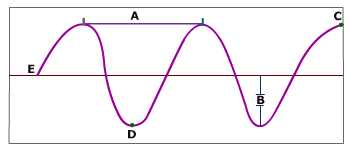
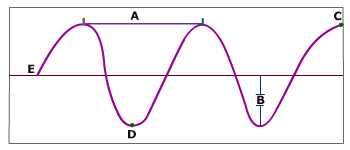
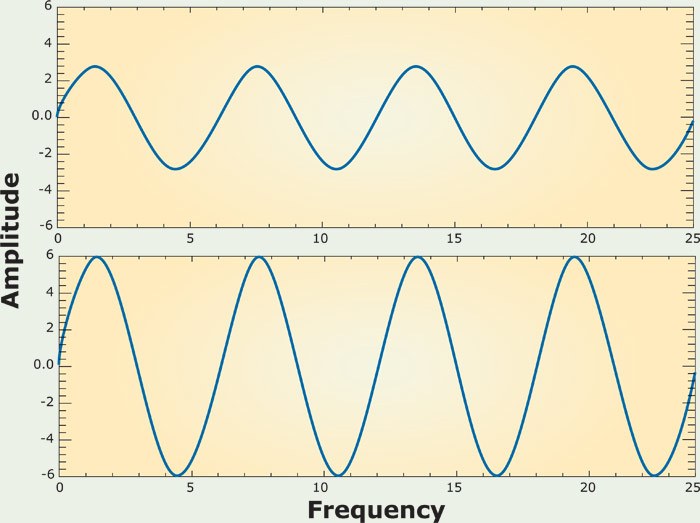
What is the material waves travel through called?

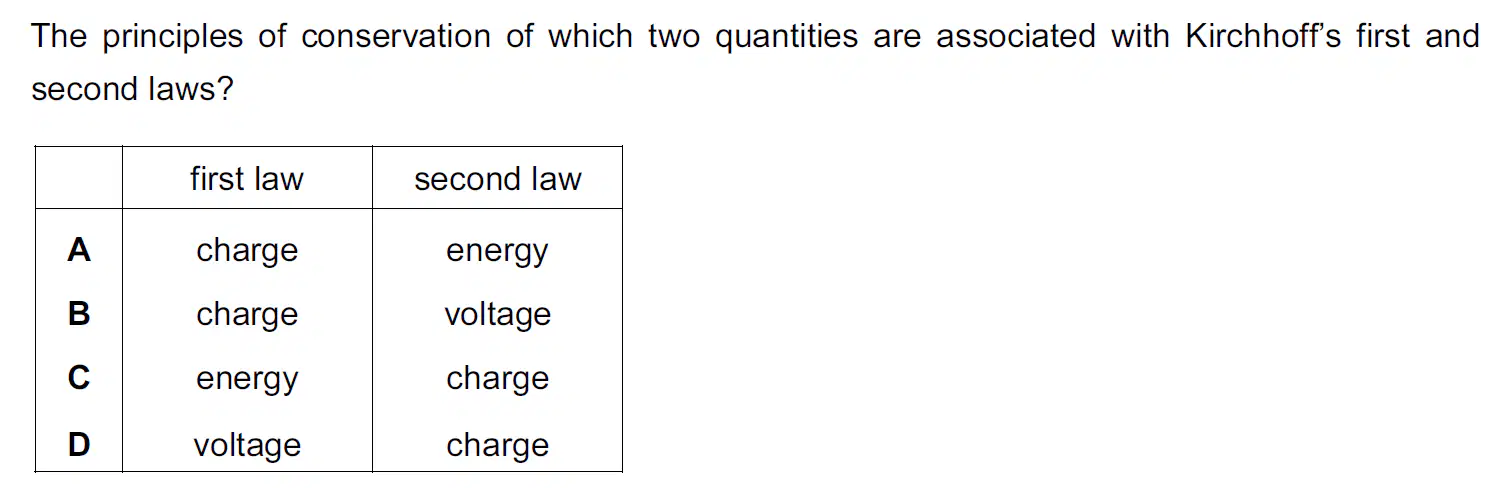
Kirchoff's First Law states
the sum of the currents entering any junction in an electric circuit must equal the sum of the currents leaving that junction
the sum of the charges entering any junction in an electric circuit must equal the sum of the charges leaving that junction
the sum of the emfs entering any junction in an electric circuit must equal the sum of the pds leaving that junction
none of these

Kirchoff's second law states
in any closed loop in an electric circuit the algebraic sum of the electromotive forces in the loop is equal to the algebraic sum of the potential differences in that loop
in any closed loop in an electric circuit the vector sum of the electromotive forces in the loop is equal to the vector sum of the potential differences in that loop
in any closed loop in an electric circuit the algebraic sum of the currents in the loop is equal to the algebraic sum of the potential differences in that loop
none of these
Select all true statements
Kirchoff's second law depends on the conservation of energy principle
Kirchoff's first law depends upon the conservation of charge
Kirchoff's second law depends on the conservation of charge principle
Kirchoff's first law depends upon the conservation of energy

Select all true statements
In the dark an LDR has very high resistance in the MΩ range
The output p.d. will be low in the dark
In the light an LDR has very high resistance in the MΩ range
The output p.d. will be high in the dark

Select all true statements
This is a thermistor circuit symbol
This component is a semiconductor
This component resistance decreases as temperature increases
This component resistance decreases as temperature decreases

Select all true statements
This component is a light emitting diode
It only allows current to flow one way
It is temperature dependent
It depends on light intensity

i1 + i5 +i4 = i2 + i3
i1 + i5 +i3 = i2 + i4
i5 + i2 +i4 = i1 + i3
i1 + i5 = i2 + i3 + i4

Which equations are correct?
ε1 - i1R1 - i2R2 = 0
ε1 + ε2 + i3R3 - i2R2 = 0
ε1 - i2R1 - i2R2 = 0
ε1 - ε2 - i3R3 + i2R2 = 0

For this circuit select the correct statements
i1 = 2 A
i3 = 8 A
i2 = 6 A
i2 = i1 + i3

V1 = 17 V
V3 = 15 V
V3 = 4.5 V
V1 = 3.0 V
emf stands for
electron motion force
potential difference
electromotive force
electromagnetic force
The defining word equation for the Volt
energy per unit charge
rate of flow of charge
work per unit time
product of electrical resistance and current
If three 1.5 V cells are connected in series
the combined emf is 4.5 V and it will last as long as a single 1.5 V cell
the combined emf is 1.5 V and it will last as long as a single 1.5 V cell
the combined emf is 4.5 V and it will last longer than a single 1.5 V cell
none of these
If three 1.5 V cells are connected in parallel
the combined emf is 4.5 V and it will last as long as a single 1.5 V cell
the combined emf is 1.5 V and it will last longer than a single 1.5 V cell
the combined emf is 4.5 V and it will last as long as a single 1.5 V cell
none of these
five 100 Ω resistors are connected parallel
20 Ω
120 Ω
200 Ω
500 Ω
Two 4000 Ω are connected in parallel, and then these are connected in series to another pair of parallel wired resistors to give a total circuit resistance of 6000 Ω. What are the possible values of the other pair?
both 8000 Ω
both 4000 Ω
one 5500 Ω and the other 8000 Ω
one 6000 Ω and the other 12000 Ω
To measure the emf of a cell accurately use a
slide wire potentiometer
voltmeter
ammeter
power pack

What current would flow?
0.36 A
1.04 A
0.021 A
0.82 A

A
B
C
D

A
B
C
D

A
B
C
D

A
B
C
D

A
B
C
D

A
B
C
D

A
B
C
D

A
B
C
D

A
B
C
D
A
B
C
D
A student connects a length of unknown material in series with a battery and an ammeter (which measures current flow). When the circuit is complete, the ammeter reads that no current is flowing. The unknown material is most likely (a)
Silicon is a substance often used in electronic devices. Silicon has a high electrical resistance compared to metals which means that it does not release its electrons very easily. However, it does conduct electricity when the right conditions are met. These properties allow electronic devices to control the electrical current sent through silicon much easier than a typical metal substance.
The properties of silicon would cause it to best be classified as a (a)
Which of the following, on average, has the highest electrical resistance value?
conductors
insulators
semiconductors
superconductors

A cell phone company is trying to improve their chargers so that the battery charges faster. Based on the information above, which material would be the best to use when making the cell phone charger cable?
(a)

According to the above diagram, what is the equivalent resistance of the circuit?
0.96 Ω
1.21 Ω
20 Ω
284 Ω
Using the diagram above, what is the current leaving the battery?
0.40 A
2.50 A
8.33 A
10.67 A
What is the power output in Watts of a lightbulb connected in series to a 1.5 V battery if the current flowing through the circuit is 0.5 A? Record your answer. Be sure to use the correct place value.
How many Joules of energy is dissipated by a resistor each minute if the voltage drop across it is 2 V and the current passing through it is 0.1 A? Record your answer. Be sure to use the correct place value.
The newest generation of smart phone uses three different batteries connected in a series simultaneously to extend battery life and generate the energy necessary to power the device. If each battery is rated at 2.4 V, what is the overall voltage provided to the phone?

A student is attempting to create a circuit that will generate the maximum amount of heat possible. All resistors have equivalent length, area, and shape.
Which of the following would be most effective in generating heat?
(a)
A single 12.0 V battery is connected in series with two identical 10 Ω resistors. What is the current moving through the first resistor?
A 20A fuse is connected in series with a circuit containing a 240 V source. What is the minimum resistance required to prevent the fuse from melting?
0.82 Ω
12 Ω
120 Ω
240 Ω
A student examining a flashlight observes that it uses a traditional incandescent light bulb. The power rating of the bulb is 60 W and the bulb is connected to 36 V. What is the current moving through the bulb?
(a)
A 15-Watt fan is connected to a 12 Volt battery. What is the current passing through the circuit in Amperes? Record your answer. Be sure to use the correct place value.

Which of the following must be the same for both resistors R1 and R2?
(a)
One light bulb in the kitchen burns out and suddenly several lights go out in the house. This would provide evidence that the bulbs were wired in —
Series
Parallel
Reverse
Different circuits
An average 1.50 V Alkaline AA battery has 9,360 J of stored energy. If the battery is placed in a toy that requires 2.00 amperes of current to operate, how many minutes will the battery last before it runs out of energy?

A student creates a parallel circuit that has three branches. The student places a resistor on each branch of the circuit so that each path has only one resistor. The student collected some of the electrical measurements in the circuit and recorded them below.
Based on the information above, which values should replace the A, B, and C in the Student Circuit Data table?
A= 3 ohms
B= 4.5 Amps
C= 24 Volts
A= 9 Volts
B= 9 ohms
C= 3 Amps
A= 9 ohms
B= 4.5 Amps
C= 3 Volts
A= 3 Volts
B= 9 ohms
C= 24 Amps

A student is classifying everyday substances as conductors or insulators using a simple circuit. The tested substances are connected to the circuit in the dotted box.
Based on the observations, which substance has the lowest resistance?
(a)

The current supplied by the battery for the circuit is 0.17 amps. Based on the circuit shown above, what is the potential difference across the 20.0 ohm resistor?

Find the total resistance of the circuit shown above.
If the battery is 5.0 volts, what is the power dissipated by the circuit in the graphic shown above?
Kirchoff's First Law states
the sum of the currents entering any junction in an electric circuit must equal the sum of the currents leaving that junction
the sum of the charges entering any junction in an electric circuit must equal the sum of the charges leaving that junction
the sum of the emfs entering any junction in an electric circuit must equal the sum of the pds leaving that junction
none of these
Kirchoff's second law states
in any closed loop in an electric circuit the algebraic sum of the electromotive forces in the loop is equal to the algebraic sum of the potential differences in that loop
in any closed loop in an electric circuit the vector sum of the electromotive forces in the loop is equal to the vector sum of the potential differences in that loop
in any closed loop in an electric circuit the algebraic sum of the currents in the loop is equal to the algebraic sum of the potential differences in that loop
none of these
Select all true statements
Kirchoff's second law depends on the conservation of energy principle
Kirchoff's first law depends upon the conservation of charge
Kirchoff's second law depends on the conservation of charge principle
Kirchoff's first law depends upon the conservation of energy
Select all true statements
In the dark an LDR has very high resistance in the MΩ range
The output p.d. will be low in the dark
In the light an LDR has very high resistance in the MΩ range
The output p.d. will be high in the dark
Select all true statements
This is a thermistor circuit symbol
This component is a semiconductor
This component resistance decreases as temperature increases
This component resistance decreases as temperature decreases
Select all true statements
This component is a light emitting diode
It only allows current to flow one way
It is temperature dependent
It depends on light intensity
i1 + i5 +i4 = i2 + i3
i1 + i5 +i3 = i2 + i4
i5 + i2 +i4 = i1 + i3
i1 + i5 = i2 + i3 + i4
Which equations are correct?
ε1 - i1R1 - i2R2 = 0
ε1 + ε2 + i3R3 - i2R2 = 0
ε1 - i2R1 - i2R2 = 0
ε1 - ε2 - i3R3 + i2R2 = 0
For this circuit select the correct statements
i1 = 2 A
i3 = 8 A
i2 = 6 A
i2 = i1 + i3
V1 = 17 V
V3 = 15 V
V3 = 4.5 V
V1 = 3.0 V
emf stands for
electron motion force
potential difference
electromotive force
electromagnetic force
The defining word equation for the Volt
energy per unit charge
rate of flow of charge
work per unit time
product of electrical resistance and current
If three 1.5 V cells are connected in series
the combined emf is 4.5 V and it will last as long as a single 1.5 V cell
the combined emf is 1.5 V and it will last as long as a single 1.5 V cell
the combined emf is 4.5 V and it will last longer than a single 1.5 V cell
none of these
If three 1.5 V cells are connected in parallel
the combined emf is 4.5 V and it will last as long as a single 1.5 V cell
the combined emf is 1.5 V and it will last longer than a single 1.5 V cell
the combined emf is 4.5 V and it will last as long as a single 1.5 V cell
none of these
five 100 Ω resistors are connected parallel
20 Ω
120 Ω
200 Ω
500 Ω
Two 4000 Ω are connected in parallel, and then these are connected in series to another pair of parallel wired resistors to give a total circuit resistance of 6000 Ω. What are the possible values of the other pair?
both 8000 Ω
both 4000 Ω
one 5500 Ω and the other 8000 Ω
one 6000 Ω and the other 12000 Ω
To measure the emf of a cell accurately use a
slide wire potentiometer
voltmeter
ammeter
power pack
What current would flow?
0.36 A
1.04 A
0.021 A
0.82 A
Complete the sentence: The ring mains consist of three wires: live, neutral and
Mars
ground
earth
mains
Complete the sentence: The role of the neutral wire in a mains circuit is
to carry current from the power station to your home.
to provide a path of least resistance to the ground.
to resist all current flow.
to complete the circuit so that current can flow.
Complete the sentence: The role of the earth wire in a mains circuit is
to protect the user should the appliance develop a fault.
to carry current from the power station to your home.
to resist the flow of current.
to provide an alternating current.
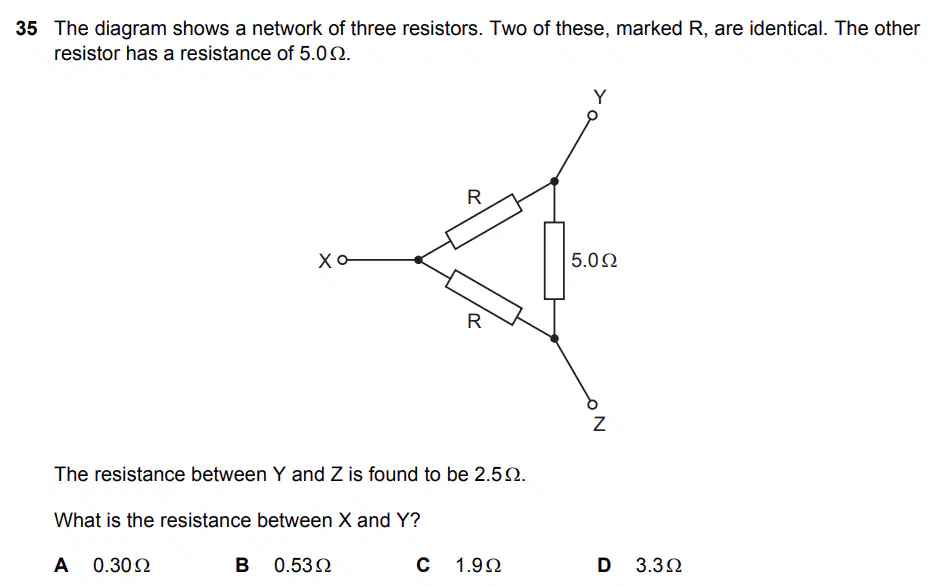
A
B
C
D
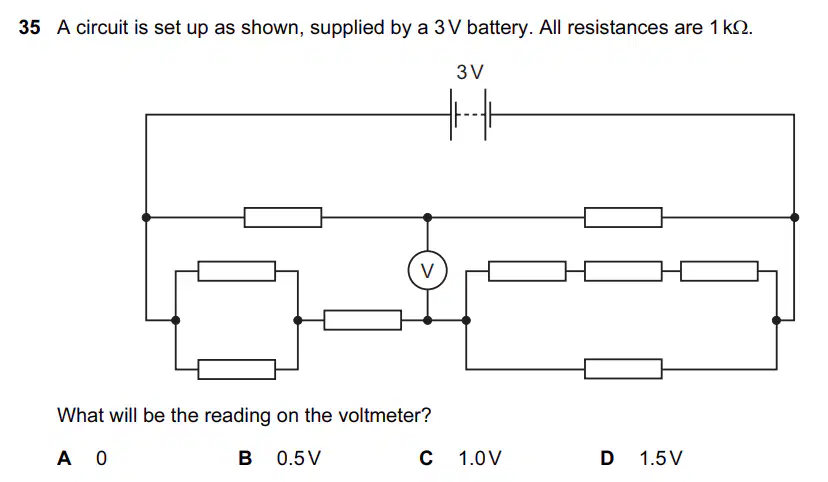
A
B
C
D