
 Worksheets
Exploring Electrochemistry Concepts
Total questions: 156
Worksheet time: 8hrs 36mins
What is an electrochemical cell?
A device that only stores electrical energy.
A type of battery that cannot be recharged.
A machine that generates heat from chemical reactions.
An electrochemical cell is a device that converts chemical energy into electrical energy or vice versa.
Describe the components of a galvanic cell.
A galvanic cell consists of a single electrode and a resistor.
A galvanic cell is made up of a battery and a capacitor.
A galvanic cell includes only a power source and a load.
A galvanic cell includes two half-cells (anode and cathode), electrodes, electrolytes, and a salt bridge.
What is the function of the salt bridge in an electrochemical cell?
To act as a barrier preventing ion flow between electrodes.
To maintain electrical neutrality and complete the circuit by allowing ion flow.
To generate electricity directly without any ion movement.
To increase the voltage output of the cell.
Define oxidation and reduction in the context of redox reactions.
Oxidation is the gain of protons; reduction is the loss of protons.
Oxidation is the loss of mass; reduction is the gain of mass.
Oxidation is the loss of electrons; reduction is the gain of electrons.
Oxidation and reduction are both processes that involve the transfer of heat.
What is the role of electrons in redox reactions?
Electrons are not involved in chemical reactions.
Electrons are produced during combustion reactions.
Electrons are only involved in ionic bonding.
Electrons are transferred between substances, facilitating oxidation and reduction.
How do you identify the oxidizing and reducing agents in a reaction?
The oxidizing agent is the substance that loses electrons.
The oxidizing agent is the substance that gains electrons, and the reducing agent is the substance that loses electrons.
Both agents are always the same substance in a reaction.
The reducing agent is the substance that gains protons.
What is the Nernst equation used for?
To determine the temperature of a chemical reaction.
To measure the concentration of a solution.
To calculate the mass of reactants in a reaction.
The Nernst equation is used to calculate the cell potential of an electrochemical cell under non-standard conditions.
How does temperature affect the cell potential according to the Nernst equation?
Temperature affects cell potential by influencing the Nernst equation, where higher temperatures can increase or decrease the potential depending on the reaction.
Temperature has no effect on cell potential.
Cell potential is only affected by concentration, not temperature.
Higher temperatures always decrease cell potential.
What is the standard electrode potential?
The standard electrode potential is the temperature at which a reaction occurs.
The standard electrode potential measures the concentration of ions in a solution.
The standard electrode potential is the mass of the reactants involved in a reaction.
The standard electrode potential is the voltage associated with a half-cell reaction at standard conditions.
How do standard electrode potentials relate to the spontaneity of a reaction?
A negative cell potential guarantees a reaction will occur.
Standard electrode potentials have no effect on reaction rates.
Standard electrode potentials help determine the spontaneity of a reaction; a positive cell potential indicates spontaneity.
Standard electrode potentials only apply to gas-phase reactions.
Explain the process of electrolysis.
Electrolysis is the process of using electrical energy to drive a chemical reaction, typically involving the decomposition of an electrolyte.
Electrolysis is the process of using light energy to decompose water.
Electrolysis involves mixing chemicals to create a reaction without electricity.
Electrolysis is a method of heating substances to high temperatures.
What are the products of electrolysis of water?
Hydrogen and Oxygen
Methane and Ammonia
Hydrogen Peroxide and Water
Nitrogen and Carbon Dioxide
What factors affect the efficiency of electrolysis?
Factors affecting the efficiency of electrolysis include electrolyte type, concentration, temperature, applied voltage, electrode surface area, and electrode material.
Type of light used during electrolysis
Time of day when electrolysis is performed
Size of the container holding the electrolyte
How is Faraday's law related to electrolysis?
Electrolysis is unrelated to any physical laws.
Faraday's law only applies to magnetic fields, not electrolysis.
Faraday's law quantifies the relationship between electric charge and the amount of substance transformed during electrolysis.
Faraday's law states that electric charge has no effect on electrolysis.
What is the difference between an electrolytic cell and a galvanic cell?
Electrolytic cells require external energy; galvanic cells produce energy from spontaneous reactions.
Galvanic cells are used for electrolysis; electrolytic cells are for energy production.
Electrolytic cells generate energy; galvanic cells require energy.
Both cells operate without any external energy source.
How can you calculate the cell potential using standard electrode potentials?
E_cell = E_anode / E_cathode
E_cell = E_cathode * E_anode
E_cell = E_cathode - E_anode
E_cell = E_anode + E_cathode
What is the significance of the SHE (Standard Hydrogen Electrode)?
The SHE is used to measure temperature changes in reactions.
The SHE is significant for determining the pH of solutions.
The SHE is significant as a reference electrode for measuring standard electrode potentials.
The SHE is a type of galvanic cell used for energy storage.
Describe a practical application of electrochemical cells.
Water purification systems.
Batteries used in portable electronic devices.
Thermal insulation materials.
Solar panels for energy conversion.
What is the relationship between Gibbs free energy and cell potential?
Gibbs free energy is directly proportional to cell potential.
Gibbs free energy is inversely related to cell potential; a negative ΔG indicates a positive cell potential.
A positive ΔG indicates a negative cell potential.
Cell potential has no relation to Gibbs free energy.
How do concentration cells operate?
Concentration cells produce electricity by mixing two different metals.
Concentration cells require a constant temperature to function properly.
Concentration cells generate electricity from the difference in ion concentration between two solutions.
Concentration cells operate by using solar energy to generate electricity.
Faraday's law of electrolytic cell

Diagram shows an electrolysis of dilute sulphuric acid.
What could be gas X and the half-equation occurring at the cathode?
Carbon dioxide, C + O2 → CO2
Hydrogen, 2H+ + 2e —>H2
Oxygen, 4OH- → H2O + O2 + 4e-
Sulphur dioxide, SO4 2- → SO2 + O2 + 2e-
Which of the following reactions shows that copper is oxidized?
Reaction of magnesium with copper (II)
oxide
Reaction of copper with silver nitrate solution
Electrolysis of copper (II) nitrate
solution by using carbon nitrate
Voltaic cell with copper and magnesium
electrodes in dilute sulphuric acid

Table shows the results of the electrolysis of molten lead (II) bromide.
The ammeter only shows reading when solid lead (II) bromide, PbBr2 is completely melted. Which of the following explains the observation?
Bromide ions receive electrons to form bromine gas
Lead (II) ions donate electrons to produce lead metal
In the solid state, bromide and lead (II) ions are in fixed position
Electrical conductivity occurs throughout
the whole experiment

Diagram shows an electrolysis cell.
Which of the substances cause the bulb to light up when electricity passes through it?
Ethanol
Dilute ethanoic acid
Solid lead(II) bromide
Tetrachloromethane

In electrolysis, particles which move towards cathode are called
anions
cations
photons
positrons
In electrochemical cell Anode is of which charge
–ve
+ve
No charge
Both charge

When aqueous copper(II) chloride solution is electrolysed using copper electrodes, the half-equation for the reaction that occurs at the anode is
Cu2+ + 2e -------> Cu
Cu --------> Cu2+ + 2e
2Cl- --------> Cl2 + 2e
4OH- --------> 2H2O + O2 + 4e
What are the cations present in zinc sulphate solution?
Zn2+
Zn2+, SO42
Zn2+ , H+
OH- , SO42-
Which metal is the negative electrode?
Zn/Zn2+ // Cu2+/Cu
zinc
copper

Galvanic cells convert
mechanical energy in to electrical energy
potential energy in to electrical energy
electrical energy in to chemical energy
chemical energy in to electrical energy
Which of the species strong oxidizing agent?
Cl2(g) + 2e → 2Cl-(aq) Eocell = + 1.36 V
Cu2+(aq) + 2e → Cu(s) Eocell = + 0.34 V
Ni2+(aq) + 2e → Ni(s) Eocell = – 0.25 V
Ca2+(aq) + 2e → Ca(s) Eocell = – 2.87 V
Cl2(g)
Cu2+(aq)
Ni2+(aq)
Ca2+(aq)
Which is correct to write cell notation
Anode: Zn
Cathode: Ni
Zn2+ (aq,1M) / Zn (s) // Ni (s) / Ni2+ (aq,1M)
Zn (s) /Zn2+ (aq,1M) // Ni2+ (aq,1M) / Ni (s)
Zn2+ (s,1M) / Zn (aq) // Ni (aq) / Ni2+ (s,1M)
Zn (aq) /Zn2+ (s,1M) // Ni2+ (s,1M) / Ni (aq)
Calculate standard cell potential for this equation:
Zn2+(aq) + 2e → Zn(s) Eº = – 0.76 V
Cd2+(aq) + 2e → Cd(s) Eº = – 0.40 V
Eocell = -0.36 V
Eocell = -1.16 V
Eocell = +1.16 V
Eocell = +0.36 V
One half-cell in a voltaic cell is constructed from a copper wire dipped into a 4.8 x 10 -3 M Solution of Cu(NO3)2. The other half-cell consist of zinc electrode in a 0.40 M Solution Zn(NO3)2. Calculate the Cell potential.
---
Cu2+(aq) (4.8 x 10 -3 M) + 2e- ---> Cu(s), if [Eored=0.337 V]
Zn2+(aq) (0.40 M) + 2e- ---> Zn(s), if [Eored= - 0.763 V]
---
Just the number value and the UNIT
(a)
In the cell notation;
one vertical line: denotes PHASE BOUNDARY
two vertical line: denotes (a)
(two words, ANSWER IN ALL CAPS)
How many participating electrons in the redox reaction of Fe2++Cr2O2-7 ---> Fe3++Cr3+? (Just the number)
(a)
How many participating electrons in the redox reaction of MnO-4 +I- ---> MnO2 + I2? (Just the number)
(a)
In the reaction of Cu(s) + Ni2+(aq) ---> Ni (s) + Cu2+(aq), the ________ undergoes reduction reaction.
Copper
Nickel
Is it possible for a cell potential to have NEGATIVE sign?
NO
YES
How many electrons is needed to transform Fe2+ ion to solid state?
1
2
3
4
In a galvanic cell, it is an electrode where the oxidation happens?
Cathode Electrode
Anode Electrode
A chemical species in an electrochemical reaction that GAINS electrons undergoes _________.
Oxidation Reaction
Reduction Reaction
A chemical species in an electrochemical reaction that LOSSES electrons undergoes _________.
Oxidation Reaction
Reduction Reaction
Which of the following statement is false
flow of ions takes place in both direction
conductivity of electrolyte is generally low
electrolysis involves physical changes
flow of electrons is unidirectional
Electronic conduction is due to flow of
Protons
Electrons
Neutrons
Ions
Electrochemistry deals with
electric energy
chemical energy
only a
both a & b
In the reaction of Cu(s) + Ni2+(aq) ---> Ni (s) + Cu2+(aq), the ________ undergoes oxidation reaction.
Copper
Nickel
True or False, is a negative sign of delta G a favorable answer that indicates spontaneity?
TRUE
FALSE
Applications of Kohlrausch’s law
Determination of Dissociation constant
Degree of dissociation
Solubility of sparingly soluble salts
All the above
EO represents
Single electrode potential
Standard electrode potential
Standard hydrogen electrode
None
In electrochemical cell, oxidation takes place at
Right
Left
Top
Bottom
In electrochemical cell, reduction takes place at
Right
Left
Top
Bottom
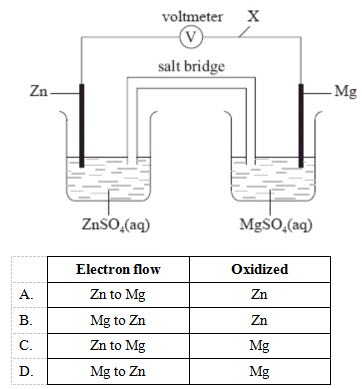

Reactions in galvanic/voltaic cells are

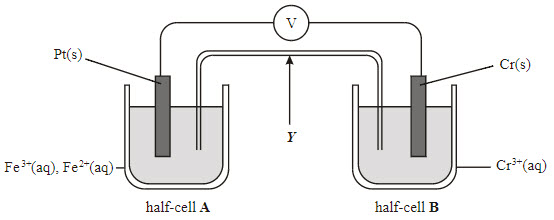
To maintain the excess buildup of charges in the electrolyte
To allow ions to move from one half cell to the other

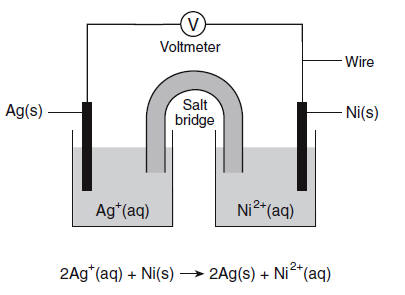
_______ is the reference electrode that can be used as an anode or a cathode depends on the half-cell to with it is coupled.
Standard electrode potential
Standard hydrogen electrode
Standard cell potential
Electrode potential
Three factors affecting the selection of species to be discharged at electrodes except..
Standard reduction potential of the species
Concentration of the species
Nature of electrodes (active or inert)
Mass of the species

Reactions in electrolytic cells are
spontaneous, redox reactions
non-spontaneous, redox reactions
spontaneous, non-redox reactions
non-spontaneous, non-redox reactions
The method of coating metals by immersing the metals in a liquid and then passing an electric current through the liquid is called ________
Electrolysis
Electroplating
Electropalting
Electroplation
Electroplating is an industrial process where objects are coated by a thin layer of a nonreactive metal by electrolysis. What should be used as the cathode in this process?
Graphite electrode
The electroplating metal
The object to be electroplated
Magnesium ribbon
Which of the following is NOT equal to 1 Faraday?
96500C
1 mole of electron
one second
how much charge is required to reduce 1 mol of Na+ into Na?
2F
3F
2 X 96500 c
96500 c
how much charge is required to reduce 1 mol of Cu+2 into Cu?
1 c
2 c
1F
2F
Given the standard electrode potentials,
K+/K = −2.93V, Ag+/Ag = 0.80V,
Hg2+/Hg = 0.79V
Mg2+/Mg = −2.37 V, Cr3+/Cr = − 0.74V
their increasing order of reducing power.
K<Mg<Cr<Hg<Ag
Ag >Hg > Cr > Mg > K
Ag < Hg < Cr < Mg < K
K>Mg>Cr>Hg>Ag
Nernst equation FOR (i) Mg(s) | Mg2+(0.001M) || Al3+(0.0001 M) | Al(s)
ECELL=E0CELL-0.0591/6 log[Mg2+]3/[Al3+]2
ECELL=E0CELL-0.0591/6 log[Al3+]2/[Mg2+]3
ECELL=E0CELL+0.0591/3 log[Mg2+]3/[Al3+]2
ECELL=E0CELL-0.0591/3 log[Mg2+] /[Al3+]
Conductivity always ____________ with a decrease in concentration
decreases
increases
remain same
irregular for weak and strong
How much charge in Faraday is required for the following reductions:
1 mol of Al3+ to Al.
1F
2F
3F
4F
conductivity of a solution decrease with dilution DUE TO
The number of ionsper unit volume (responsible for carrying current) increases
The number of ionsper unit volume (responsible for carrying current) decreases
The number of ionsper unit volume (responsible for carrying current) remains same
none
molar conductivity of NH4OH increases sharply at infinite dilution due to
decrease in dissociation
increase in dissociation
increase in association
decrease in association
Which of the following is the SI unit of conductivity.
S m-1
S m2 mol-1
S m2 mol
S m2 mol-2
Which of the following is the SI unit of molar conductivity.
S m-1 mol-1
S m mol-1
S m2 mol-1
S m2 mol-2
The value of Λm0 of CaCl2 is ------------. given: λm0(Ca2+=119.0) and λm0(Cl−=76.3)
271.6
195.3
314,3
390.6
which of the following is not correct
G* = Rk
G* = l/A
G* = Gk
k = GG*
What is the oxidation state for a lead atom?
2+
4+
0
2-
What is the oxidation number of carbon in H2CO3(aq)?
4-
2+
2-
4+
When an electrochemical cell is operating, it is
approaching equilibrium
using external energy
undergoing oxidation, only
undergoing reduction, only
Which statement best describes how a salt bridge maintains electrical neutrality in the half-cells of an electrochemical cell?
It prevents the migration of electrons.
It prevents the reaction from occurring spontaneously.
It permits the migration of ions.
It allows for the reaction from occurring spontaneously.


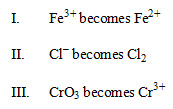
2CaO--> 2Ca + O2
which element, if any, is oxidized?
2Ca(s) + O2(g) --> 2CaO(s), calcium is __________
In a galvanic cell with the following cell notation:
∣Ni(s)∣Ni+2(aq)∥Co+2(aq)∣Co(s)∣
Which of the following is true?
Ni is being reduced
Co+2 is being oxidized
Energy will be added to operate this cell.
This cell operated spontaneously

An electrolytic cell uses electrical energy to drive
chemical reaction
physical reaction
no reaction
none of above
Galvanic cells convert
mechanical energy in to electrical energy
potential energy in to electrical energy
electrical energy in to chemical energy
chemical energy in to electrical energy

Pb + 2Ag+ → Pb+2 + 2Ag
The chemical species being reduced is
Ag
Pb
Pb+2
Ag+

Oxidation-reduction reactions occur because of the competition between particles for
electrons
positrons
protons
neutrons

The reaction 2NaCl → 2Na + Cl2 is an example of
a reduction reaction, only
both an oxidation and reduction reaction
an oxidation reaction, only
neither an oxidation nor a reduction reaction

An oxidizing agent will
increase in mass
lose electrons
be reduced
increase in oxidation number
Electrochemistry is
Study of electron in atom
Study of electricity in molecules
The relationship between chemical reactions and electricity
the study of electrons moving from one a tom to another

Diagram shows an apparatus set-up for a chemical cell. What can you observed from this experiment?
Hydrogen gas is liberated at the copper plate
Magnesium electrode becomes thinner
Colourless solution turns to brown
Electron flows from magnesium to the copper plate
Diagram shows an electrolysis of dilute sulphuric acid.
What could be gas X and the half-equation occurring at the cathode?
Carbon dioxide, C + O2 → CO2
Hydrogen, 2H+ + 2e- → H2
Oxygen, 4OH- → H2O + O2 + 4e-
Sulphur dioxide, SO4 2- → SO2 + O2 + 2e-
Which of the following reactions shows that copper is oxidized?
Reaction of magnesium with copper (II) oxide
Reaction of copper with silver nitrate solution
Electrolysis of copper (II) nitrate solution by using carbon nitrate
Voltaic cell with copper and magnesium electrodes in dilute sulphuric acid
Table shows the results of the electrolysis of molten lead (II) bromide.
The ammeter only shows reading when solid lead (II) bromide, PbBr2 is completely melted. Which of the following explains the observation?
Bromide ions receive electrons to form bromine gas
Lead (II) ions donate electrons to produce lead metal
In the solid state, bromide and lead (II) ions are held in a lattice
Electrical conductivity occurs throughout
the whole experiment
Molten X is electrolysed using carbon electrodes. After 10 minutes, a brown solid is deposited on the cathode and a brown gas is released at the anode. What is molten X?
Lead(II) chloride
Lead(II) bromide
Copper(II) chloride
Copper(II) bromide

Diagram
shows the apparatus set-up for the electrolysis of 1.0 mol dm -3 sodium chloride solution using carbon electrodes.Which of the following are the observation for the electrolysis process shown in Diagram?
Grey solid deposited on electrode B
Colourless gas is released at electrode B
Carbon electrode A becomes thinner
Greenish yellow gas is released at electrode A

Diagram shows the electrolysis of concentrated copper(II) chloride solution using carbon as electrodes.
Which of the followings is the correct half equations represents the reactions at the anode?
4OH- → 2H2O + O2 + 4e
2Cl- → Cl2 + 2e
Cu → Cu2+ + 2e
Cu2+ + 2e → Cu

Table shows information about three chemical cells.
What is the possible potential difference of the chemical cell when metal Z is paired with W ?
0.3 V
1.2 V
1.5 V
2.1 V
What are the products formed at the anode and the cathode during the electrolysis of molten magnesium oxide using carbon electrodes?
Anode: Oxygen
Cathode: Magnesium
Anode: Magnesium
Cathode: Oxygen
Anode: Hydrogen
Cathode: Oxygen
Anode: Oxygen
Cathode: Hydrogen
Diagram shows an electrolysis cell.
Which of the substances cause the bulb to light up when electricity passes through it?
Ethanol
Dilute ethanoic acid
Solid lead(II) bromide
Tetrachloromethane
What reaction occurs at the anode?
Ag+/Ag = 0.80V
Ni2+/Ni = -0.25V
Ag+ + e- →Ag
Ag → Ag+ + e-
Ni2+ + 2e- → Ni
Ni → Ni2+ + 2e-

Given their standard reduction potentials, which of the species is going to be oxidized?
Cu2+/Cu = 0.34V
Zn2+/Zn = -0.76V
Cu
Zn
CuSO4
ZnSO4
Nernst equation for an electrode is based on the variation of electrode potential of an electrode with
Temperature
Concentration of electrolyte
Both a & b
Density of the electrodes
At equilibrium
Cell potential will be zero
Equilibrium constant becomes equal to electrode potential
Equilibrium constant becomes zero
Cell potential becomes unity
Galvanic cell converts
Chemical energy into electrical energy
Electrical energy into chemical energy
a metal from its elemental form to combined form
Electrolyte into individual ions
Given the standard reduction potentials, Eo of iron is -0.44V and Eo of oxygen is 1.23V.
what will be the emf of the cell?
-0.79V
-1.67V
1.67V
0.79V
Consider the galvanic cell reaction Zn (s) + Cu2+ (aq) → Cu (s) + Zn2+ (aq) When the cell is running spontaneously, which is the only true statement?
The copper electrode loses mass and the zinc electrode is the cathode.
The copper electrode gains mass and the copper electrode is the cathode.
The zinc electrode gains mass and the zinc electrode is the anode.
The zinc electrode loses mass and the zinc electrode is the cathode.
In a Galvanic Cell, the salt bridge...
completes the circuit so that electrons can flow through the wire
maintains charge balance
is soaked in an unreactive electrolyte such as KNO3
all of the above
In a Galvanic cell, the cations in the salt bridge...
flow the same way as the electrons flow in the wire
flow the opposite way to the electron flow in the wire
stay in the salt bridge
In a redox reaction, the oxidising agent... (choose two options)
is oxidised
is reduced
increases its oxidation number
decreases its oxidation number
In a Galvanic cell, the electrons flow from the...
anode to the cathode
cathode to the anode
In a Galvanic Cell, the anode is...
positive
negative


What is a cathode?
It is the electrode where oxidation takes place.
It is the electrode where reduction takes place.
It is an aqueous solution containing an electrode.
It is the salt bridge that connects half-cells.
What is an anode?
It is the electrode where oxidation takes place.
It is the electrode where reduction takes place.
It is an aqueous solution containing an electrode.
It is the salt bridge that connects half-cells.
What is a standard half-cell?
It is one cell that comprises half of a whole battery.
It is a cell containing only a metal bar with no aqueous ion solution.
It is a cell containing only an aqueous ion solution and no metal bar.
It is a cell that generates half of a volt of electricity.
What is a galvanic (voltaic) cell?
It is a cell that destroys electrons on one side and creates electrons on the other side.
It is a cell that contains only one metal bar and one aqueous ion solution.
It is a type of battery that drives a redox reaction when electricity is applied.
It is a type of battery that generates an electrical current from redox reactions.
What is an oxidizing agent?
It is the species that gets reduced -- gains electrons.
It is the species that gets oxidized -- loses electrons.
It is the species that creates electrons.
It is the species that loses electrons.
What is a reducing agent?
It is the species that gets reduced -- gains electrons.
It is the species that gets oxidized -- loses electrons.
It is the species that creates electrons.
It is the species that destroys electrons.
What is oxidation?
It is the gain of electrons.
It is the loss of electrons.
It is the creation of electrons.
It is the destruction of electrons.
What is reduction?
It is the gain of electrons.
It is the loss of electrons.
It is the creation of electrons.
It is the destruction of electrons.
What is a redox reaction?
A reaction where both reactants get reduced.
A reaction where both reactants get oxidized.
A reaction that involves a transfer of electrons between reactants.
A reaction that involves the combustion of at least one reactant.