
NEW
Font size
S
M
L
XL
 Worksheets
Classification keys
Total questions: 12
Worksheet time: 10mins
Name
Class
Date
1.
The scientific name for an organism is made from the:
a)
class and family name
b)
genus and species name
c)
domain and kingdom name
d)
kingdom and phylum name
2.
The scientific name for an organism is made from the:
a)
class and family name
b)
genus and species name
c)
domain and kingdom name
d)
kingdom and phylum name
3.

Which of the following shows taxonomic groups in order from broadest to most specific?
a)
kingdom, phylum,order, class, genus, species
b)
species, genus, family, order, class, phylum, kingdom
c)
kingdom, phylum, class, order, family, genus, species
d)
phylum, kingdom, order, class, genus, family, species
4.

What is the most specific (smallest) level of classification?
a)
family
b)
domain
c)
order
d)
species
5.

The grizzly bear is most closely related to the
a)
black bear
b)
panda bear
c)
fox
d)
sea star
6.
In what kingdom would you find trees and flowers?
a)
Plantae
b)
Fungi
c)
Eubacteria
d)
Animalia
7.
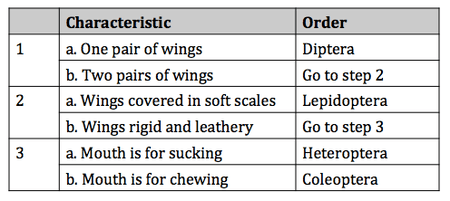
A dichotomous key for insects is given. To what order does an insect with two pairs of scaly wings belong?
a)
Coleoptera
b)
Heteroptera
c)
Diptera
d)
Lepidoptera
8.

A dichotomous key for trees is provided. Hikers found a tree that has large brown cones and single sharp needles. What species of tree have the hikers found?
a)
Juniper
b)
Pine
c)
Spruce
d)
Fir
9.
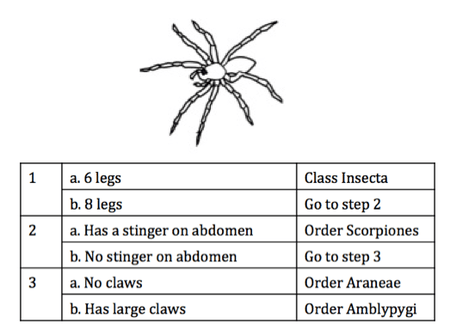
An illustration and a dichotomous key are given. What is the correct classification for this organism?
a)
Class Insecta
b)
Order Amblygygi
c)
Order Araneae
d)
Order Scorpiones
10.

To what order does a two pairs of wings, rigid and leathery and mouth for sucking belong to?
a)
Diptera
b)
Lepidoptera
c)
Heteroptera
d)
Coleoptera
11.

Which of the following is a centipede?
a)
b)
c)
d)
12.

Which of the following organisms is M. erminea?
a)
A
b)
B
c)
C
d)
D
e)
E
Reset

