
 Worksheets
Newton's Laws of Motion (Lesson 6 OpenScied))
Total questions: 57
Worksheet time: 5hrs 19mins
Soccer is becoming more and more popular in the United States. And while other soccer-related injuries are happening less frequently, youth soccer players in the United States are experiencing more concussions. A concussion is a type of traumatic brain injury caused by the head experiencing an impact and moving quickly back and forth, causing the brain to bounce around in the skull.OP.CF.L6.002 [35]
A concussion can result from a force of 400–1,000 N on the head. There has been debate in different sports about how to best prevent concussions. In soccer, one idea is to ban headers (when a ball makes contact with a head) in youth and professional soccer.
Which is the moment of peak (max) force of a header in soccer?

Option 1

Option 2

Option 3

Option 4
Soccer is becoming more and more popular in the United States. And while other soccer-related injuries are happening less frequently, youth soccer players in the United States are experiencing more concussions. A concussion is a type of traumatic brain injury caused by the head experiencing an impact and moving quickly back and forth, causing the brain to bounce around in the skull.OP.CF.L6.002 [35]
A concussion can result from a force of 400–1,000 N on the head. There has been debate in different sports about how to best prevent concussions. In soccer, one idea is to ban headers (when a ball makes contact with a head) in youth and professional soccer.
What can cause a traumatic brain injury?
Soccer is becoming more and more popular in the United States. And while other soccer-related injuries are happening less frequently, youth soccer players in the United States are experiencing more concussions. A concussion is a type of traumatic brain injury caused by the head experiencing an impact and moving quickly back and forth, causing the brain to bounce around in the skull.OP.CF.L6.002 [35]
A concussion can result from a force of 400–1,000 N on the head. There has been debate in different sports about how to best prevent concussions. In soccer, one idea is to ban headers (when a ball makes contact with a head) in youth and professional soccer.
Can a concussion result from a force of 450N?
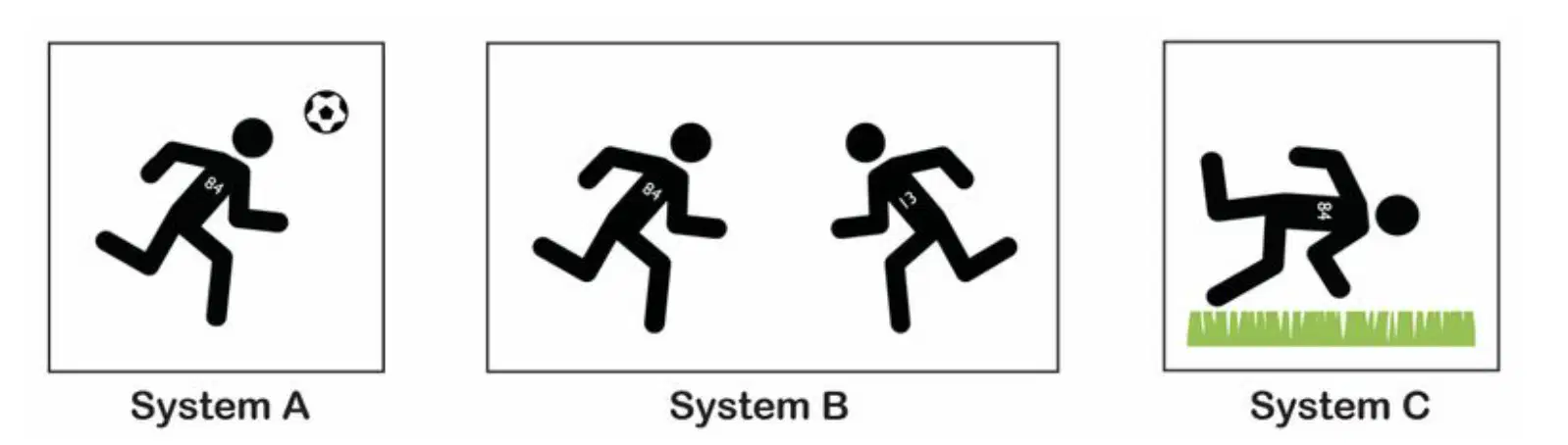
Soccer is becoming more and more popular in the United States. And while other soccer-related injuries are happening less frequently, youth soccer players in the United States are experiencing more concussions. A concussion is a type of traumatic brain injury caused by the head experiencing an impact and moving quickly back and forth, causing the brain to bounce around in the skull.OP.CF.L6.002 [35]
A concussion can result from a force of 400–1,000 N on the head. There has been debate in different sports about how to best prevent concussions. In soccer, one idea is to ban headers (when a ball makes contact with a head) in youth and professional soccer.
Which system is a type C collision?
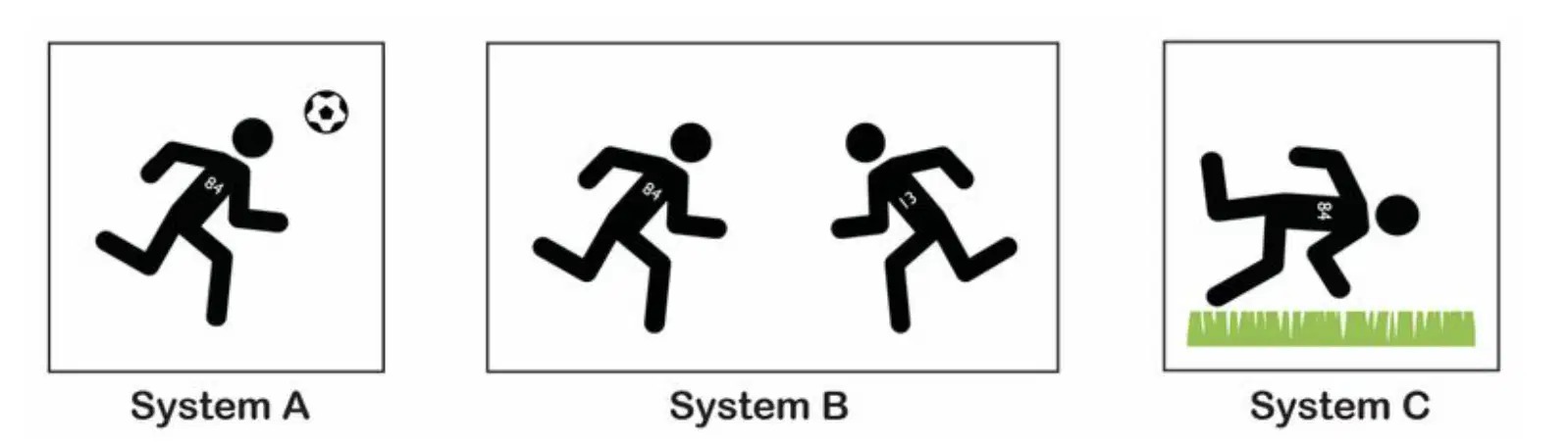
Soccer is becoming more and more popular in the United States. And while other soccer-related injuries are happening less frequently, youth soccer players in the United States are experiencing more concussions. A concussion is a type of traumatic brain injury caused by the head experiencing an impact and moving quickly back and forth, causing the brain to bounce around in the skull.OP.CF.L6.002 [35]
A concussion can result from a force of 400–1,000 N on the head. There has been debate in different sports about how to best prevent concussions. In soccer, one idea is to ban headers (when a ball makes contact with a head) in youth and professional soccer.
Which system is a type A collision?
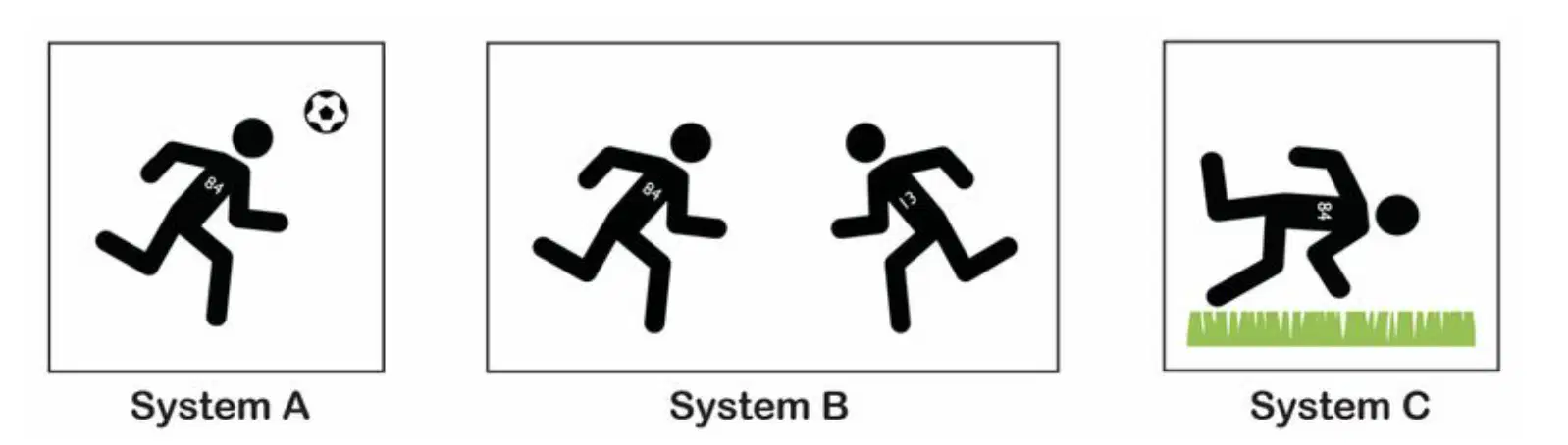
Soccer is becoming more and more popular in the United States. And while other soccer-related injuries are happening less frequently, youth soccer players in the United States are experiencing more concussions. A concussion is a type of traumatic brain injury caused by the head experiencing an impact and moving quickly back and forth, causing the brain to bounce around in the skull.OP.CF.L6.002 [35]
A concussion can result from a force of 400–1,000 N on the head. There has been debate in different sports about how to best prevent concussions. In soccer, one idea is to ban headers (when a ball makes contact with a head) in youth and professional soccer.
How would the amount of force on the head compare to the amount of force on the object it collides with, in each system A, B, and C?
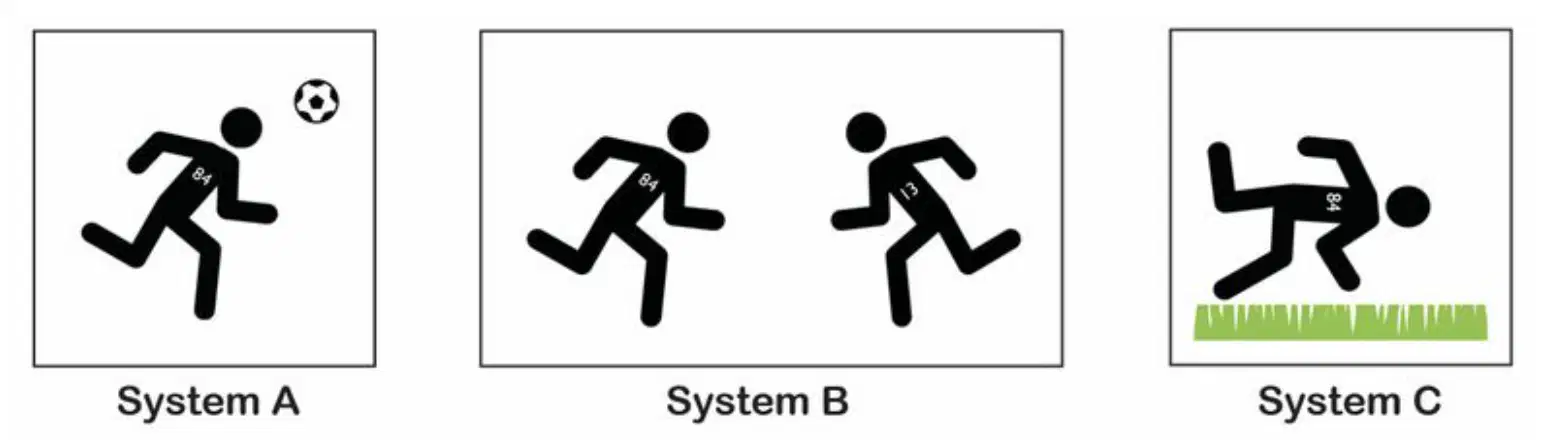
Sports scientists concluded that concussions result from headers, a running player colliding with another running player and a running player hitting the ground. So far in this unit, we have looked at collisions and how much kinetic energy the objects in the system have before they collide and how this is related to the peak forces they can produce in any collision. Let’s consider the three main types of systems that can lead to concussions and make predictions about them using forces and energy as it relates to Player #84.
Considering both objects that are about to collide in each interaction, which system would you predict to have the least amount of total kinetic energy in the system right before the objects collide? In each instance below, Player #84 is running at a speed of 7 miles per hour.
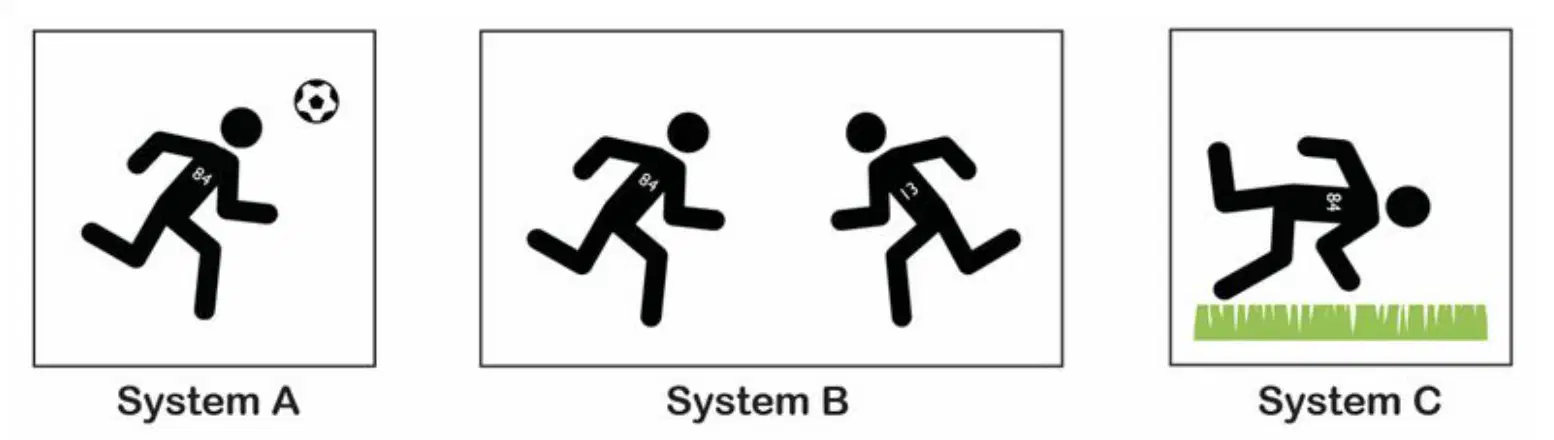
Sports scientists concluded that concussions result from headers, a running player colliding with another running player and a running player hitting the ground. So far in this unit, we have looked at collisions and how much kinetic energy the objects in the system have before they collide and how this is related to the peak forces they can produce in any collision. Let’s consider the three main types of systems that can lead to concussions and make predictions about them using forces and energy as it relates to Player #84.
The ground has ____ kinetic energy.
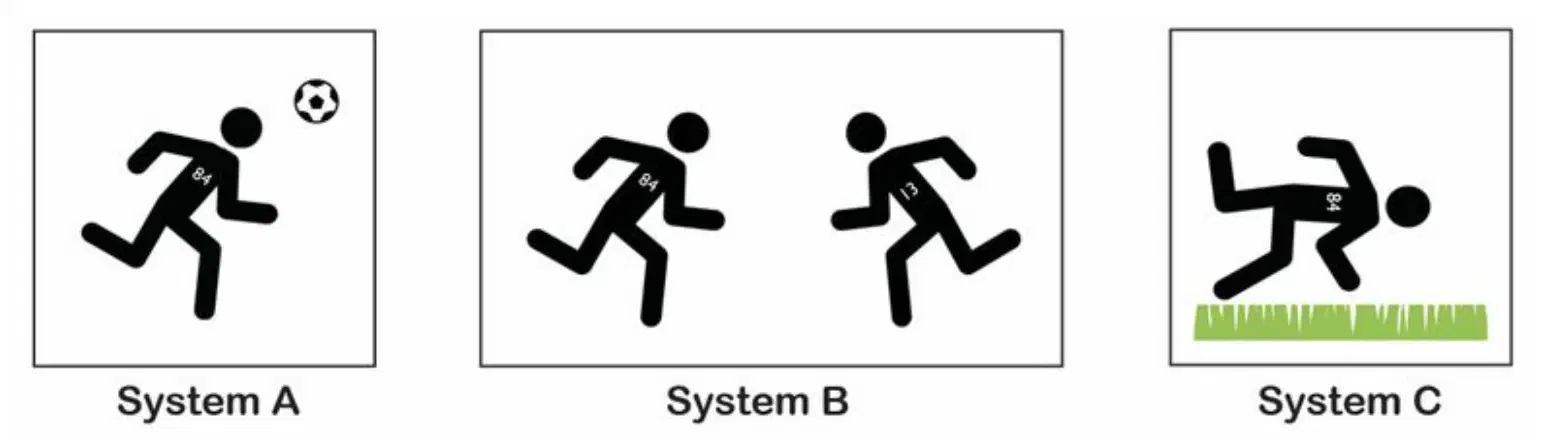
Sports scientists concluded that concussions result from headers, a running player colliding with another running player and a running player hitting the ground. So far in this unit, we have looked at collisions and how much kinetic energy the objects in the system have before they collide and how this is related to the peak forces they can produce in any collision. Let’s consider the three main types of systems that can lead to concussions and make predictions about them using forces and energy as it relates to Player #84.
Which object in these systems has the least amount of kinetic energy?
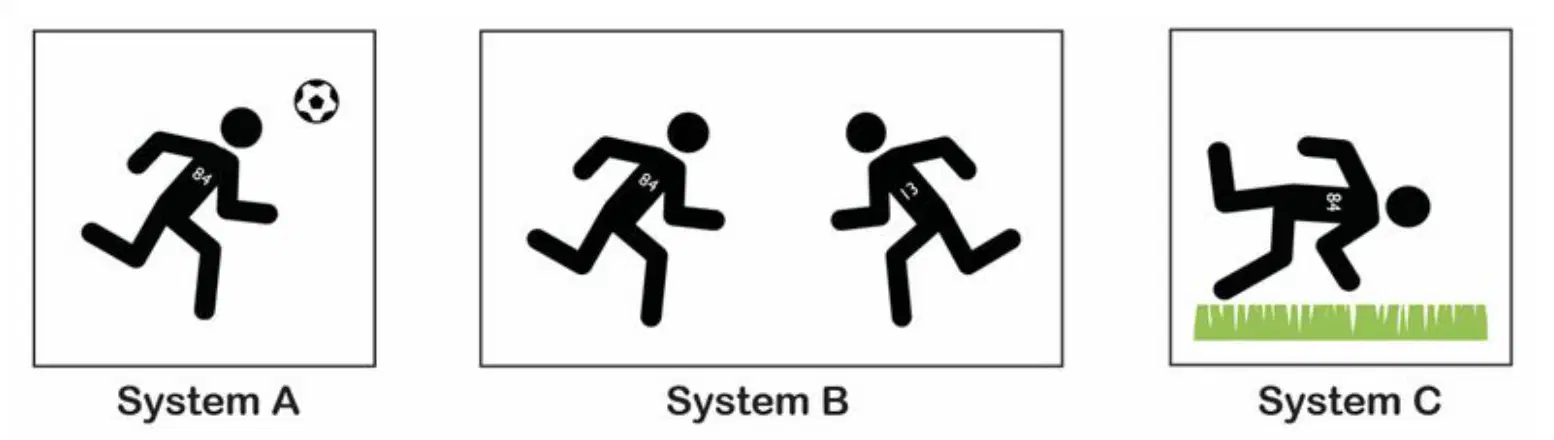
Sports scientists concluded that concussions result from headers, a running player colliding with another running player and a running player hitting the ground. So far in this unit, we have looked at collisions and how much kinetic energy the objects in the system have before they collide and how this is related to the peak forces they can produce in any collision. Let’s consider the three main types of systems that can lead to concussions and make predictions about them using forces and energy as it relates to Player #84.
In what way is a soccer ball able to cause a concussion?
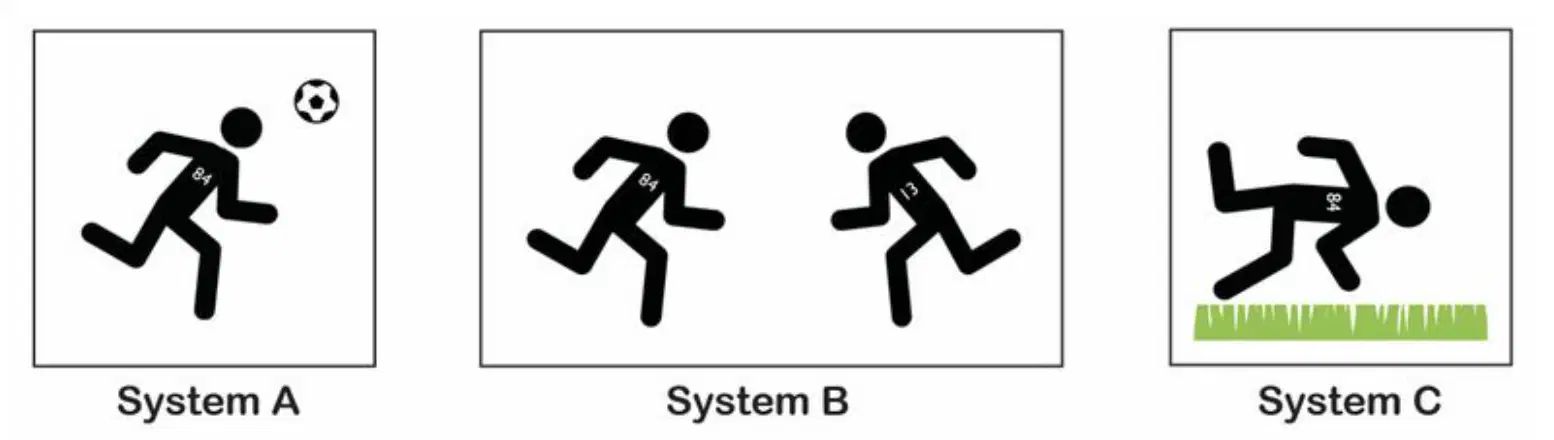
Sports scientists concluded that concussions result from headers, a running player colliding with another running player and a running player hitting the ground. So far in this unit, we have looked at collisions and how much kinetic energy the objects in the system have before they collide and how this is related to the peak forces they can produce in any collision. Let’s consider the three main types of systems that can lead to concussions and make predictions about them using forces and energy as it relates to Player #84.
In what way will two people colliding cause a concussion?
The brain is an organ made of interconnected cells called neurons. Neurons send signals to communicate information from one cell to another. The long part of the neuron is called an axon, and they have a breaking point. Recent research provides evidence that permanent damage to axons in the brain occurs from just a single damaging head collision (concussion).
An example of breaking points is...
The brain is an organ made of interconnected cells called neurons. Neurons send signals to communicate information from one cell to another. The long part of the neuron is called an axon, and they have a breaking point. Recent research provides evidence that permanent damage to axons in the brain occurs from just a single damaging head collision (concussion).
An axon is...
The brain is an organ made of interconnected cells called neurons. Neurons send signals to communicate information from one cell to another. The long part of the neuron is called an axon, and they have a breaking point. Recent research provides evidence that permanent damage to axons in the brain occurs from just a single damaging head collision (concussion).
How much force is required for an axon to break?
Units for force (choose 2)
Units for mass (choose 2)
Dropped Phone on Concrete
Collision Type A
Collision Type B
Collision Type C
A Baseball colliding with a Moving Truck
Collision Type A
Collision Type B
Collision Type C
Throwing a Water Balloon at a Tree
Collision Type A
Collision Type B
Collision Type C
Stepping on a Laptop
Collision Type A
Collision Type B
Collision Type C
Two Moving Skateboarders Colliding at the Skate Park
Collision Type A
Collision Type B
Collision Type C
Cat Knocking Glass Over
Collision Type A
Collision Type B
Collision Type C
Which of the following is NOT a synonym of "Deform"?
Bend
Change Shape
Straight
Distort
Which of the following is NOT an example of a contact force?
Pushing Your Chair in
Pulling the Window Shut
Hitting a Homerun in Baseball
Using a Magnet to Move Iron
What does "force" mean in Science?
A Push or Pull that acts upon an object
A Pull that acts upon an object
To make someone do something they don't want to
A Push that acts upon an object
When the damaged object was moving and the other object was stationary
Collision Type A
Collision Type B
Collision Type C
When the damaged object was stationary and the other object was moving
Collision Type A
Collision Type B
Collision Type C
When both the damaged object and other object were moving
Collision Type A
Collision Type B
Collision Type C
What is a "Contact Force"?
A Force applied by the Earth's gravity on all objects near and on the planet
A Force where two objects have to touch
A Force where two objects do not have to touch
A Force applied by the compression or stretch of a spring
Which of the following is an example of a change in motion?
Was moving but stopped
Started moving backwards
Speeds Up
Slows Down
Continues at the same speed in the same direction
True or False: Concrete can deform with enough force.
True
False
Survey: When objects collide does their motion change?
Yes
Not
Still Trying to Answer
Survey: When objects collide do they deform?
Yes
Not
Still Trying to Answer
Newton's 3rd Law states that for ever action there is an equal and opposite ________.
reaction
satisfaction
fraction
transaction
If a 10 kilogram object accelerates suddenly at 15 m/s2, how much force was applied to the object?
150 Newtons
15 Newtons
150 kilograms
100 kilograms

A force of 250 N is applied to an object that accelerates at a rate of 5 m/s2. What is the mass of the object? To solve this problem you must do -
250 ÷ 5
5 ÷ 250
250 x 5

A 50 kg skater pushed by a friend accelerates 5 m/s2. How much force did the friend apply? To solve this problem you must do -
50 ÷ 5
5 ÷ 50
50 x 5

A 5 kg block is pulled across a table by a net force of 32 N. Calculate the acceleration of the object.
160 m/s2
6.4 m/s2
0.16 m/s2

What is the formula for force?
F=m/a
F=a/m
F=ma
F=Fm
Unit for acceleration?
m/s2
kg
newtons
a
What is the unit for force?
m/s2
kg
N
F
A 50 kg skater pushes off from a wall with a force of 200 N. What is the skater’s acceleration?
Solve this problem
200 / 50 = 4 m/s2
50 / 200 = 4 N
200 x 50 = 10,000 m/s2
200 / 50 = 4 N

