
 Worksheets
Unit 2 – Exponentials and Logarithms
Total questions: 268
Worksheet time: 21hrs 16mins
Stand and Fight!
Yes
No
g(x) = x2+3 , find f(g(x)).
g(x) = x - 2
Find g(f(-10))
Find h(-3).
Which one is the same as fοg(x)
g(f(x))
f(g(x))
g(x) = x - 2
Find (f∘g)(0)


Find g(f(2))
-4
-2
0
4
Find f(g(4))
1
-2
-3
-4

Find f(g(−1))
(a)
Find g(f(6))
(a)

Find f(g(−1))
-7
-4
0
2
Find g(f(1))
-7
-1
0
2

Find g(f(−1))
(a)
Find f(g(−2))
(a)

Find g(f(0))
(a)
Find f(g(−2))
(a)
Which one is the same as fοg(x)
g(f(x))
f(g(x))
and g(x) = x - 2
Find f(g(5))
g(x) = x - 2
Find (f∘g)(0)
If f(x) = x2 and g(x) = 3x - 1, find f(g(x))
9x2 - 6x + 1
3x - 1
3x2 - 1
9x2 - 1
Find the domain and range of the f(x)=(x−2)2−2 .
Df=(−∞,∞), Rf=[−2, ∞)
Df=(−∞,∞), Rf=[2, ∞)
Df=(−∞,∞), Rf=(2, ∞)
Df=(−∞,∞), Rf=(−2, ∞)
Find the domain and range of the f(x)=x−1+2 .
Df=(1,∞), Rf=(2, ∞)
Df=[1,∞), Rf=[2, ∞)
Df=(1,∞), Rf=[2, ∞)
Df=[1,∞), Rf=(2, ∞)
For the functions f(x)=1−x and g(x)=1−x2 , find gf(x) .
gf(x)=2x−x2
gf(x)=2x+x2
gf(x)=−2x−x2
gf(x)=−2x+x2
Questions 18-20 are all referring to the same problem.
Consider the function f(x) = x + 5
What is the domain and range of the function?
Domain: all real numbers, Range: y ≥ 0
Domain: x ≥ 5, Range: all real numbers
Domain: x ≥ -5, Range: y ≥ 0
Domain: x ≥ -5, Range: all real numbers
If f(x) = 1/x and g(x) = x - 10, what is the domain of f(g(x))?
{x | x not equal to 0}
{x | x not equal to -10}
{x | x not equal to 10}
{x | x is all real numbers}
Find g(f(6))
(a)

Compose the Function and Determine the Domain
(-inf, 0) U (0, inf)
(-inf, -1/2) U (-1/2, 3/2) U (3/2, inf)
(-inf, 1/2) U (1/2, 3/2) U (3/2, inf)
(-inf, -3/2) U (-3/2, 1/2) U (1/2, inf)

A
B
C
D

A
B
C
D

A
B
C
D

A
B
C
D

A
B
C
D

A
B
C
D

A
B
C
D

A
B
C
D

A
B
C
D

A
B
C
D

A
B
C
D

A
B
C
D

A
B
C
D

A
B
C
D

Find the Inverse.
A
B
C
D

Find the inverse.
A
B
C
D

Find the inverse.
A
B
C
D

Find the inverse.
A
B
C
D

Find the inverse.
A
B
C
D

Find the inverse.
A
B
C
D
Find the domain of this composite function
f(x) = ( x - 5 ) / ( x + 1 ) g(x) = (x−3)(x+2)
f°g
X cant be 1/2
X cant be 3
All Real Numbers
X can't be - 1/2
X can't be -3
Find the domain
f(x) = (x - 5)/(x+1), g(x) = (x + 2)/(x - 3)
g°f
x cant be -4
all real numbers
x can't be 4
x can't be -2
x can't be -1
Find the domain
f(x) = (x - 5)/(x+1), g(x) = (x + 2)/(x - 3)
f(f(x))
x cant be -1
x cant be 2
x cant be -2
all real numbers
Find the domain
f(x) = (x - 5)/(x+1), g(x) = (x + 2)/(x - 3)
g(g(x))
X cant be 11/2
X cant be 3
X can't be -11/2
X cant be 5
All real numbers
Find the domain
f(x) = (x^2+1), g(x) = sqrt(x-1)
f(g(x))
X cant be 1
X can't be -1
X is greater than or equal to 1
X is greater than 1
X is less than or equal to 1
Find the domain
f(x) = (x^2+1), g(x) = sqrt(x-1)
g(f(x))
all real numbers
x cant be equal to negative one
Find the domain
f(x) = (x^2+1), g(x) = sqrt(x-1)
f(f(x))
all real numbers
all real numbers except x = 1
Find the domain
f(x) = (x^2+1), g(x) = sqrt(x-1)
f(f(x))
x is greater than or equal than 2
x is less than or equal to 2
We are strong
Of course!
We got this!
We got the energy!

The relation in the graph is..
a function but not a one-to-one function.
a one-to-one function.
not a function

The relation in the graph is..
a function but not a one-to-one function.
a one-to-one function.
not a function

The relation in the graph is..
a function but not a one-to-one function.
a one-to-one function.
not a function

The relation in the graph is..
a function but not a one-to-one function.
a one-to-one function.
not a function

The relation in the graph is..
a function but not a one-to-one function.
a one-to-one function.
not a function
Which of the following graphs illustrates a one-to-one relationship?


Which of the following graphs does not represent that of a one-to-one function?


In which of the following formulas is the variable y a one-to-one function of the variable x? (Hint – try generating some values either in your head or using TABLES on your calculator.)
y=x2
y=∣x∣
y=2x
y=5
Which of the following tables illustrates a relationship in which y is a one-to-one function of x?


A recent newspaper gave temperature data for various days of the week in table format. In which of the tables below is the reported temperature a one-to-one function of the day of the week?


Verify if the two functions are inverses of each other. f(x)=−x−5
g(x)=−3x−9
SHOW YOUR WORK
Inverse Functions
Not Inverse Functions
f(x) = 5x − 5 g(x) = 51x + 1
Use composition of functions to determine if f(x) and g(x) are inverse functions.
SHOW YOUR WORK
yes
no
f(x)=3x+10
Find g(f(x))
SHOW YOUR WORK
f(g(x))=1
f(g(x))=x
f(g(x))=0
None of these.
Verify if f(x) and g(x) are inverses of each other.
f(x)=4+31x
g(x)=3x−12
SHOW YOUR WORK
Inverse Functions
Not Inverse Functions
What operation allows us to verify if functions are inverses?
Multiplying
Dividing
Adding
Composing
To prove two functions are inverses of each other, both f(g(x)) and g(f(x)) should equal...
1
x
0
y
Use composition of functions to determine if f(x) and g(x) are inverse functions.
f(x)=2x−3
g(x)=(2x+3)2
SHOW YOUR WORK
yes
no

Which of the following relations is a one-to-one function?
(a)
(b)
(c)
None of these
Which of the following relations is a one-to-one function?
(a)
(b)
(c)
None of these
The relation in the graph is..
a function, but not a one-to-one function.
a one-to-one function.
not a function
This is HOMEWORK
Students must use ALGEBRA to show f(g(x)) = x AND g(f(x)) = x to verify the two functions are inverses
If the two functions are not inverse only one composition must be that does not equal x
I understand and will write the problems on paper and use ALGEBRA.
I plan to not earn credit for this homework and will not be writing anything down on paper.

Verify if the functions are inverses.
Must show ALGEBRA to verify YES or NO

Verify if the functions are inverses.
Must show ALGEBRA to verify YES or NO

Verify if the functions are inverses.
Must show ALGEBRA to verify YES or NO

Verify if the functions are inverses.
Must show ALGEBRA to verify YES or NO
Are f(x) =x+6 and g(x) =x-6 inverses?
Must show ALGEBRA to verify YES or NO
Yes
No
f(x) = 5x − 5 g(x) = 51x + 1
Use composition of functions to determine if f(x) and g(x) are inverse functions.
Must show ALGEBRA to verify YES or NO
yes
no
(1,3), (2,4), (6,8)
Find the inverse of f(x)=3x+2
f−1(x)=3x−2
f−1(x)=2x−3
f−1(x)=23x
f−1(x)=32+x
Find the inverse of f(x)=−5x−7
f−1(x)=−75x+7
f−1(x)=7x+5
f−1(x)=−5x+7
f−1(x)=−5+x7
Find the inverse of f(x)=12x−3
f−1(x)=12x+3
f−1(x)=12x−3
f−1(x)=3x+12
f−1(x)=3x−12
Find the inverse of f(x)=−43x+5
f−1(x)=5(x−34)
f−1(x)=−43(x−5)
f−1(x)=−34(x−5)
f−1(x)=−5(x−43)
Find the inverse of f(x)=x2−4
f−1(x)=x+16
f−1(x)=x−4
f−1(x)=x+4
f−1(x)=x+4

A
B
C
D

A
B
C
D


Which equation is the inverse of the equation above?


Which equation is the inverse of the equation above?


Which equation is the inverse of the equation above?


Which equation is the inverse of the equation above?


f(x) = 103x
Find the inverse of y = 5x - 8
y=log5(x-8)
y=log5(x+8)
y=log8(x-5)
y=log8(x+5)
f(x) = 3x-1 + 9
f(x)=3x+4; g(x)=31(x−4)
Are they inverses? Is there any solution that aren't included?
Yes, its inverse
No, its not inverse
it results in x
it does not result in x
there isn't any solutions that aren't included
f(x)=x+4(2x+3) g(x)=2−x(4x−3)
Is it an inverse and what the excluded domain values
Its an inverse
Its not an inverse
It does not exclude any domain values
It does exclude domain values
Find the inverse of this function
f(x)=(x+2)(2x+3)
(a)
Rewrite log28 = 3 in exponential form
28 = 3
23 = 8
32 = 8
83 = 2
62 = 36
log2(1/8) = -3
Write in logarithmic form
2-4 = 1/16
log2(1/16) = -4
log-4(1/16) = 2
log -4 2 = 1/16
log2(-4) = 1/16
To evaluate a logarithm statement log981, you think "9 to what power is 81".
True, and it's 2
False
Evaluate the log by thinking " 3 to what power is 1/9" so
log3(1/9) =
1/2
2
-2
3
Evaluate by thinking 4 to what power is 16, so
log416
2
4
1/2
-2
Evaluate log8 8 by thinking 8 to what power is 8, so the answer is
8
-1
0
1
log636 = 2
The base of common log is 10. So log 100 = ?
1
2
10
50
log(4x)
log4-logx
log4+logx
4logx
xlog4
log(xy2)
logx+2logy
logx+logy2
logx-2logy
logx+logy+log2
log(yx)
logx+logy
xlogy
log(x-y)
logx-logy
log(nm3)
logm-log3-logn
3logm+logn
3logm-logn
3log(m-n)
ln(4xy)
ln4+lnx+lny
4lnxy
4lnx+lny
4ln(x+y)
log(3x)2
2log(3+x)
2log3+logx
log3+2logx
2(log3+logx)
ln(z42x2y)
ln2+2lnx+lny+4lnz
ln2+2lnx+lny-4lnz
2ln(2xy)-4lnz
2ln2x+lny-4lnz
log(yz8x)
log8+logx-logy-logz
log8+logx-logy+logz
log(8x)-log(yz)
8logx-ylogz
log(x7)
log(7x)
log7+logx
xlog7
7logx
log(49)
log9+log4
log(9-4)
log9-log4
4log9
log(nm3)
logm-log3-logn
3logm+logn
3logm-logn
3log(m-n)
Expand: log ab
loga − logb
bloga
alogb
loga+logb
Expand: logb nm
logbm −logbn
logbm + logb n
mlogbn
nlogbn
Expand: log2 x5
log25 + log2x
log2x−log25
log25−log2x
5log2x
Expand: log dk
klogd
logk + log d
log k − logd
logd−logk
Expand: log7 y8
log7y + log78
log7y−log78
8log7y
log78+log7y
Expand: log923
21log923
log9(21)−log923
log92+log93
log9 (21)+log923


Write the expression in radical form.
y1/2
√y
∛y
√y2
∛y2
521
5
10
25
25
an exponent 1/2 means
square root
cube root
fourth root
fifth root
13
6
13
1321
132


3xy2−12x4y3 Simplify:
−15xy
−9xy
4xy
−4xy
Simplify: (a4b2)2(ab2)
a7b6
a9b6
a8b8
a9b61
(2a2b4z)(6a3b2z5)
x5y143x3y8⋅x9y32x2y5
5x9y4
6x9y4
x9y45
x9y46
Solve using the product law of exponents
Resolver utilizando la ley de productos de los exponentes
(55)(53)
258
515
2515
58
Solve using the product law of exponents.
(Espanol) Resolver utilizando la ley de productos de los exponentes.
(1012)(104)
1016
1048
10016
10048
Simplify.
Simplificar.
(x4) (x)
2x4
x
x5
x4
Evaluate and leave answer as an exponent.
Evaluar y dejar la respuesta como exponente.
48(48)(4-5)
6411
411
6421
4-21
Use the product law to solve.
Utilice la ley de productos para resolver.
(7-17)(7-24)
7 -7
49697
7 -41
49 -41
Simplify
w5(wx)w7
w35x
w13
w12x
w12 + x
Solve.
Resolver.
(y6)(y-11)
y-66
y-5
y5
y17
Solve using the product law of exponents and simplify your answer.
Resolver utilizando la ley de productos de los exponentes y simplifica tu respuesta.
(m)(m6)(m-2)
m-12
m5
m4
m9
Solve and leave answer as exponent.
Resolver y dejar la respuesta como exponente.
9-13(93)9-1(913)
92
9-2
9-30
6561507
Solve and leave answer as exponent.
Resolver y dejar la respuesta como exponente.
(8n)(82)
642n
8(2 + n)
83
82n
log(4x)
log4-logx
log4+logx
4logx
xlog4
log(xy2)
logx+2logy
logx+logy2
logx-2logy
logx+logy+log2
log(yx)
logx+logy
xlogy
log(x-y)
logx-logy
log(nm3)
logm-log3-logn
3logm+logn
3logm-logn
3log(m-n)
log2x - 5log2y
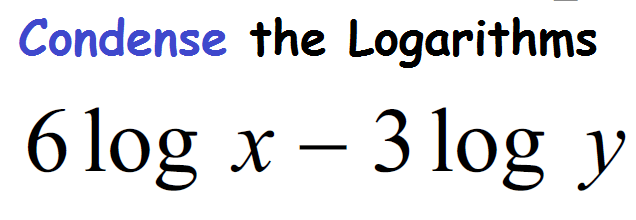
log(yz8x)
log8+logx-logy-logz
log8+logx-logy+logz
log(8x)-log(yz)
8logx-ylogz
log636 = 2
When you have two log expressions separated by a minus sign (-), we really need to ___________ them to simplify into one log expression.
add
subtract
multiply
divide
When you have two log expressions separated by a plus sign (+), we really need to ___________ them to simplify into one log expression.
add
subtract
multiply
divide
log(54) Expand the Log
log4 +log5
log 20
log4 −log5
log2 5x.


Expand
log212a−log25
log512a−log52
log512−log5a−log52
log512+log5a−log52


Use the change of base rule to rewrite this problem:
log575
log(75)/log(5)
log(5)/log(75)
Use the change of base rule to rewrite this problem:
log6216
log(6)/log(216)
log(216)/log(6)
Use the change of base rule to rewrite this problem:
log7729
log(7)/log(729)
log(729)/log(7)
Use the change of base rule to rewrite this problem:
log575
log(75)/log(5)
log(5)/log(75)
Use the change of base rule to rewrite this problem:
log6216
log(6)/log(216)
log(216)/log(6)
Use the change of base rule to rewrite this problem:
log7729
log(7)/log(729)
log(729)/log(7)

You want to solve for x. Which of these is the correct "step 1"?
log78=log7x
log742=log7x
log748=log7(6x)
log754=log7x

After step 1 is completed, we get to here. What's the same about the left and right sides of the equation? What's different?

Finish solving for x
x = 6
x = 7
x = 8
x = 56

We want to solve for x. What's the first step?
Rewrite as a logarithm: log1893=x
Rewrite as a logarithm: log3189=x
Rewrite 189 with a base of 3: 3x=363
Rewrite 189 with a base of 3: 3x=39

Finish solving for x.
0.210 = x
5 = x
63 = x
4.771 = x
4.462 = x

We want to solve for x. Which of these is the correct "step 1"?
log(64)=log(3x)
log(16)=log(x3)
log(16)=log(3x)
log(64)=log(x3)
log(1)=log(x3)

Continue solving for x. Which is the correct "step 2"?
64=x3
643=x
x64=3
364=x

Finish solving for x.
Fill in the blank in the box below
(a)

Which is the correct "step 1" to solve for x?
Hint: look at the schoology discussions if you feel stuck
log2(100x5)=7
log2(95x)=7
log2(20x)=7
log2(500x)=7

Finish solving for x.
Hint: look at the schoology discussions if you're stuck
x = 0.175
x = 6.4
x = 0.7
x = 12.8
Solve for x: 9x=60
1.748
x = 6.667
x = 0.537
x = 1.863
Solve for x.
log52+log5x=log520
x = (a)
Solve for x.
2log410=log4(8x)+log4(5)
x = 2.5
x = 0.5
x = 1.538
x = 11.875
Which formula(s) should you use for compound interest?
select ALL that apply.
A=P(1+r)t
P+I=A
A=P(1+r)t
Ms. Pierson is working out a compound interest problem. This is what she plugged into her calculator:
500(1+1003)7
Did she do that correctly?
Yes, everything looks good!
No, she made a mistake :(
Your 3 year investment of $20,000 received 5.2% interest compounded annually. What will your total balance be at the end?
$23,285.05
$3,285.05
$2,385
$32,285
The Arnold's took out a loan for $195,000 to purchase a home. At a 4.3% interest rate compounded annually, how much interest will they have paid over the course of 30 years?
$494,546.99
$529.305.61
$689,546.99
$640,891.53
You borrowed $1,690 for 5.5 years at an interest of 5.7% compounded annually. How much extra did you pay by taking out the loan?
$602.45
$2,292.45
$1,87.55
$3,982.45
Your $440 gets 5.8% interest compounded annually for 8 years. What will your total balance be in 8 years?
Don't forget to round your answer to 2 decimal places.
(a)
Jay'den earned $475 from mowing lawns last summer. He deposited this money in an account that pays an interest rate of 3.8% compounded annually.
How much interest will he end up earning over the course of 15 years?
Don't forget to round your answer to 2 decimal places.
(a)
Which formula(s) should you use for compound interest?
select ALL that apply.
A=P(1+r)t
P+I=A
A=P(1+r)t
Ms. Pierson is working out a compound interest problem. This is what she plugged into her calculator:
500(1+1003)7
Did she do that correctly?
Yes, everything looks good!
No, she made a mistake :(
Your 3 year investment of $20,000 received 5.2% interest compounded annually. What will your total balance be at the end?
$23,285.05
$3,285.05
$2,385
$32,285
The Arnold's took out a loan for $195,000 to purchase a home. At a 4.3% interest rate compounded annually, how much interest will they have paid over the course of 30 years?
$494,546.99
$529.305.61
$689,546.99
$640,891.53
You borrowed $1,690 for 5.5 years at an interest of 5.7% compounded annually. How much extra did you pay by taking out the loan?
$602.45
$2,292.45
$1,87.55
$3,982.45
Your $440 gets 5.8% interest compounded annually for 8 years. What will your total balance be in 8 years?
Don't forget to round your answer to 2 decimal places.
(a)
Jay'den earned $475 from mowing lawns last summer. He deposited this money in an account that pays an interest rate of 3.8% compounded annually.
How much interest will he end up earning over the course of 15 years?
Don't forget to round your answer to 2 decimal places.
(a)
Does the function y=4e0.75x represent exponential growth or decay?
Exponential growth of 75%
Exponential decay of 75%
Exponential growth of 25%
Exponential decay of 25%
Tritium is a chemical that decays over time. In a sample of tritium, the amount y(in millligrams) remaining after t years is given by the equation below. How much Tritium will be left after 10 years? Round to 2 decimal places. y=10e−0.0562t
4.84
5.71
1.32
3.84
Tritium is a chemical that decays over time. In a sample of tritium, the amount y(in millligrams) remaining after t years is given by the equation below. What is the half-life of Tritium? Round to 2 decimal places. y=10e−0.0562t
5.00 minutes
7.87 minutes
10.24 minutes
12.33 minutes
Miguel had 25 bacteria in his petri dish at 2 PM. There were 72 in the dish at 2:30 PM. Assuming exponential growth, at what rate are they increasing?
9.6% per minute
0.03526% per minute
35.26% per minute
3.526% per minutes
The population of Guyana was roughly 787,000 in 2020 and 747,000 in 2000. If the population is growing exponentially, what is the rate of growth?
0.002608
0.00113
0.0527
.2608
Which expression does NOT represent exponential decay?
5(0.86)x
5e−0.14
5e0.14x
5(0.14)x
If a population of 300 animals in a certain region is growing exponential at 2% per year, when will the population reach 400?
14.4 years
15 years
6.2 years
20 years
A new computer continuously loses about 45% of its value each year. If Monique spent $1600 on her computer, how much will it be worth in 5 years?
$1420.00
$146.31
$65.61
$168.64
32=64er(23)
Using this equation above where the time is in hours, which of the following are true? Select all that apply.
The half-life is 23 hours.
The start amount is 64.
The equation represents exponential growth.
r will be a negative number.
The half-life is 32 hours.
Without doing any calculations, which one will increase the fastest?
100(1+4.03)4(t)
100(1+2.03)2(t)
100e.03(t)
100(1+12.03)12(t)