
 Worksheets
Airway Management Review
Total questions: 20
Worksheet time: 11mins
The exchange of oxygen and carbon dioxide between the systemic circulation and the cells of the body is:
Anaerobic metabolism
Internal respiration
External respiration
Metabolic respiration
The narrowest portion of the adult trachea is the:
Carina
Larynx
Cricoid Cartilage
Glottic opening
Which of the following patients would benefit most from the use of CPAP?
A patient with signs of shock and two-word dyspnea who cannot hold his head up
A patient with COPD c/o of a stomach bug
A patient with rales and pedal edema struggling to breath but alert
A patient who suffered a blow to the chest, is in respiratory distress and has unequal chest wall movement
You are responding to a 68 y/o male patient who is complaining of SOB. The patient is tripoding and anxious. The patient answers questions by nodding or shaking his head, though he seems slow to respond and confused at times. His vitals are RR 30/min and shallow, SPO2 90%, P134. You should:
Assist ventilations, evaluate perfusion, and transport
Give supplemental O2 via NRB, listen to breath sounds, and treat for shock
Apply a nasal cannula at 6lpm, assess the skin, transport
Open the airway, suction, and place patient on a NRB at 15 lpm
Which of the following is not a contraindication to the use of CPAP?
Cardiogenic shock
Recent GI surgery
Closed head injury
Systolic BP of 102
Why is hypotension a risk of CPAP use?
As intrathoracic pressure builds, venous blood return to the heart meets resistance and preload drops
Increased intrapulmonary pressure forces fluid out of the alveoli causing a drop in the amount of fluid in the vasculature
Increased intrathoracic pressure forces vasodilation and preload decreases as a result
Cardiac output is decreased due to an overall reduction of systemic circulating volume when CPAP is applied
Which of the following structures is designed to increase the surface area of the nasal passage to allow more time for warming, humidifying, and filtrating inspired air?
Turbinates
Visceral Pleura
Nasal Cincher
Surfactant
The manubrium is:
The bottom point of the sternum
The point of bifurcation of the trachea
The top portion of the sternum
None listed
All of the following are within the mediastinum except: Select all that apply.
Lungs
Heart
Great Vessels
Esophagus
Trachea
Which of the following is the process by which we naturally breath?
Positive Pressure Ventilation
Diffusion
Negative Pressure Ventilation
Oxygenation
Respiration
Which process of ventilation is passive?
Inspiration
Expiration
Hering Brewer Reflex
Respiration
Which of the following describes that amount of air that can be forcibly exhaled from the lungs after breathing in deeply?
Tidal Volume
Residual Volume
Vital Capacity
Minute Volume
Alveolar Minute Volume
What is the stimulus that triggers us to take a breath?
Oxygen Depletion
CO2 Excess
Hypoxia
External Aerobia
What is the partial pressure of oxygen in exhaled air?
21%
19%
23%
16%
Which of the following have neural control of breathing? Select all that apply.
Cerebellum
Cerebrum
Medulla
Pons
Limbic System
A patient in respiratory acidosis will display what type of breathing pattern?
Hyperventilation
Kussmaul Respirations
Hypoventilation
Eupnea
Chemoreceptors that measure the amount of CO2 in arterial blood are located where? Select all that apply.
Plasma
Adjacent to the respiratory centers in the medulla
Aortic Arch
Carotid Bodies
Ventral Respiratory Group
Which of the following describes low levels of oxygen in the arterial blood?
Hypoxia
Shock
Hypoxemia
Anoxia
Which of the following monitoring devices monitors ventilation?
Pulse Ox (SPO2)
Peak Expiratory Flow Measurement
ETCO2 Assessment
EDD
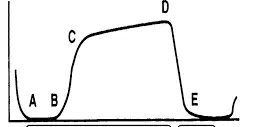
Which of the following points is the measurement of CO2 in expelled air?
A
B
C
D
E

