
 Worksheets
P5 Religion UT - Term 1 (Solomon & Esther)
Total questions: 69
Worksheet time: 41mins
When God appeared to King Solomon in a dream and gave him the opportunity to ask for anything, what did Solomon ask for?
Great wealth and many riches
Defeat of all his enemies
A long and healthy life
Understanding and wisdom to lead God's people
King Solomon was famous for his wisdom. What is the definition of wisdom?
Knowing and doing it the godly way and good way
Knowing lot about things and sharing it with everyone
Acting smart only but is really bad
Being the best at everything
Why was God pleased with King Solomon's request in 1 Kings 3:9–10?
Because Solomon asked for power to conquer surrounding nations
Because Solomon asked for wisdom to help his people rather than selfish things
Because Solomon asked to build the largest palace in the world
Because Solomon requested that his name be remembered forever
What is the central theme of this passage based on 1 Kings 3:1-15?
The importance of wisdom in leadership
The power of prayer
The love between a father and son
The dangers of pride
How did King Solomon solve the dispute between the two mothers claiming ownership of the same living baby (1 Kings 3:16–28)?
He flipped a coin to decide who would get the baby
He ordered the baby cut in two, revealing the true mother who showed compassion
He kept the baby in the palace to be raised as a prince
He gave the baby to a court official to raise
What did King Solomon ask for when God appeared to him in a dream? (1 Kings 3:9)
Wealth (all the material and treasure)
Knowledge (to know everything in life)
Wisdom (to judge between good and evil)
Power (to rule all over the world)
What major construction project on Mount Zion did Solomon execute using God's wisdom?
The Ark of the Covenant
The Temple of the Lord
The Tower of Babel
The Gardens of Babylon
Why was the Lord pleased with Solomon's request?
Solomon asked for something selfish.
Solomon asked for something that would benefit himself.
Solomon asked for something that would benefit God's people.
Solomon asked for something that was easy to grant.
How did Solomon demonstrate his continuous humility and gratitude to God despite his great power?
By writing laws that banned trading with other countries
By regularly offering burnt offerings, incense, and prayers to God
By stepping down from being king every Sabbath day
By giving away his palace to the poor
What does King Solomon's choice to ask for wisdom instead of wealth or power teach us about the importance of seeking knowledge and understanding in our lives?
Wealth and power are the most important goals in life.
Wisdom and understanding are more valuable than material possessions.
Seeking knowledge will always lead to personal riches.
Power is the key to success, and wisdom is secondary.
If a grade 5 student faces a choice between playing video games or completing their homework first, how can Solomon's example of wisdom guide their decision?
Choose whatever brings immediate fun regardless of consequences
Ask a friend to complete the homework for them
Use wisdom to discern what is right and prioritize important responsibilities
Play games until late at night and skip school the next day
What was the significance of Solomon's dream and his subsequent actions?
It showed that Solomon was a wise king.
It showed that Solomon was a powerful king.
It showed that Solomon was a humble king.
It showed that Solomon was a faithful king.
What primary gift from God did Esther possess and use alongside her simplicity to stand up for what is right?
Superior military training
Deep knowledge of foreign political laws
A beautiful face and a caring, faithful heart
Wealth inherited from her ancestors
Solomon judged wisely over the rightful mother of a child, but how did he determine who the child belonged to? (1 Kings 3:25)
Threatened to divide the child (with a sword)
Threatened to punish two women (to be jailed)
Threatened to kill one of the women (with a knife)
Threatened to take care of the child ( to adopt the child)
Why was Esther’s decision to approach the king on behalf of her people considered a major act of courage?
She risked her life by approaching the king to defend her people
She had to travel across the entire continent on foot
She was giving up her royal inheritance to become a servant
She was challenging the king to a physical duel
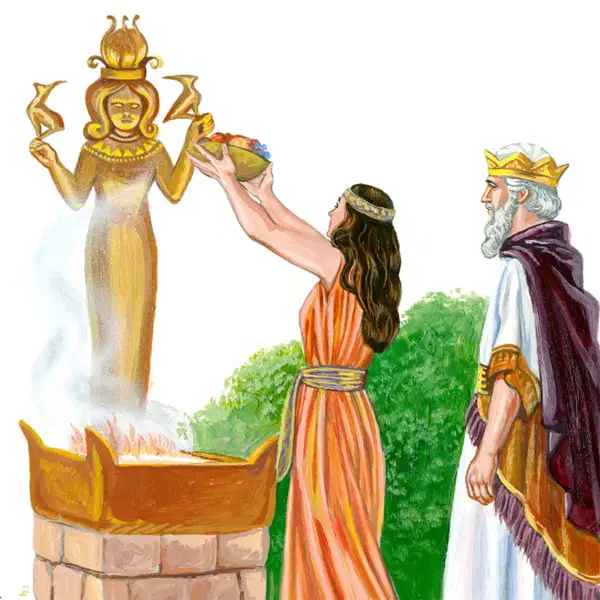
Why did Solomon turn away from God when he was old? (1 Kings 11:4)
Because his foreign wives turned his heart after other gods
Because he lost in a battle and he was forced to worship idols
Because his only son died that make him turned back from God
Because he killed many people during the war
What key spiritual truth is illustrated by Esther being placed in the king's palace as queen?
Success is purely the result of good luck
God places people in specific positions 'for such a time as this' to fulfill His divine purpose
Being royal means one never has to worry about others
God only uses powerful political leaders to accomplish His plans
As a king, Solomon also is known as one of the writers of the Bible. What are the books in the Bible written by Solomon?
The book of Psalm, Genesis, Exodus and Numbers
The Book of Proverbs, the Song of Solomon, and Ecclesiastes
The book of Matthew, Mark, Luke and John
The book of Isaiah, Leviticus, 1-2 Kings
In Esther 7:1-6, what action did Queen Esther take during the banquet with the king?
She asked the king for more gold and silver for her family
She exposed the plot against her nation and pleaded for the salvation of her people
She announced that she was abandoning the palace to return home
She organized a feast to celebrate military victories
Solomon's wisdom was on full display when ....
he showed mercy to Adonijah
he married the Queen of Sheba
he settled the dispute of two mothers
he had Joab killed
What does Solomon’s prayer in 1 Kings 3:9 ('Give Your servant a heart to judge Your people...') reveal about true leadership?
True leadership is about holding total authority over others
True leadership begins with humility, prayer, and a desire for justice
True leadership requires accumulating vast personal fortunes
True leadership means making decisions based on personal gain
Which of the following statement is INCORRECT about king Solomon?
Solomon was the son of King David and Bathsheba who known for his wisdom and riches.
Solomon was Jacob favorite son who become second-in-command of Egypt and God uses him to save his entire family in Egypt from starvation.
Solomon had seven hundred wives who were from royal families and three hundred slave women who gave birth to his children.
Solomon built the first temple in Jerusalem and made a famous ruling involving two women and a baby.
Why is inner beauty and a caring heart considered more valuable in Esther’s story than physical appearance alone?
Physical beauty disappears, but inner beauty drives actions that save lives and reflect God's love
Physical appearance was ignored by the king completely
Inner beauty allows a person to gain material wealth faster
Physical beauty is useless in royal palaces
Solomon felt he didn't have the experience to rule Israel. He also wanted to be a great king like his father. He didn't pray for long life or wealth, but for ....
an understanding heart and the wisdom to be able to tell good from evil.
a great and famous king and all the selfish things
a power of God to defeat all his enemies
getting many wives in order to have more children or descendants
How does Solomon's choice of wisdom over riches evaluate the ultimate source of true success?
Wealth automatically guarantees wisdom and happiness
True riches consist of a wise heart that seeks God's will rather than material possessions
Riches are bad and should always be rejected by godly people
Power is the single most important tool to help society
How did Queen Esther synthesize (combine) her personal privilege as queen with her faith?
She used her privilege to isolate herself from the problems of her people
She used her position and courage as an instrument to carry out God’s protection for her people
She surrendered her royal crown to live in hiding
She convinced the king to make her the sole ruler of the empire
What is the primary message of this story based on 1 Kings 3:16-28 (A Wise Ruling)?
The importance of justice and fairness in leadership
The power of deception and manipulation
The dangers of trusting strangers
The value of motherhood.
Based on the lessons from both King Solomon and Queen Esther, what defines modern leaders needed in society today?
Leaders who prioritize personal wealth and quick fame
Leaders who are wise, willing to learn, think about the future, and fight for the common good
Leaders who rely on strict force without showing mercy
Leaders who avoid making tough decisions when challenges arise
How does the story of King Solomon's wisdom and fair judgment inspire you to seek wisdom and make just choices in your own interactions with others?
It teaches me that making fair judgments is only important for leaders and rulers.
It inspires me to pursue wisdom, so I can handle difficult situations with fairness and understanding.
It shows that wisdom is not necessary in everyday decisions, only in important matters.
It encourages me to focus more on my own success than on helping others make fair decisions.
How can you apply the principles of fairness and empathy in your daily life?
By always putting my own needs and desires first because it is the most important thing.
By listening to others’ perspectives and treating everyone with kindness and respect.
By only being fair to those who agree with me because it will make me feel good.
By avoiding difficult situations to prevent conflict because everyone deserves to live a happy life.
What was the name of Solomon’s son who succeeded him as king? (1 Kings 11:43)
(a)
- "I will give you what you have not asked for— both wealth and (a) —so that in your lifetime you will have no equal among kings." (1 Kings 3:13)
"The woman whose son was alive was deeply moved out of love for her son and said to the king, 'Please, my lord, give her the (a) baby! Don’t kill him!'" (1 Kings 3:26)
"So God said to him, 'Since you have asked for this and not for long life or wealth for yourself, nor have asked for the (a) of your enemies, but for discernment in administering justice.'" (1 Kings 3:11).
- Israel split into two kingdoms after the reign of King Solomon, with Israel in the North, but what was the name of the Southern kingdom? (1 Kings 12:20-21).
(a)
"So give your servant a discerning heart to govern your people and to distinguish between right and (a) ."(1 Kings 3:9)
The prophet who delivered God's message to King Solomon and who previously rebuked King David for his sins with Bathsheba and Uriah. (1 Kings 1:22-23)
(a)
"I will give you a wise and discerning (a) , so that there will never have been anyone like you, nor will there ever be." (1 Kings 3:12)
"Now, Lord my God, you have made your servant king in place of my father (a) ."(1 Kings 3:7)
"When all Israel heard the verdict the king had given, they held the king in (a) , because they saw that he had wisdom from God to administer justice."(1 Kings 3:28)
What lesson can we learn from Solomon's decision to prioritize wisdom over material wealth?
Material wealth is the key to happiness.
Wisdom leads to better decision-making and fulfillment.
Power is more important than knowledge.
Wealth can buy wisdom.
What can we infer about the relationship between wisdom and leadership from Solomon's story?
Leadership requires only strength and power.
Wise leaders are more likely to gain the trust of their people.
Wisdom is not necessary for effective leadership.
Leaders should focus solely on their own interests.
In what ways can the story of King Solomon's request for wisdom influence your approach to problem-solving in your life?
It encourages me to rely solely on my instincts without seeking advice.
It motivates me to seek knowledge and understanding before making decisions.
It suggests that wisdom is overrated and not necessary for success.
It teaches me that asking for help is a sign of weakness.
How does Solomon's ability to discern the true mother of the child reflect the qualities of a good leader?
It shows that a good leader must be decisive and authoritative.
It highlights the importance of empathy and understanding in leadership.
It indicates that leaders should avoid making tough decisions.
It suggests that leaders should prioritize their own interests over others.

Mordecai worked at the palace in Persia and looked out for Esther. Who was Mordecai?
According to Esther 3:2-6, why did Haman want to destroy all the Jews?
He wanted to destroy the Jews because they had stolen his money.
He wanted to destroy the Jews because Esther was a Jew, and Haman did not want her to be queen.
He wanted to destroy the Jews because Mordecai would not bow down to him, so he hated Mordecai and his people.
He wanted to destroy the Jews because they had taken control of the Persian Empire.
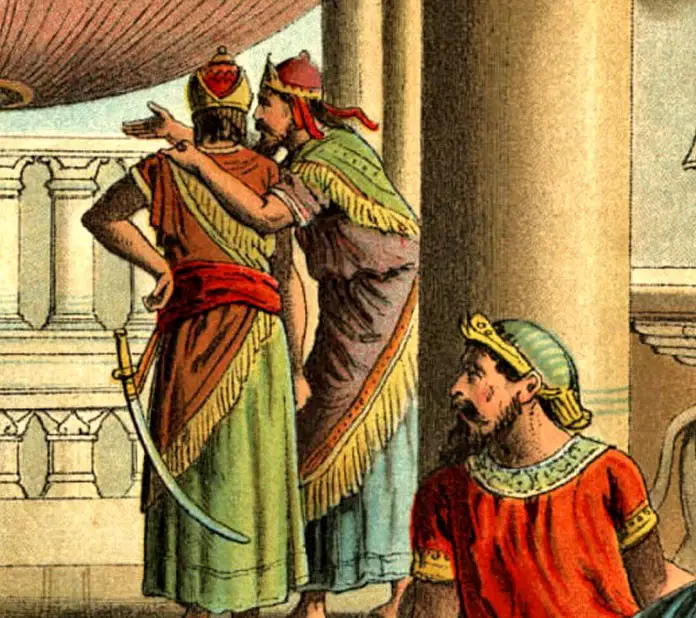
Why was the plan of killing the king of Persia failed?
Based on Esther 4:11, why was Esther afraid to approach King Ahasuerus uninvited?
She was afraid because the penalty for approaching the king without being called was death.
She was afraid because if she approached the king, he might decide to make her queen.
She was afraid because the king hated her.
She was afraid because she had never met the king before.
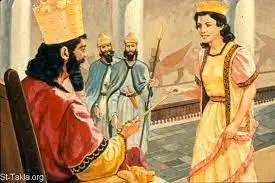
What happened to the Queen after she approached King Ahasuerus uninvited?
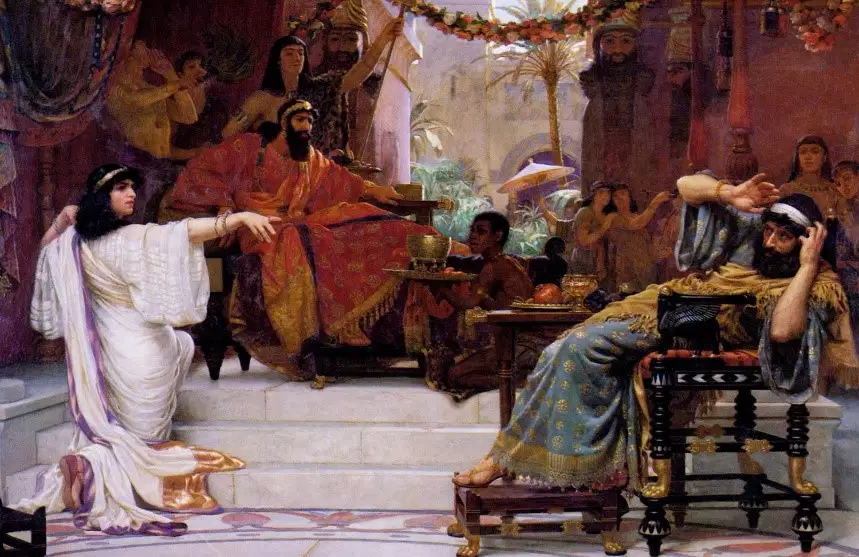
What was the next thing that the queen did to the king after approaching him uninvited?
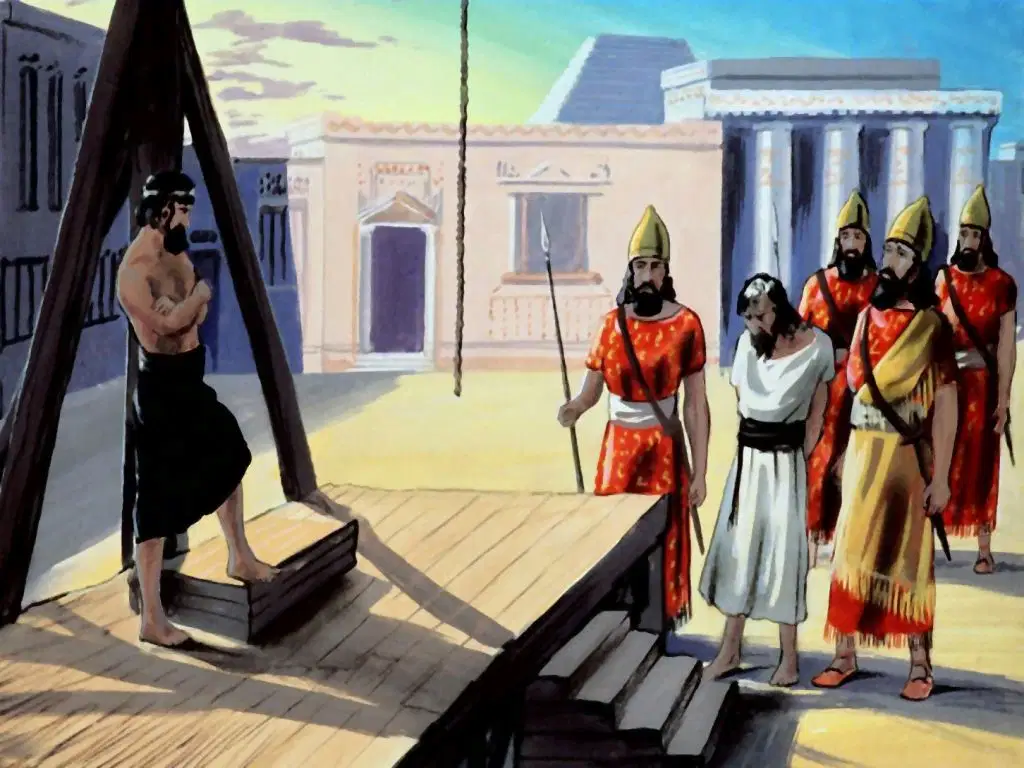
What happened to the arrogant and wicked man, Haman at the end?
He was hanged and killed.
He ran to the other kingdom.
He became a slave to the queen.
He was sent to the battle and died.
Why did Haman want to destroy all the Jews?
In Esther 4:16, Queen Esther says, "If I perish, I perish." What is the main meaning of this verse?
Esther is giving up because she is afraid.
Esther is willing to risk her life to save her people.
Esther is asking someone else to go before the king for her.
Esther is angry and doesn’t care what happens to her.
What lesson do we learn from the story of Queen Esther?
What kind of characteristics does the queen show us in the story?
What did Esther do before going to the king?

In the Catholic Church Tradition there was a female figure who has a spirit of caring, very concerned about the poor, sick and suffering in Calcutta, India. Who is she?
Mother Teresa
Elizabeth
Mother Mary
Mary Magdalene
Esther was a _____ girl who had been taken captive.
Jewish
Persian
Balylonian
Roman
What was the name of Persia’s king who looked for a new queen?
Ahasuerus
Haman
Mordecai
Esther
Esther asked support from all the Jews through her uncle Mordecai. She asked the Jews to fast and pray for her for _______ days.
three
forty
nine
five
Based on Esther 2:7, what was the real name of Esther since she lived in Persia so that her name did not appear to be a descendant of Israel?
Hegai
Abihail
Shimei
Hadassah
According to Esther 3:1-2, there was a wicked man who tricked the king of Persia into signing a law by giving the king's ring that at a certain time, every Jew in the kingdom would be killed. Who is the wicked man?
Zechariah
Xerxes
Haman
Mordecai
According to Esther 3:2-6, why did Haman want to destroy all the Jews?
He wanted to destroy the Jews because they had stolen his money.
He wanted to destroy the Jews because Esther was a Jew, and Haman did not want her to be queen.
He wanted to destroy the Jews because Mordecai would not bow down to him, so he hated Mordecai and his people.
He wanted to destroy the Jews because they had taken control of the Persian Empire.
Why did Esther risk her life to go before the king without being called?
She wanted to become famous.
She wanted to save her people from destruction.
She wanted to ask for more wealth.
She wanted to throw a big celebration.
What message can we learn from Esther's courage?
We should always look for praise from others.
Standing up for others can make a positive difference.
It's better to stay silent than to speak up.
Only powerful people can make a change.
How does Esther's story inspire us in real life?
To be brave and stand up for what's right, even if it's hard.
To try to make as many friends as possible.
To stay quiet and let others solve problems.
To only care about ourselves and our own success.
What was the name of the arrogant man who wanted people to pay respect by bowing to him and who plotted against the Jews? (Esther 3:1)
(a)
Esther's cousin who raised her and who brought Esther to Persia and encouraged her to save her people. (Esther 2:7)
(a)
Esther asked support from all the Jews to fast and pray for her for (a) days. (Esther 4:16)