
 Worksheets
Ancient Greece Test
Total questions: 26
Worksheet time: 13mins
Name
Class
Date
1.
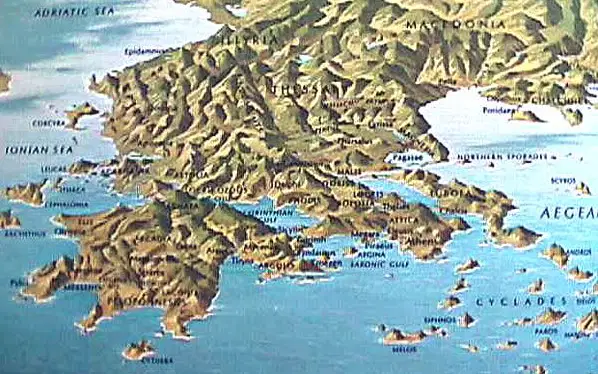
How did the geography of Greece affect its development?
a)
The cold weather prevented any agriculture from succeeding.
b)
The many mountains and seas caused many rival city-states to develop.
c)
The few natural barriers allowed one strong clan to unite the entire country.
d)
The intense heat generally forced most outdoor activities inside.
2.
What two things did each Greek city-state have in common?
a)
currency and government
b)
social structure and topography
c)
economic base and attitude toward slaves
d)
religion and language
3.
What was NOT true of ancient Greece?
a)
The mountains and seas prevented trade.
b)
The limited amount of good farmland led to increased trade and colonization.
c)
The lack of a central government led to constant tribal warfare.
d)
Cities were built for use as defensive fortresses.
4.
After the fall of the Minoans and Mycenaean, the Dorian Period was known as -
a)
the Golden Age
b)
the Dark Age
c)
the Middle Period
d)
the Bronze Age
5.
Which is a true statement about the democracy of ancient Athens?
a)
Every person was able to vote in government.
b)
Only the extremely wealthy were able to participate in government.
c)
All citizens were able to vote or hold a political office.
d)
Citizens were not allowed to freely speak their opinion about the government.
6.
Who decided the laws in Athenian democracy?
a)
elected officials
b)
citizens
c)
slaves
d)
the king
7.
What group was allowed citizenship in Athens?
a)
free men
b)
young children
c)
women
d)
slaves
8.
Which city-state was characterized by strong military discipline, more freedoms for women, and severe treatment of slaves?
a)
Athens
b)
Corinth
c)
Sparta
d)
Syracuse
9.
Which is NOT an accurate description of a type of government used in ancient Greece?
a)
democracy - rule by common citizens
b)
aristocracy - rule by wealthy citizens
c)
tyranny - rule by adult males
d)
monarchy - rule by King or royal dynasty
10.
What war saw a united Athens and Sparta against an Asian foe?
a)
First Persian War
b)
Second Persian War
c)
Peloponnesian War
d)
Trojan War
11.
What did the Persian and Peloponnesian wars indicate about the relationship between Sparta and Athens?
a)
They always fought on same side in war.
b)
They were not very successful in war.
c)
They sometimes fought with and sometimes against each other.
d)
They usually fought each other and had a long, bitter relationship.
12.
Which is the best description of the Delian League?
a)
a trade alliance that linked the Greek city-states with Northern Africa
b)
an athletic league designed to promote the Greek athletic stars
c)
a military alliance between Athens and other Greek city-states
d)
a secret agreement amongst the great Greek philosophers to spread their political beliefs
13.
What happened in Athens during the “Golden Age” of Pericles?
a)
Athens became the sole military power in the world by invading and defeating the Persians and Egyptians.
b)
A gold deposit was found in the Athenian foothills making the city the most wealthy in the world.
c)
Politics and architecture flourished in the city as it became the center of Greek culture.
d)
The capital city of the Greek nation was moved to Athens and it became the largest city in the world.
14.
What was the form of government in Athens during its Golden Age under Pericles?
a)
socialism
b)
democracy
c)
oligarchy
d)
aristocracy
15.
Which wonder of the ancient world was created by the sculptor, Phidias?
a)
Colossus of Rhodes
b)
Hanging Gardens of Babylon
c)
Zeus at Olympia
d)
Temple of Artemis
16.
Who is considered the "father of history" and wrote about the Persian Wars?
a)
Thucydides
b)
Socrates
c)
Herodotus
d)
Pericles
17.
What philosopher taught that the way to seek truth is through a series of questions and answers?
a)
Socrates
b)
Plato
c)
Aristotle
d)
Thales
18.
What group eventually conquered the Greek city-states?
a)
Egypt
b)
Macedonia
c)
Mesopotamia
d)
Gaul
19.
What is the Hellenistic Age known for?
a)
diffusion of Greek ideas eastward.
b)
supremacy of Athens in the Mediterranean.
c)
Egypt conquers Nubia.
d)
Rome establishes an empire.
20.

How did Alexander the Great spread Greek culture?
a)
his writings
b)
through word of mouth
c)
by being the model of the perfect human.
d)
through conquest
21.
Greek has many _________that are like mini countries.
a)
counties
b)
city-states
c)
provinces
d)
parishes
22.
What is another name for a Greek city-state?
a)
pantheon
b)
ziggurat
c)
town
d)
Polis
23.
What are two city-states that we've been learning about?
a)
Cairo and Memphis
b)
Tigris and Euphrates
c)
Rome and Venice
d)
Athens and Sparta
24.
What was the outcome of the Peloponnesian War?
a)
Athens won and expanded its empire
b)
Sparta won and imposed its rule over Athens
c)
It ended in a stalemate with no clear winner
d)
Persia intervened and conquered both Athens and Sparta
25.
What was the primary form of government in Sparta?
a)
Democracy
b)
Oligarchy
c)
Monarchy
d)
Theocracy
26.
Which city-state was known for its focus on education, art, and philosophy?
a)
Sparta
b)
Athens
c)
Corinth
d)
Thebes
100 %

