
 Worksheets
Spanish 1 Grammar Review (24-25)
Total questions: 100
Worksheet time: 2hrs 14mins


Which Spanish subject pronoun would you use to replace “María y Paula”?
nosotras
ustedes
ellas
ella


Match the following
I
YO
YOU, MARÍA
TÚ
My FRIENDS AND I
NOSOTROS
YOU (an adult)
USTED
JUAN
ÉL

Match the following English Subject Pronoun to its Spanish counterpart.
We (girls)
Nosotras
They (boys and girls)
Ellos
We (boys)
Nosotros
You formal
Usted
You informal
Tú
Match the pronoun that you would use to replace the subject in Spanish.
Mi mamá
Ella
Mi perro
El
Mis amigos y yo (boys & girls)
Nosotros
Los estudiantes
Ellos

Vosotros
Jeremiah y Alvin son muy estudiosos. (a) hacen la tarea.
If you were talking to your younger cousin, which of the following pronouns would you use?
tú
usted
Which Spanish subject pronoun would you use to replace “María y Santiago”?
nosotros
ellos
ustedes
yo

To talk TO your female teacher, use...
tú
usted
ustedes
ella
What does the subject "TÚ" mean?
you (informal)
he
we
you (formal)

How do you conjugate the verb "SER" for yo?
es
somos
eres
soy
¡Hola! Yo ______ un amigo de Marcos.
Nosotros ______ alumnos en una escuela secundaria en Nueva York.
Marcos ______ un alumno muy bueno en matemáticas.
Marcos y yo ______ muy buenos amigos.
How do you conjugate ser for Rosa y ella?
es
son
somos
sois
How do you conjugate "SER" for Juan y yo?
soy
eres
es
somos

A mí __ gusta jugar tenis.

A ti __ gusta practicar el golf con tu padre.

A ellas _ gusta escuchar la música.


A mí ___________ la pizza.
Me gusta
Te gusta
Nos gusta
Le gusta

A Juan _______ las papas fritas.
me gustan
te gustan
le gustan
nos gustan

What is the correct form of the verb "nadar" if "tú" is the subject?
estudiar - Tú _____________

What is the correct form of the verb "Cocinar" if "Nosotros" is the subject?
cocinamos
cocináis
cocinan
cocino
yo/estudiar
estudio
estudias
estudia
estudian

tú/bailar
bailas
baila
bailan
bailo

yo/escuchar
escucho
escuchas
escuchamos
eschuca

los amigos/trabajar
trabajan
trabaja
trabajas
trabajamos
Which of the following are the -ar verb endings?
-o, -as, -a, -amos, -an
-o, -es, -e, -emos, -en
-o, -es, -e, -imos, -en
-e, -as, -a, -emos, -an
Which -ar verb ending goes with the subject pronoun "ella?"
es
imos
e
a
Which -ar verb ending goes with the subject pronoun "yo?"
o
as
a
en

Which of the following is an -ar verb?
escribir
cantar
comer
conducir


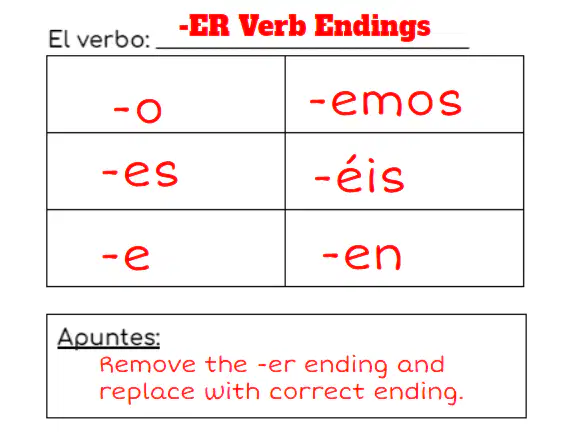
In ER verbs what is the ending used for Nosotros
-en
-o
-emos
-éis
-o is what present tense ending
Nosotros
Tú
Ello, Ellas,
Ustedes
Yo

Ellas______ las papas fritas. (comer)
comen
comer
como
comemos

Sandra, Javier y Yo________ un libro
leemos
leer
comemos
leen


Yo ___________ la pizarra. (ver)

Ella (correr) mucho.
corre
corra
corri
corro

Beber (nosotros)
bebemos
bebimos
bebo
bebamos
What is the first step when you want to conjugate a verb?
(When you want to use a verb in a sentence.)
Remove the last letter
Add an ending
Add the letter 'o'
Remove the last two letters
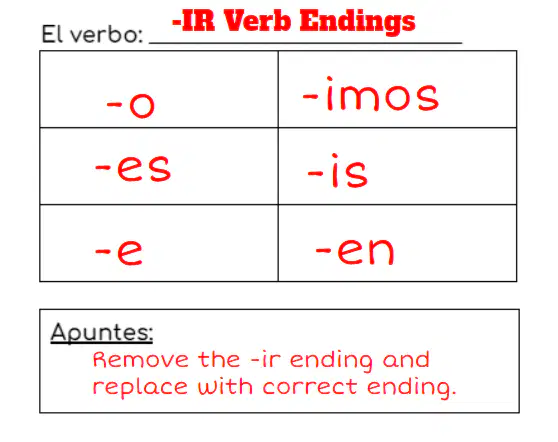

Yo ______ (vivir) en una casa azul.
vive
viven
vivo
vives

él / escribir
escribo
escribes
escribe
escriben

la clase y yo / escribir
escribemos
escribimos
escribís
escriben

Sammy y Izzy / escribir
escriben
escribís
escribimos
escribe

ella / abrir
abro
abre
abres
abri

yo / abrir
abro
abre
abriro
abroy
-er & -ir verbs share all of the same present tense ending EXCEPT in the . . .
yo & nosotros forms
tú & él forms
nosotros & vosotros forms
vosotros & ellos forms
Which of the following Spanish verbs means to go?
bailar
ser
ir
vivir
How do you say I go?
(Conjugate ir in the yo form)
yo voy
yo estoy
yo soy
yo vivo
How do you say you go?
(Conjugate ir in the tú form)
tú eres
tú estás
tú comes
tú vas
How do you say she goes?
(Conjugate ir in the ella form)
ella va
ella es
ella está
ella llama
How do you say we go?
(Conjugate ir in the nosotros form)
nosotros bailamos
nosotros bebemos
nosotros vamos
nosotros vivimos
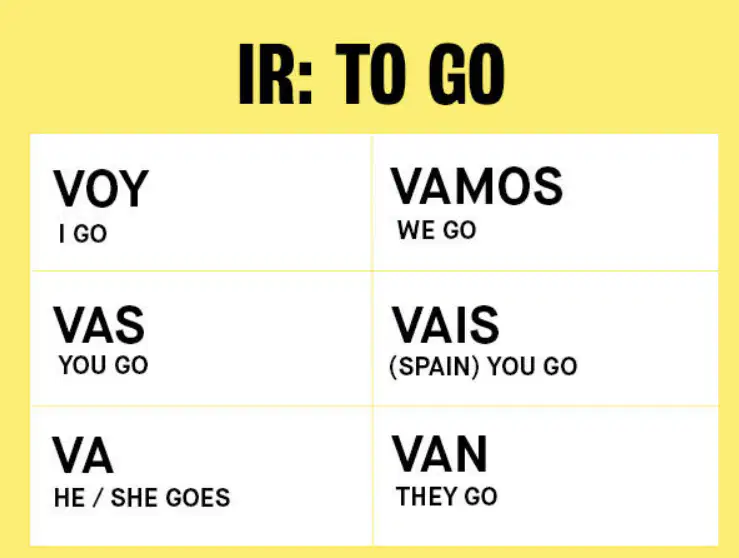
How do you say they go?
(Conjugate ir in the ellos form)
ellos son
ellos llaman
ellos están
ellos van
Ir = ??
to be
to go
to have
to be going to

What is the correct conjugation of ir for the subject Nosotros?
Voy
Vas
Va
Vamos

What is the correct conjugation of ir for the subject Tú?
Voy
Vas
Va
Van

What is the correct conjugation of ir for the subject Yo?
Voy
Vas
Vamos
Van
a + el =
a el
al
a la
ael

Yo voy _____ piscina en el verano para nadar. ("la" piscina).
a la
al
a el

Mis amigos y yo vamos _______ gimnasio para hacer ejercicio. ("el" gimnasio)
a la
al
a el

¿Tú ______ al cine con tus amigos el viernes?
voy
va
vas
van

Los estudiantes _______ a la biblioteca para estudiar el vocabulario.
vamos
van
vas
voy
Mi familia y yo _______ a las montanas en el invierno para esquiar.
voy
vas
van
vamos

Me gusta ir ___ partidos de fútbol. ("los" partidos)
I like to go to the soccer games.
al
a los
a las
a la

Vamos ___ parque. ("el" parque)
We go to the park.
al
a los
a las
a la

Voy ___ montañas. ("las" montañas)
I go to the mountains.
al
a los
a las
a la

Voy ___ cine. ("el" cine)
I go to the movie theater.
al
a los
a las
a la
What is the STEM of a verb?
The -ar, -er, -ir ending on a verb
The part of the verb MINUS the -ar, -er, and -ir ending
The verb in the past tense
The verb in the present tense
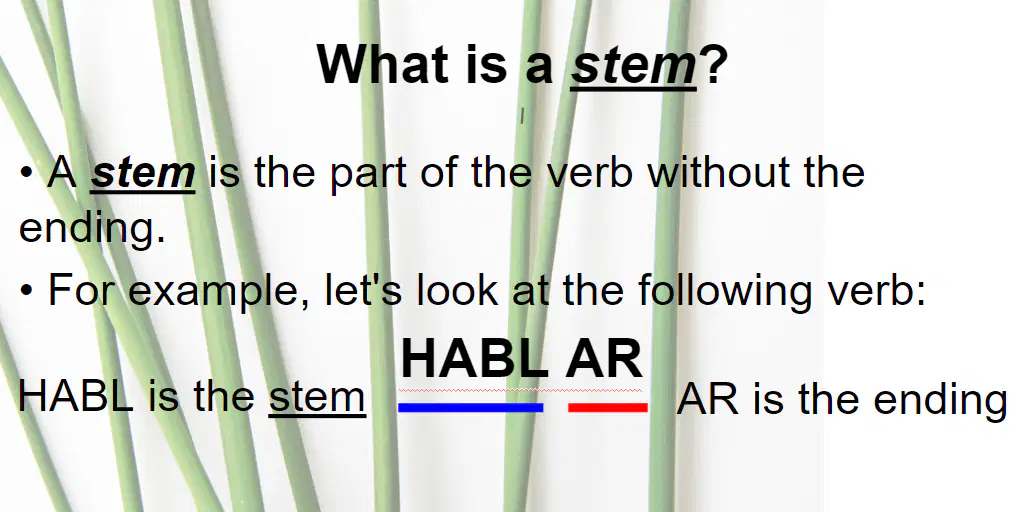
What is the stem of the verb "PENSAR"?
-AR
Pienso
Pens
Pensamos
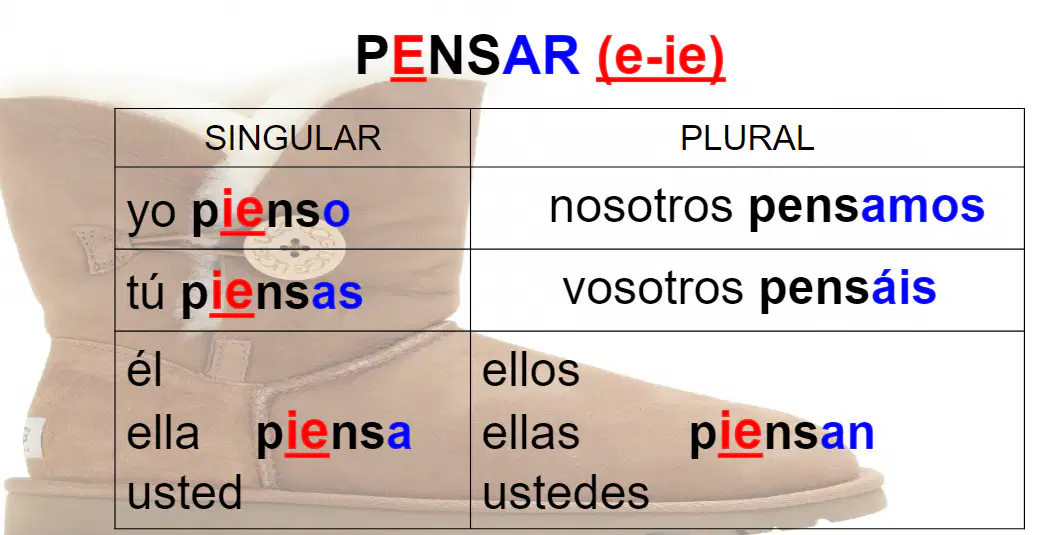
When conjugated, stem-changing verbs will change in the stem of the verb.
However, which two forms of a stem-changing verb will NOT change?
yo, tú
nosotros, ellos
nosotros, vosotros
él, tú
To make sure you're paying attention: What is a stem-changing verb?
A verb that changes its root or stem
A verb with a different ending than regular verbs
A verb that changes from o to ue, e to ie, and e to i
A verb that talks about gardening or planting flowers
Which two subjects NEVER stem change?
él/ella/ud.
nosotros
vosotros
tú

Conjugate: yo cerrar (e to ie)
cirro
cierro
cuerro
cerro

Mis hermanos no _____ (poder: o to ue)
pieden
poden
pueden
piden

Ellas ______ (PENSAR: e to ie) estudiar en la biblioteca.
pensan
pensamos
piensa
piensan

Tú ________ (PEDIR: e to i) el pollo, y yo el bistec.
pedes
pido
pides
pieeideis

Which two subjects NEVER stem change?
él/ella/ud.
nosotros
vosotros
tú

Mis hermanos (a) (pedir: e to i) las papas fritas.

Los estudiantes (a) (cerrar: e to ie) los libros.
Juan no ___ en el futuro. (pensar - e-ie)
piensan
pienso
pensamos
piensa
Christie y yo ___ el helado de chocolate. (querer - ie)
quieres
quiero
queremos
queréis
La mujer _______________ (pedir, e-i) un taco en Taco Bell.
puedo
pide
podo
puede
tú / poder (o - ue)
podes
puedemos
puedes
puedo
Yo (tener)
tengo
tienes
tiene
tenemos
tienen
El señor (tener)
tengo
tienes
tiene
tenemos
tienen
Tú (tener)
tengo
tienes
tiene
tenemos
tienen

