
Font size
 Worksheets
Module 1: Prologue: American Beginnings
Total questions: 45
Worksheet time: 28mins
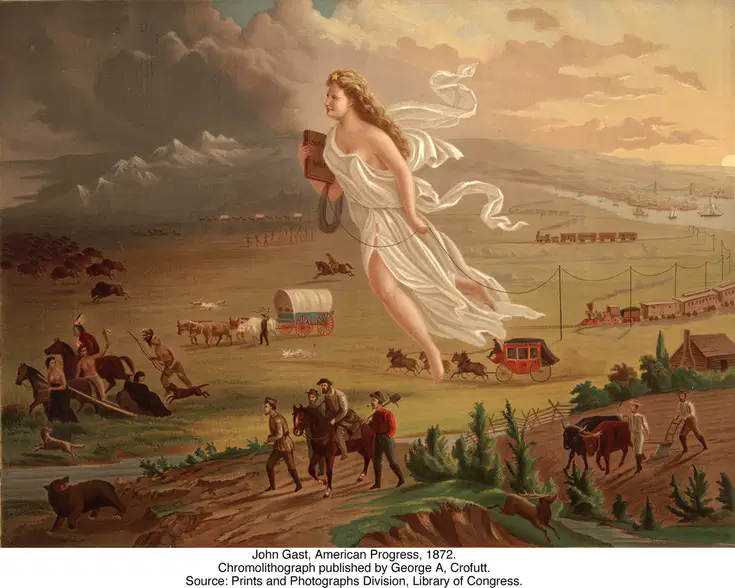
What is the central idea behind Manifest Destiny as depicted in John Gast's painting "American Progress"
The belief in the inherent superiority of American culture
The divine mission to expand American territory from coast to coast
The promotion of democracy and freedom worldwide
The advocacy for the abolition of slavery in all states
These were a group of British colonies on the Atlantic coast of North America. Founded in the 17th and 18th centuries, they declared independence in 1776 and together formed the United States of America.
How did the Enlightenment affect the political attitudes of colonists?
This was our second government (US) which established a constitutional federation with checks and balances, the separation of powers, and a system of amendments.
This was the name of the document many of them signed officially separating the colonies from the British Empire.

What did Federalists and Antifederalists disagree most strongly about?
a strong national government
creating a system of checks and balances
protecting individual liberties
increasing the power of the confederation
Why did the Federalists urge ratification of the Constitution?
They wanted to strengthen state governments.
They wanted to increase the army to seize Canada from the British.
They feared that individual liberties would be threatened if the national government were too strong.
They wanted a stronger federal government to defend the country from foreign threats and domestic unrest.
What was the result of the Great Compromise?
How did the Louisiana Purchase affect the United States?
How did the invention of the cotton gin affect the South?
Which colony was founded primarily for religious freedom?
Virginia
Massachusetts
New York
Georgia
Which of the following was NOT a reason for European colonization of America?
To find new trade routes to Asia
To spread Christianity
To escape oppressive governments
To establish communist societies
What was the main cause of the Boston Tea Party during the American Revolution?
The imposition of the Stamp Act
The quartering of British soldiers in American homes
The taxation of tea by the British government without colonial representation
The closing of the Boston Harbor
Who was the first President of the United States?
Thomas Jefferson
George Washington
John Adams
Benjamin Franklin
What was the primary cause of the Civil War?
Taxation without representation
The issue of slavery
Territorial disputes
Industrial vs. agricultural economic interests
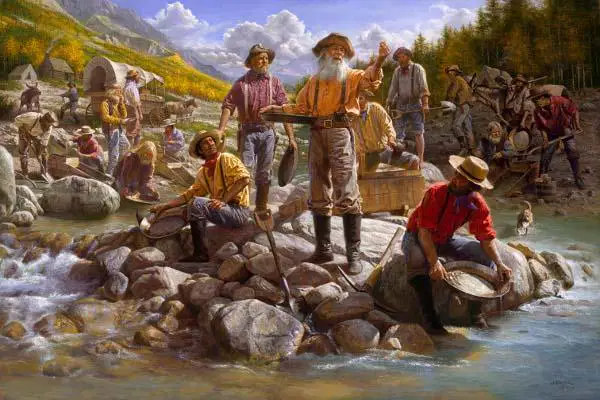
What were four main reasons (US) settlers moved west in the 1840s?
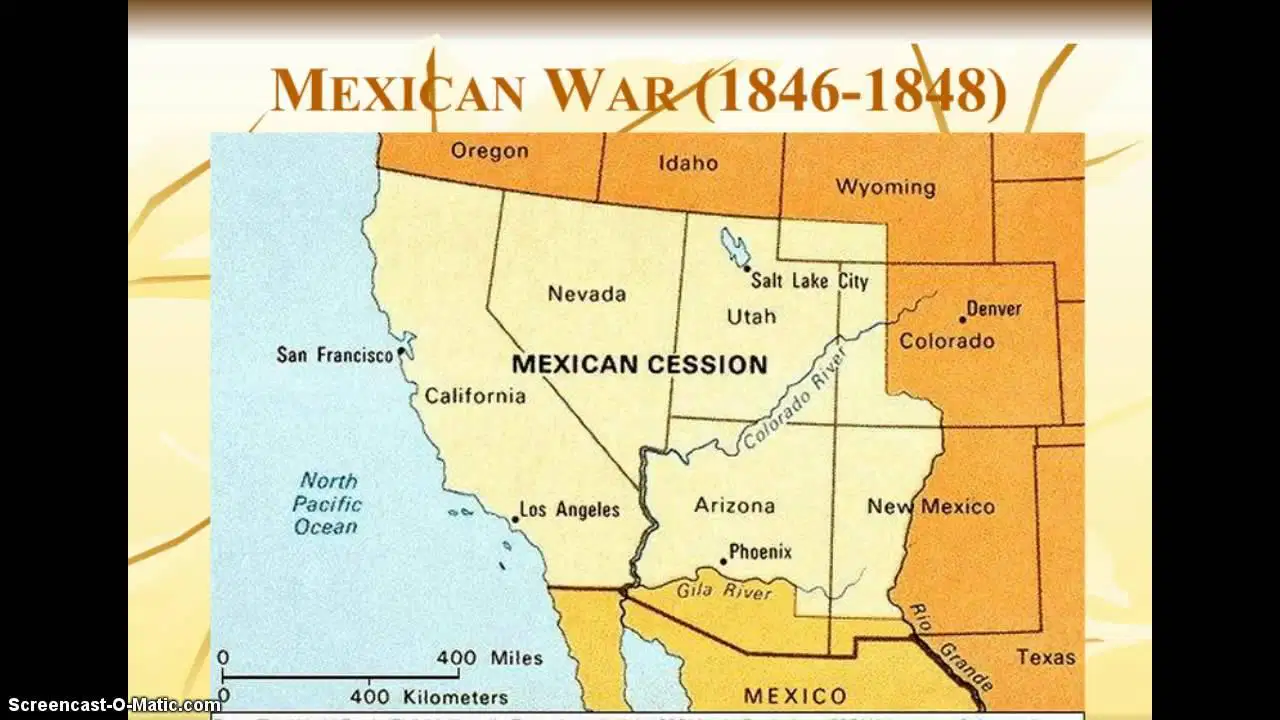
What was the effect of manifest destiny?
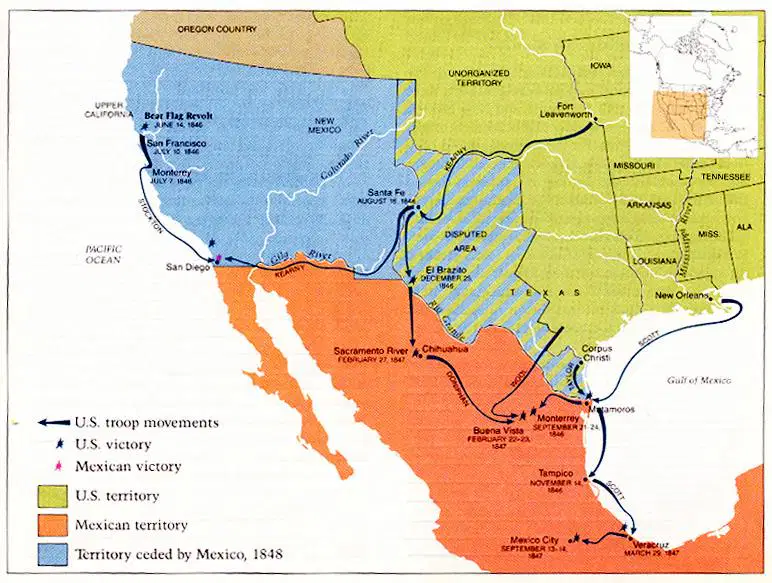
What brought American settlers into conflict with the Mexican government?



- written by Abraham Lincoln
- freed slaves in the "states in rebellion"
- issued after the Union victory at Antietam
- added a new purpose to the Civil War

While the emancipation proclamation freed slaves in the South, which amendment legally made all slaves free?
The 1st Amendment
The 10th Amendment
The 18th Amendment
The 13th Amendment
What did the 14th amendment accomplish?
Freedom of religion
Grants citizenship and equal protection
Made slavery illegal
Guarantees voting rights
"with malice toward none and charity for all, to bind up the nation's wounds". . .. this quote refers to Lincoln's idea that ---
the Union should punish the south for seceding
the Union should welcome the southern states back without punishment
the southern states had every right to secede
the southern states should receive money

What was the significance of The Dredd Scott Decision?
Slavery would be allowed in Missouri and all new states
The Supreme Court ruled that runaway slaves had the right to leave their master
The Supreme Court ruled that slaves had no rights
California was admitted as a free state and New York as a slave state
Responsible for the burning of Atlanta and the "March to the Sea"
Robert E. Lee
Thomas "Stonewall" Jackson
Ulysses S. Grant
William T. Sherman
Why were the Fourteenth and Fifteenth Amendments passed?
What were the main features of the Reconstruction Act?
Which act established the first form of government in the newly independent United States?
The Constitution
The Declaration of Independence
The Articles of Confederation
The Bill of Rights
Article I. Section 2.
"Representatives . . . shall be apportioned among the several states which may be included within this Union, according to their respective numbers(population) . . . ."
Article I. Section 3.
"The senate of the United States shall be composed of two senators from each state . . . ."
An important debate between large states and small states led to the writing of these portions of the Constitution. Identify the correct issue being debated.
Small States argued for Article 1. Section 3., because they believed in equal representation for all states, regardless of size.
Large States argued for Article 1. Section 3., because they believed that representation should be equal for all states.
Small States argued for Article 1. Section 2., because they wanted their individual population to count towards their representation.
Large States argued for Article 1. Section 2., because they wanted representation based on population.
Place the following events in chronological order.
American Revolution
Writing and the ratification of the U.S. Constitution and U.S. Bill of Rights
Civil War
Building of the Transcontinental Railroad
Large scale immigration from Eastern Europe
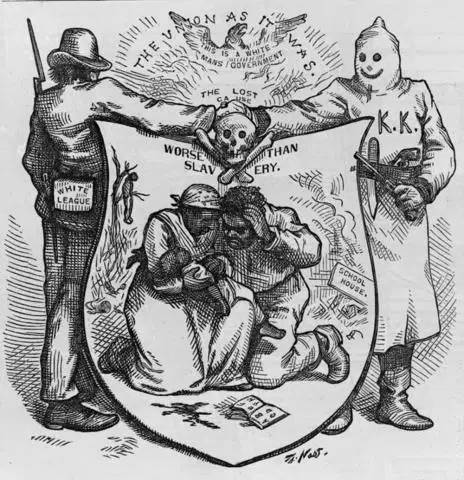
What is the context of this political cartoon?
Vigilante groups held power over southern society during Reconstruction
Northern Republicans rebuilt the South during Reconstruction.
Violence was used to terrorize Black Americans in the South and strip them of their civil rights.
Both A and C are correct.
The "Black Codes" passed in the South early in the Reconstruction era were designed to
restrict the rights of former slaves.
guarantee a minimum wage for former slaves.
force former slaves to move to cities and work in industry.
offer financial assistance to African Americans who had fought for the Confederacy during the Civil War.
The "Black Codes" passed in the South early in the Reconstruction era were designed to
restrict the rights of former slaves.
guarantee a minimum wage for former slaves.
force former slaves to move to cities and work in industry.
offer financial assistance to African Americans who had fought for the Confederacy during the Civil War.
How did southerners react to Reconstruction?
Which is the best description of Reconstruction?
rebuilding the US after a big earthquake
a period of rebuilding in the US after the Civil War
a period of rebuilding in the US after the Revolutionary War
unfair treatment of African Americans after the Civil War

