
 Worksheets
Quiz on Early Calculation Machines
Total questions: 50
Worksheet time: 25mins
The earliest type of calculation machine was called a:
Abacus
ENIAC
Slide Rule
Napier’s Bones
What is a logarithm?
A set of instructions
The power to which a fixed number (the base) must be raised to produce a given number.
Calculations
A Counting machine
A manually-operated calculating device used for calculation of products and quotients of numbers were developed by whom?
Pascaline
Charles P. Babbage
Napier’s bones
Dr. Herman Hollerith
The person is known as the Father of Computers:
Charles Babbage
Ada Lovelace
George Poole
Alan Turing
The World’s First Computer Programmer is:
Dr. Herman Hollerith
Ada Lovelace
John W. Mauchly
Presper Eckert Jr.
A mechanical calculator that adds and subtracts two numbers directly and multiply and divide by repetition:
Pascaline
Abacus
Napier’s bones
Slide Rule
The logic designed to be used later in the design of computer circuitry:
Modal Logic
Boolean Logic
Modus Ponens
First-order Logic
The person that suggested a binary system should be used for storage rather than a decimal system:
Ada Lovelace
Dr. Herman Hollerith
George Boole
Lee Dee Forest
A machine designed to perform logical operation that can read and write:
Vacuum Tube
Turing Machine
Harvard Mark I
ENIAC
What is the name of the first computer designed and sold commercially, specifically, for business data-processing applications?
UNIVAC I
IBM System
Apple Computer
MacIntosh Computer
CPU stands for:
Computer processing unit
Central Processing Unit
Central Power Unit
Computer programming
This part is known as the “brains of the computer” that carries the instructions of a computer program by performing basic arithmetic, logical, and controls input & output instructions:
CPU
RAM
ROM
Storage devices
Computers are made of electronic parts called:
Hard drive
Components
Storage devices
External storage
In a computer, _________ refers to the number of pulses per second generated by an oscillator that sets the tempo for how quickly the CPU can communicate with the graphics card, RAM, and other components.
RAM
ROM
Clock speed
CPU
Clock speed is usually measured in _______ and ________.
Kilogram; Megagram
Bytes; kilos
decimal; binary
Gigahertz; Megahertz
__________ is the observation that the number of transistors in a dense integrated circuit doubles about every 2 years.
Computer Law
Bit Law
Moore’s Law
Cyber Law
RAM is known as:
Random Add Memory
Random Access Memory
Random Access More
Rand Access More
Main memory is called:
RAM
ROM
Storage device
CPU
__________ is the first software that boots and runs on a computer when power is first added to the computer.
Windows
Basic Input Output System (BIOS)
Operating System
Application software
In a computer converts the power from the wall outlet to the type of power needed by the computer:
Power Supply
Power cord
Electrical cord
Lights
__________ is a collection of instructions for performing a specific task that is designed to solve a specific class of problems.
ROM
Power Supply
RAM
Computer program
Hard Drive
In Science, computers can be used to perform:
Communication between scientists
Storage of all the gathered information
Huge calculations in Space Science
All the above
In Medicine, computers can be used to perform:
Diagnosis and cure disease
Call on the telephone
Draw a picture
None of the above
In Banking, computers can be used to perform:
Type papers
Online access to a bank account
Use SIRI
None of the above
The second step in problem-solving:
Understand the problem
Carry out the plan
Plan a solution
None of the above
The first step in problem-solving:
Carry out the plan
Understand the problem
Review and discuss action taken
None of the above
The third step in problem-solving:
Plan a solution
Review and discuss action taken
Carry out the plan
None of the above
The fourth step in problem-solving:
Carry out the plan
Understand the problem
Review and discuss action taken
None of the Above

When planning or reading a flowchart, this symbol is a:
Do Something
Decision
Start or Stop
Connector

In a flowchart, this symbol represents:
Do Something
Process
Decision
Connector

In a flowchart, this symbol represents:
Decision
Do Something
Input or Output
Connector
In a flowchart, this symbol represents:
Do Something
Input or Output
Decision
Connector
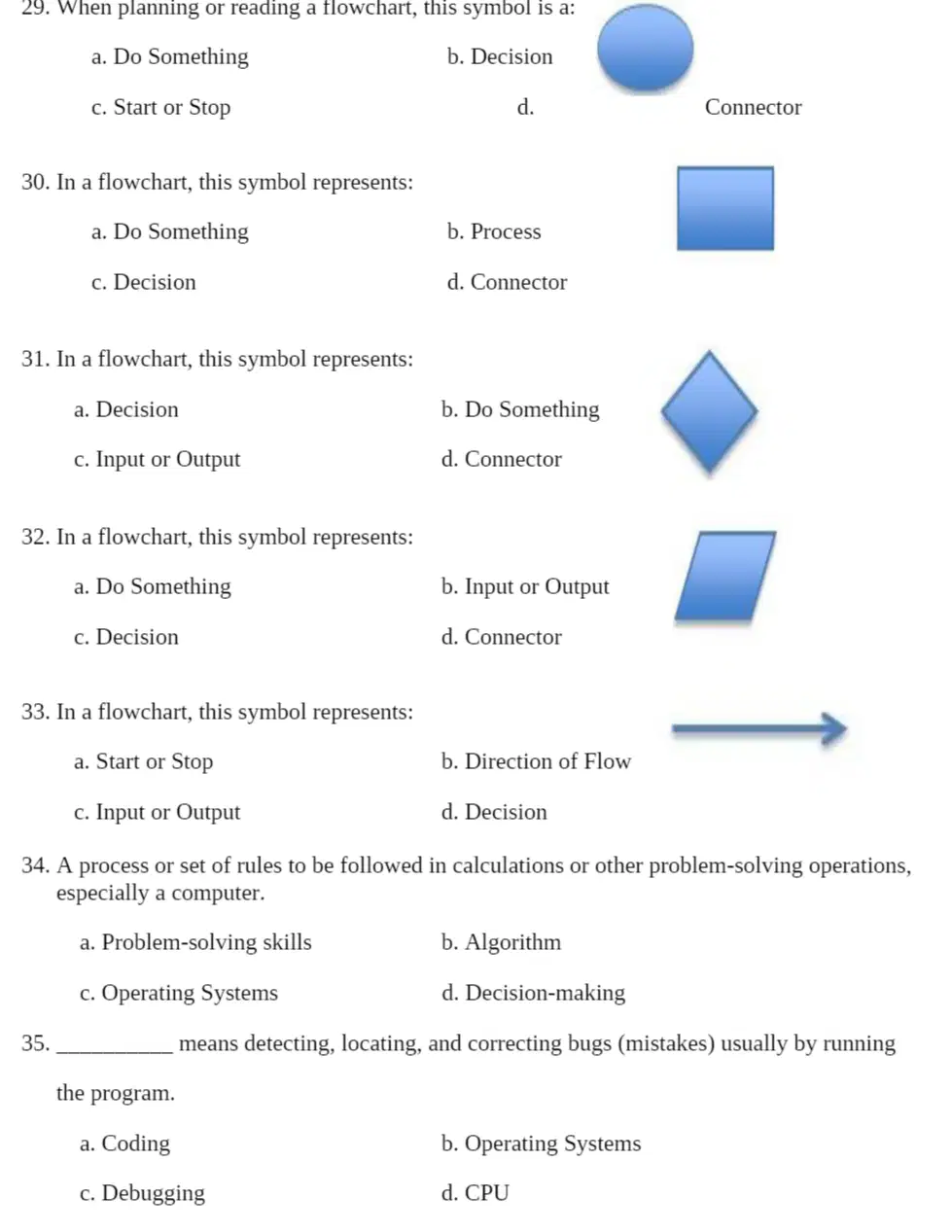
In a flowchart, this symbol represents:
Start or Stop
Direction of Flow
Input or Output
Decision
A process or set of rules to be followed in calculations or other problem-solving operations, especially a computer.
Problem-solving skills
Algorithm
Operating Systems
Decision-making
__________ means detecting, locating, and correcting bugs (mistakes) usually by running the program.
Debugging
Compiling
Executing
Designing
A computer program can be written using:
Coding
Basic Control Structures
Debugging
Decision-making
A ________ is any variable or expression that returns a Boolean value.
Boolean expression
Basic control structures
Arithmetic operator
String literal
HTML stands for:
Hyper Time Mission Line
Hyper-Text Markup Language
Hyper-Type More Line
Hyper Time More Language
CSS stands for:
Cascading Style Sheets
Cascading Simple Sign
Cascading Simple Sheets
Cascading Style Sign
What version of HTML is used by www.w3schools.com?
HTML 2.0
HTML 3.2
HTML 4.0
HTML 5
Conditional Controls are IF Statements
True
False
There are 3 forms of IF Statements: IF-THEN, IF-THEN-ELSE, and IF-THEN-ELSIF.
True
False
LOOP Statements does not let you execute a sequence of statements multiple times.
True
False
There are 3 forms of LOOP Statements: DO-WHILE-LOOP, WHILE-LOOP, and FOR-LOOP.
True
False
The www.w3schools does not allows you learn HTML, CSS, Colors, Bootstrap 3 & 4, and learn about graphics, icons, and other website features.
True
False
With HTML you can create your own websites.
True
False
HTML tags do not use pairs.
True
False
A start tag is called an opening tag.
True
False
The Scratch program uses building blocks to program the Sprite.
True
False
Scratch is the introductory language for programming and skills learned in Scratch can be applied to Python and Java.
True
False

