
 Worksheets
Quick Review
Total questions: 10
Worksheet time: 16mins
Consider a ball thrown up from the surface of the earth into the air at an angle of 30° above the horizontal. Air friction is negligible. Just after the ball is released, its acceleration is:
0 m/s2
Upwards at 9.8 m/s2
Downwards at 9.8 m/s2
Upwards at 4.9 m/s2
None of these
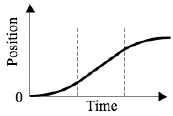
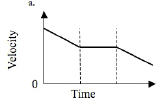
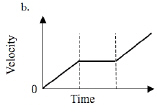
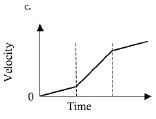
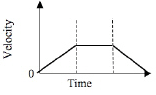
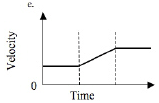
The graph given here shows the position vs. time for an object traveling along the x-axis. Which graph below shows the velocity vs. time for this same object during the same time period?
A whiffle ball is tossed straight up, reaches a highest point, and falls back down. Air resistance is not negligible.Which of the following statements are true?
I. The ball's speed is zero at the highest point.
II. The ball's acceleration is zero at the highest point.
III. The ball takes a longer time to travel up to the highest point than to fall back down.
I only
II only
I and II
I and II
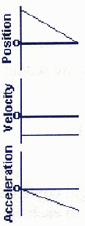
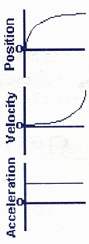
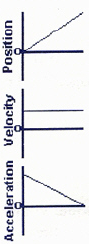
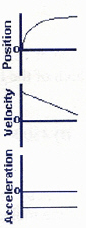
Which of the following sets of graphs might be the corresponding graphs of Position, Velocity, and Acceleration vs. Time for a moving particle?

Two forces act on an object to the right at the same time. What force is required to bring the object into equilibrium?
9 N to the right
9 N to the left
3 N to the left
18 N to the left

As the angle of the incline increases, what happens to the normal force?
The normal force increases
The normal force decreases
The normal force is not affected by the incline
The normal force is only dependent on the force due to gravity

Which of the following statements is true about the image above?
The accelerations of the blocks will vary according to their mass
The net force acting on each block is the same
The blocks will experience the same acceleration
The 3m box will eat the 2m and the m boxes
A tennis ball is thrown against a vertical concrete wall that is fixed to the ground. The ball bounces off the wall. How does the force exerted by the ball on the wall compare with the force exerted by the wall on the ball?
The force exerted by the ball is greater.
The forces exerted by the ball and the wall have the same magnitude.
The force exerted by the ball is smaller.
The relative magnitudes of the forces cannot be determined without knowing how long the ball and the wall are in contact.
A man standing on a scale in an elevator notices that the scale reads 40 newtons greater than his normal weight. Which type of movement of the elevator could cause this greater-than-normal reading?
accelerating upward
accelerating downward
moving upward at a constant speed
moving downward at a constant speed

Assuming both objects are at rest, which object is more massive? M1 or M2?
M1 is more massive
M2 is more massive
both M1 and M2 are the same mass

