
 Worksheets
APES Unit 1 Review
Total questions: 85
Worksheet time: 1hrs 25mins
An ecosystem contains
only one species
multiple species
living and non-living components
all the similar biomes across the world
An observer notes that the various birds in her yard are using different parts of the tree for nesting sites and food. This is an example of _______________
division of labor
resource conservation
resource partitioning
mutualism
Which of the following is NOT an abiotic factor?
sunlight
bacteria
pH
soil
A population is best described as
only one species
multiple species
living and non-living components
all the similar biomes across the world
Resource partitioning
can cause the extinction of a competing species.
can occur through morphological differences between competing species.
is not the result of behavioral changes.
does not occur among competing predators.
The interaction between bees and sunflowers is an example of
predation
parasitism
mutualism
commensalism
There are two major fish species found in a local lake. Both species have the ability to survive in all regions of the lake. Species 1 can be found in the northern and southern parts of the lake while species 2 is only found in the southern part of the lake. Which of the following is incorrect?
species 2 is a stronger competitor than species 1
this is an example of the competitive exclusion principle
the southern part of the lake is species 2's realized niche
the entire lake is species 1 and species 2's fundamental niche
Which biome covers most of the land mass near Earth's equator?
Desert
Grassland
Tropical rainforest
Temperate forest

Which biome is best represented by this climatograph?
Tundra
Desert
Tropical rainforest
Boreal Forest
The rain forest soil is
poor and rocky
frozen soil
thick and nutrient rich
thin and nutrient poor
Permafrost is an important factor in which biome?
Boreal Forest
Tundra
Coral Reefs
temperate rain forest
On a climatogram, the bar graph represents _____________.
precipitation
temperature
In which biome is plant growth primarily constrained by precipitation?
boreal forest
temperate seasonal forest
temperate grassland
tropical rainforest
Which biome has high soil nutrient levels making it a great location for agriculture?
tropical rainforest
boreal forest
grassland
temperate seasonal forest

Which biome is best represented by this climatograph?
Tundra
Desert
Tropical rainforest
Grasslands
Which biome is characterized by shallow, nutrient-rich waters and mangrove forests?
Tropical Rainforests
Tundra
Coral Reefs
Estuary
Which pair of biogeochemical cycles are most associated with inorganic fertilizer and sewage waste?
Carbon and Nitrogen cycles
Carbon and Sulfur cycles
Phosphorus and Nitrogen cycles
Sulfur and Nitrogen cycles
Sulfur and Water cycles
Their nitrogen becomes trapped in clay and is unusable

What is the largest reservoir for nitrogen?
the ocean
rocks and minerals
the atmosphere
bacteria
What is the largest reservoir for water?
the ocean
rocks and minerals
the atmosphere
glaciers
Where is the largest reservoir for the phosphorus cycle?
rocks and minerals
the ocean
the atmopshere
fossil fuels
What is the effect of deforestation on the carbon cycle?
Increase in the amount of CO2 in the atmosphere
Decrease in the amount of CO2 in the atmosphere
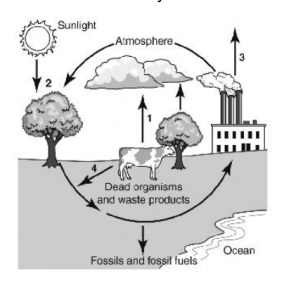
respiration: releasing CO2
decomposing CO2 in the soil
photosynthesis: absorbing CO2
turning CO2 from the atmosphere into organic molecules

__________ primary productivity = the organic materials that remain after photosynthetic organisms in the ecosystem have used some of these compounds for their cellular energy needs (cellular respiration).
Gross
Total
Net
Secondary

__________ primary productivity is the total amount of energy that producers convert to chemical energy in organic molecules per unit of time.
Net
Total
Gross
Secondary

Ecological efficiency from one trophic level to the next is generally:
1%
10%
75%
90%
Organism that relies on other organisms for food; consumer

Foxes would die out due to no food source.
The amount of primary productivity generated by all producers in a given ecosystem is called __________________________________
Gross primary production
Net primary production
Total cell respiration
Trophic levels
A lion eating a zebra is an example of:
predation
mutualism
commensalism
parasitism
A tick living on the body of a deer
predation
mutualism
commensalism
parasitism

These images represent which phenomenon?
logistic growth
competitive exclusion
exponential growth
predator prey relationships
Competition among members of the same species.
intraspecific competition
interspecific competition
This biome has very little precipitation throughout the year, often experiences big differences in temperature from day to night, and has very little plant or animal life.
Tundra
Taiga
Rainforest
Desert
This biome has extremely cold winters and short summers. They get a decent amount of precipitation but it mostly comes as snow. Pine (coniferous) trees dominate this biome.
Taiga
Desert
Grassland
Tundra
Which two biomes have the least precipitation?
tropical rainforest and temperate grassland
savanna and tropical dry forest
tundra and desert
boreal forest and temperate woodland
Where is the chaparral found? Check 2.
West coast in LA, California
Florida Everglades
Mediterranean region
Alaskan coast

About how much precipitation does this biome get in October?
32.5 cm
50 cm
5 cm
10 cm
What is the single most important difference between the marine, freshwater, and estuary biomes?
Salinity (dissolved salt)
Sunlight
Oxygen
Amount of Water
This area of the ocean only makes up 10% of the total ecosystem size, but has 90% of its biodiversity.
The coastal/tidal zones.
The photic zone in the open ocean.
The aphotic zone in the open ocean.
The benthic zone.
The marine zone that is lit by sun and lies on the open ocean is called
abyssal zone
aphotic zone
photic zone
benthic zone
Which of the following is not an environmental function of wetlands?
increasing runoff
absorbing and removing pollutants from water
trapping carbon that would otherwise be released into the air
controlling floods
Shallow plant life would be found in the _________ zone while phytoplankton would be found in the _________ zone.
limnetic; littoral
littoral; limnetic
limnetic; profundal
littoral; benthic
The _______ cycle is important for ocean life as it leads to the creation of limestone rocks as well as provides the materials needed for organisms to make shells and exoskeletons.
carbon
phosphorus
nitrogen
water
What is the process where plants use nitrates to grow?
Nitrogen Fixation
Ammonification
Assimilation
Nitrification
What is the process where bacteria turns Nitrogen gas from the atmospheres into usable compounds?
nitrification
nitrogen fixation
ammonification
denitrification
The process that convert nitrates (NO3-) back to nitrogen gas (N2) is called
Nitrogen fixation
Ammonification
Denitrification
Nitrification

If gross primary productivity in a wetland is 3 kg C/m^2/year and respiration is 1.5 kg C/m^2/year, what is the net primary productivity of the wetland?
Impossible to determine from the given information
3 kg C/m^2/year
1.5 kg C/m^2/year
2 kg C/m^2/year
4.5 kg C/m^2/year
Which time of the year would have the potential for the lowest productivity?
Winter
Spring
Summer
Fall
Which of the following is the correct equation for gross and net primary productivity
NPP = GPP - R
GPP = NPP - R
GPP = NPP / R
NPP = GPP/ R
Which ecosystem has the HIGHEST NPP?
Swamp/marsh
coral reef
tropical rain forest
Tropical seasonal forest
Which ecosystem has the LOWEST NPP?
Savanna
Desert
Tropical rain forest
Taiga
In an ecosystem, snakes feed on frogs, which feed on mosquitoes. Use of a bug spray has decreased the number of mosquitoes. What will probably happen to the number of frogs and snakes?
Frogs will increase, snakes will increase
Frogs will increase, snakes will decrease
Frogs will decrease, snakes will increase
Frogs will decrease, snakes will decrease
Why are mushrooms important to the food chain?
They recycle nutrients into the ecosystem.
They produce food energy for other living things.
They recycle oxygen into the atmosphere.
They consume excess herbivores in the ecosystem.

Which is the primary consumer in this food chain?
rabbit
grass
snake
hawk
Food chains show energy transfer between organisms. The size of a food chain can vary, yet there is a limit to the number of levels that a food chain can reach. Why is there a limit to the number of levels that a food chain can reach?
Plants are not infinitely in the world
Producers can only eat what is available
Carnivores are too big to be eaten
Energy is lost when you move up a trophic level

How much energy is available to be passed on to the next level in a food web?
100%
10%
50%
75%
What is it called when bacteria use chemicals, like hydrogen sulfide, to make carbohydrates?
Photosynthesis
Chemosynthesis
Cellular respiration
Decomposition
In an energy pyramid, energy _________ as you move up the pyramid.
increases
decreases
stays the same
changes up and down

The 10% rule states that 10% of energy moves from each trophic level to the next.
In the pyramid, if the producers level contains 1234 kilocalories, how many kilocalories are transferred to the bird (apex predator)?
123.4
1.234
1234
1234
Which of the following is NOT a part of the 2nd Law of Thermodynamics?
some energy is always lost to the environment
energy quantity always decreases
entropy will increase
energy quality decreases as it changes form

