wayground logo

Free Printable Worksheets

Font size

S
M
L
XL
Worksheets

UNDERSTANDING SOUND WAVES

Total questions: 51

Worksheet time: 35mins

Name
Class
Date
1.
A disturbance that transfers energy from one place to another without transferring energy
a)
wave
b)
trough
c)
pitch
d)
sound
2.
A reflected sound wave
a)
frequency
b)
pitch
c)
echo
d)
rarefaction
3.
You and your father inspect an empty house with the hopes of buying it. You walk through the rooms talking to one another, and you notice that your voices and footsteps are echoing in the big, empty house. What causes the echo?
a)
sound waves reflecting off smooth, flat surfaces throughout the house
b)
sound waves moving around the large rooms
c)
sound waves moving slowly through air
d)
sound waves refracting around corners in the empty rooms
4.
Cletus wants to make ear protectors for people who work around loud jet engines at Hartsfield Airport in Atlanta. Which of the following materials should he experiment with for the best results?
a)
a material that produces sound
b)
a material that absorbs sound
c)
a material that transmits sound
d)
a material that amplifies sound
5.
As the fire truck approached Mary, the pitch of the siren got higher. Once the fire truck passed and moved away, the siren's pitch got lower. This change in pitch is because of a change in the sound wave's
a)
concussion. 
b)
amplitude. 
c)
reflection.
d)
frequency. 
6.
After the train passed, the pitch of the train whistle became lower. This change in sound would be represented by what change in the diagram above? 
a)
The distance represented by C would increase. 
b)
The distance represented by C would decrease. 
c)
The distance represented by D would increase. 
d)
The distance represented by D would decrease. 
7.
Which of the following would you hear as a low pitched sound? 
a)
sound wave with a frequency of 50 Hz
b)
sound wave with frequency of 10,000 Hz
c)
sound wave with an intensity of 10 dB
d)
sound wave with an intensity of 100 dB
8.
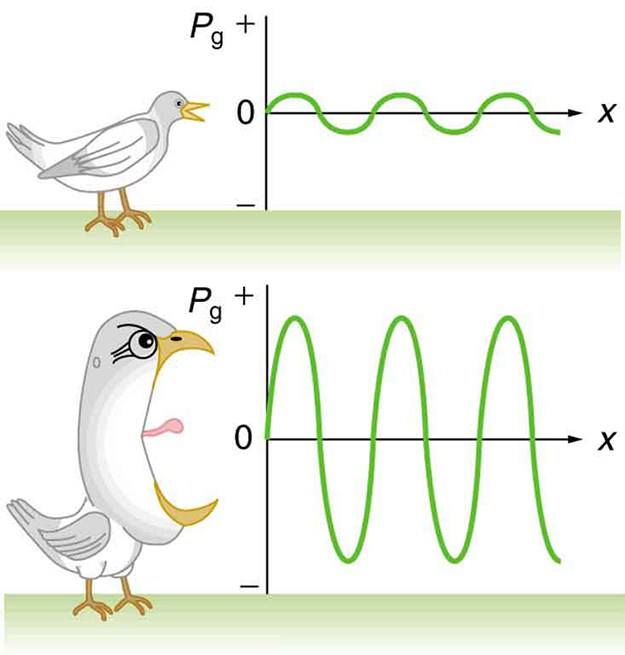
When a sound is louder what measurement gets bigger?
a)
Frequency 
b)
Amplitude 
c)
Wavelength 
d)
Crest
9.
Why is the school library covered with carpet?
a)
So everyone can make a lot of noise
b)
to help absorb sounds to keep it quiet
c)
because it looks good
d)
to help absorb sounds so it can stay noisy
10.

The speed of sound depends on these two things:

a)

The type of medium and the temperature of the medium

b)

Speed of the medium and temperature of the medium

c)

Temperature of the medium and sound of the medium

d)

None of the above

11.

Sound waves travel the fastest through ---

a)

Liquids

b)

Gases

c)

Solids

12.

Sonar and echolocation use ----- to detect objects under water.

a)

Refraction

b)

Reflection

13.

Sound waves that are beyond the range of human ear are known as ----

a)

Infrasonic waves

b)

Ultrasonic waves

14.

One important characteristic of sound waves is that they are ___________________ waves.

a)

mechanical

b)

short

c)

ultraviolet

d)

primary

15.

Sound waves must travel through ___________________.

a)

air

b)

a medium

c)

an outward area

d)

a short

16.

Sound waves can NOT travel through

a)

Air

b)

Water

c)

Earth

d)

space

17.

The sound that we actually hear is the vibration of molecules.

a)

True

b)

False

18.

Longitudinal waves means that the disturbance of the wave travels in different directions as the wave.

a)

True

b)

False

19.

This is a visual of a sound wave. It is an example of _____________________ wave.

a)

a mechanical

b)

a longitudinal

c)

both a mechanical and longitudinal

20.

If there is a loud noise in your house, the sound travels through

a)

the air

b)

the air and the wall

c)

the air, the wall, the floor

d)

the air and most everything in the house

21.

If there is a loud noise in space, the sound travels through

a)

the space particles

b)

small atoms in space

c)

space is a vacuum, so nothing

22.

What is the source of a sound wave?

a)

Electricity

b)

Vibration

c)

Light waves

d)

Tiny nuclear explosions

23.

The intensity of a sound wave is equal to the sound power (P) divided by the _______.

a)

Area

b)

Time

c)

Distance

d)

Energy

24.

Sound waves help us:

a)

see

b)

hear

c)

smell

25.

Sound waves are:

a)

visible

b)

invisible

26.

What happens when we record our voice on the computer?

a)

We can SEE the sound wave our voice makes.

b)

We can HEAR our own voice when we hit "play".

27.

PEOPLE make sound waves when they:

a)

sing

b)

whisper

c)

yell

d)

stand quietly

28.

Animals make sound waves when they:

a)

stand still

b)

growl

c)

bark

d)

chirp

29.

Machines create sound waves too.

a)

false

b)

true

30.

You can FEEL loud sound when your hands touch a speaker.

a)

true

b)

false

31.

A special kind of sound wave is an ECHO because:

a)

you can't hear it.

b)

the sound bounces off a hard surface and you can hear something more than once.

32.

Sound waves CAN travel in outer space.

a)

false

b)

true

33.

Sound needs AIR to travel.

a)

true

b)

false

34.

What can we use to make our voice louder?

a)
b)
c)
35.

Sounds in nature can come from:

a)

a waterfall

b)

a thunderstorm

c)

wind

d)

a bonfire

36.

Animals that use sound to hunt and to communicate:

a)

bats

b)

dolphins

c)

whales

d)

snakes

37.
A disturbance that travels through a medium as a longitudinal wave
a)
sound
b)
wavelength
c)
pitch
d)
frequency
38.
Bending of waves around an object (such as through a doorway)
a)
sound
b)
diffract
c)
pitch
d)
volume
39.
travels through solids fastest because the molecules are closer together
a)
speed of sound
b)
wavelength
c)
frequency
d)
amplitude
40.
The number of wavelengths that pass a point each second
a)
frequency
b)
wavelength
c)
pitch
d)
amplitude
41.
Material (matter) through which a wave travels
a)
medium
b)
Doppler Effect
c)
sound
d)
pitch
42.
How high or low a sound is; depends on the frequency (greater frequency= higher pitch)
a)
pitch
b)
frequency
c)
sound
d)
medium
43.
When the sound source moves, the frequency changes
ex. police car siren sounding lower pitch after the car passes

a)
pitch
b)
frequency
c)
Doppler Effect
d)
medium
44.
A wave in which the vibration is in the same direction as that in which the wave is traveling; sound waves
a)
longitudinal wave
b)
ocean wave
c)
transverse wave
d)
mechanical wave
45.
The part of a longitudinal wave where the particles of the medium are close together.
a)
rarefaction
b)
compression
c)
crest
d)
trough
46.
A part in a longitudinal wave where the particles are spread apart
a)
compression
b)
rarefaction
c)
crest
d)
trough
47.
The number of wavelengths that pass a point each second
a)
crest
b)
amplitude
c)
frequency
d)
pitch
48.
A disturbance that transfers energy from one place to another without transferring energy
a)
wave
b)
trough
c)
pitch
d)
sound
49.
A reflected sound wave
a)
frequency
b)
pitch
c)
echo
d)
rarefaction
50.
A wave that requires a medium through which to travel
a)
mechanical wave
b)
chemical wave
c)
electromagnetic wave
d)
pitch
51.
Highest point of a wave
a)
crest
b)
trough
c)
wavelength
d)
frequency