wayground logo

Free Printable Worksheets

Font size

S
M
L
XL
Worksheets

Unit 1Atomic Theory

Total questions: 105

Worksheet time: 59mins
Name
Class
Date
1.
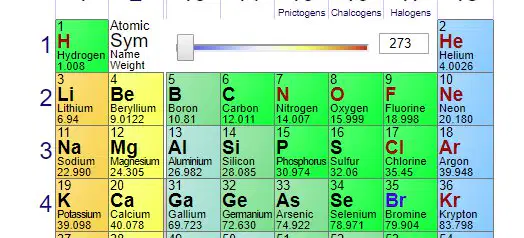
What is the average atomic mass of magnesium?
a)
23.9850 amu
b)
24.9858 amu
c)
25.9826 amu
d)
24.3050 amu
2.
What information does electron configuration notation provide?
a)
The weight of a file
b)
The number of electrons in each sublevel
c)
The number of papers in a folder
d)
The size of an atom
3.
How is electron configuration notation different from orbital filling diagrams?
a)
It uses boxes and arrows
b)
It counts the number of arrows
c)
It adds up the numbers in the electron configuration
d)
It eliminates the need for counting
4.
What is the shape of an s orbital?
a)
Spherical
b)
Dumbbell
c)
Complex
d)
Cylindrical
5.
Which quantum number determines the shape of an orbital?
a)
Principal quantum number (n)
b)
Angular momentum quantum number (l)
c)
Magnetic quantum number (ml)
d)
Spin quantum number (ms)
6.
Who proposed the first complete atomic theory?
a)
J. J. Thomson
b)
John Dalton
c)
Ernest Rutherford
d)
Niels Bohr
7.
What did J. J. Thomson's experiments with cathode rays reveal?
a)
The presence of electrons
b)
The existence of protons
c)
The structure of the nucleus
d)
The behavior of neutrons
8.
Which model of the atom proposed that electrons orbit the nucleus in fixed paths called 'shells' or 'energy levels'?
a)
Dalton's model
b)
Nagaoka's model
c)
Rutherford's model
d)
Bohr's model
9.
What did Ernest Rutherford's gold foil experiment suggest about atomic structure?
a)
Atoms are indivisible
b)
Atoms consist of a dense nucleus
c)
Atoms have a positive charge
d)
Atoms have fixed energy levels
10.
Who discovered the neutron?
a)
John Dalton
b)
J. J. Thomson
c)
Ernest Rutherford
d)
James Chadwick
11.
Which of the following is a key difference between Dalton's atomic theory and modern theory?
a)
Dalton believed atoms were divisible
b)
Dalton's atoms of a given element were not identical
c)
Dalton's model accounted for the electrical nature of matter
d)
Dalton's model explained the behavior of electrons
12.
What did Robert A. Millikan's oil drop experiment help determine?
a)
The charge of electrons
b)
The mass of protons
c)
The structure of the nucleus
d)
The behavior of neutrons
13.
What did Niels Bohr's atomic model propose about electron orbits?
a)
Electrons can occupy any orbit
b)
Electrons can occupy only certain orbits
c)
Electrons can occupy multiple orbits simultaneously
d)
Electrons can occupy orbits with different energies
14.
What did James Chadwick's discovery of the neutron explain?
a)
The mass of the nucleus
b)
The charge of the electron
c)
The behavior of protons
d)
The structure of the atom
15.
What did Ernest Rutherford's experiment with alpha particles and gold foil suggest?
a)
Atoms are indivisible
b)
Atoms have a positive charge
c)
Atoms consist of a dense nucleus
d)
Atoms have fixed energy levels
16.
Chlorine-37 has how many neutrons?
a)
37
b)
18
c)
20
d)
None of the above
17.
Isotopes of an element have a different number of ____.
a)
Protons
b)
Neutrons
c)
Electrons
d)
Fermions
18.
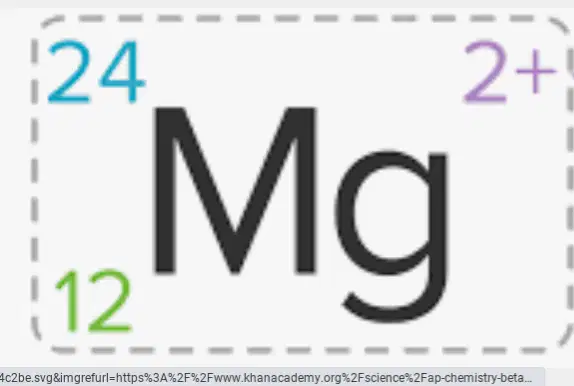
In the symbol pictured what is the number of protons, neutrons and electrons respectively?
a)
12,12,12
b)
12,12,14
c)
12,12,10
d)
12,24,10
19.
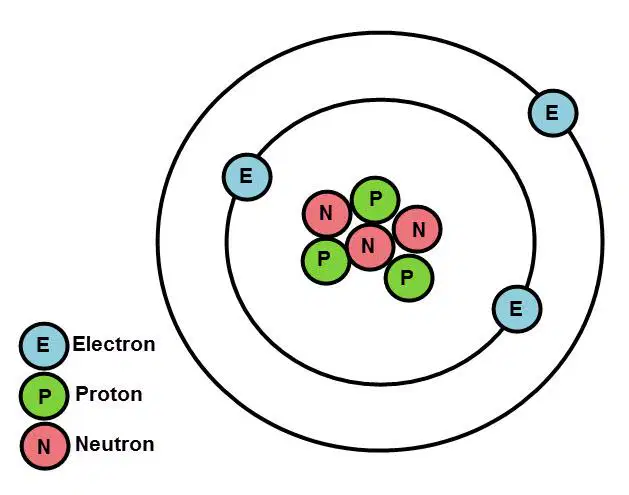
What is the charge of the atom in the diagram below?
a)
0
b)
+3
c)
-3
d)
+1
20.
How many protons does Lithium Have?
a)
3
b)
1
c)
2
d)
4
e)
5
21.
Calcium has three different isotopes. One has a mass of 35.00 amu; another has a mass of 41.00 amu; and another has a mass of 40.00 amu. Which isotope is the most abundant of the three?
a)
Calcium-35
b)
Calcium-41
c)
Calcium- 40
22.
The amount of time for half the atoms in a radioactive sample to decay.
a)
radioactive decay
b)
radioactivity
c)
transmutation
d)
halflife
23.
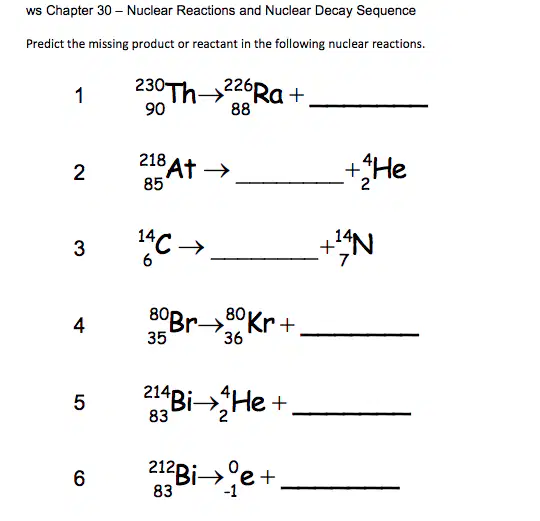
Fill in the blank for e4 of the Equations below. In format 1. ______, 2. _______ with the number corresponding to the picture
4 lines
24.
If 10 mg of iodine 131 is given to a patient, how much is left after 24 days? The half-life of iodine-131 is 8 days.
a)
0.625mg
b)
1.25mg
c)
2.5 mg
d)
5 mg
e)
10mg
25.
4.35% of all X atoms have a mass of 39.946 amu. 83.79% have a mass of 41.941 amu, 9.50% have a mass of 42.941 amu, and 2.36% have a mass of 43.939 amu. What is the average atomic mass of atom X?
a)
41.97 amu
b)
42.19 amu
c)
10.43 amu
d)
40.04 amu
26.
How many p orbitals are there for a given value of l?
a)
1
b)
2
c)
3
d)
4
27.
What is the maximum number of electrons that can occupy an f orbital?
a)
2
b)
4
c)
6
d)
8
28.
How many different f orbitals are there when l = 3?
a)
3
b)
5
c)
7
d)
9
29.
How many orbitals are there in the d sublevel?
a)
1
b)
3
c)
5
d)
7
30.
What is the maximum number of electrons that can occupy the third principal energy level?
a)
2
b)
8
c)
10
d)
18
31.
a)
a
b)
b
c)
c
d)
d
32.
How many Valance Electrons will Carbon Have
a)
2
b)
4
c)
6
d)
8
33.
How many electrons are in the 3rd energy level?
a)
2
b)
8
c)
10
d)
18
34.
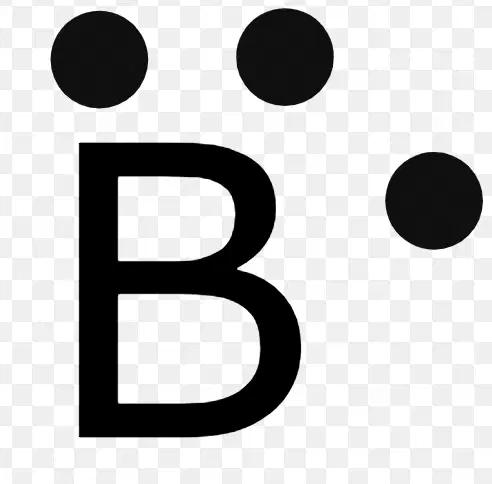
How many electrons should Boron have around its Lewis dot model?
a)
1
b)
2
c)
3
d)
4
e)
5
35.
Is this the correct Lewis Dot Structure for Boron?
a)
Yes
b)
No, missing electrons
c)
No, too many electrons
d)
No, electrons in wrong place
36.
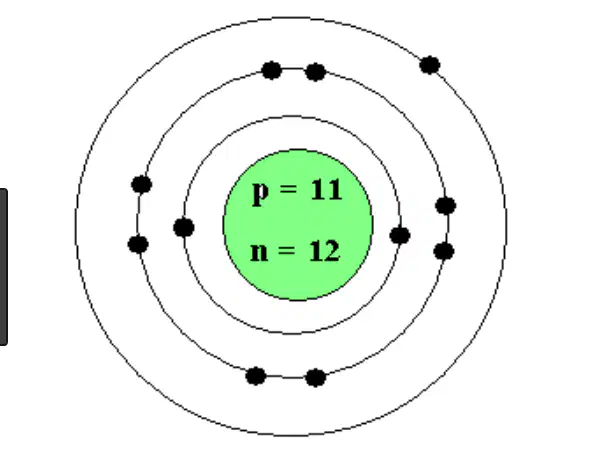
What atom is shown in the picture?
a)
Sodium (Na)
b)
Fluorine (F)
c)
Sulfur (S)
d)
Potassium (K)
37.
How many orbits will be around Calcium?
a)
4
b)
1
c)
2
d)
3
e)
5
38.
What orbitals can be found in the 3rd energy level?
a)
s
b)
p
c)
d
d)
f
39.
What is the electron configuration of helium?
a)
1s1
b)
1s2
c)
1s22s1
d)
1s22s2
40.
According to Hund's rule, how does the sixth electron enter the p orbitals?
a)
With the same spin as the fifth electron
b)
With the opposite spin as the fifth electron
c)
In a different orbital
d)
It doesn't follow Hund's rule
41.
What is the electron configuration of boron?
a)
1s22s1
b)
1s22s22p1
c)
1s22s22p2
d)
1s22s22p3
42.
How many elements are in the second period of the periodic table?
a)
2
b)
4
c)
6
d)
8
43.
What is the electron configuration of nitrogen?
a)
1s22s1
b)
1s22s22p1
c)
1s22s22p2
d)
1s22s22p3
44.
Which subatomic particle has a relative charge of +1?
a)
Proton
b)
Neutron
c)
Electron
45.
What is the relative mass of an electron?
a)
1 amu
b)
1/2000 amu
c)
1/1000 amu
d)
1/5000 amu
46.
What is the symbol used to represent the atomic number?
a)
A
b)
Z
c)
M
d)
N
47.
Which of the following is an isotope of uranium?
a)
U-235
b)
U-238
c)
U-239
d)
U-240
48.
Which model of the atom describes electrons moving in fixed energy levels?
a)
Bohr model
b)
Electron cloud model
c)
Quantum model
d)
Plum pudding model
49.
What happens when an electron moves from a higher energy level to a lower energy level?
a)
It gains energy
b)
It loses energy
c)
It stays at the same energy level
d)
It disappears
50.
What is the relationship between wavelength and frequency?
a)
Direct relationship
b)
Inverse relationship
c)
No relationship
d)
Random relationship
51.
What is the relationship between energy and frequency?
a)
Direct relationship
b)
Inverse relationship
c)
No relationship
d)
Random relationship
52.
What type of radiation has the highest penetrating ability?
a)
Alpha radiation
b)
Beta radiation
c)
Gamma radiation
d)
They all have the same penetrating ability
53.
What is the symbol for alpha particles?
a)
α
b)
β
c)
γ
d)
δ
54.
What is the symbol for beta particles?
a)
α
b)
β
c)
γ
d)
δ
55.
What is the symbol for gamma radiation?
a)
α
b)
β
c)
γ
d)
δ
56.
What is the process by which an unstable nucleus emits radiation?
a)
Radioactive decay
b)
Nuclear fusion
c)
Nuclear fission
d)
Half-life
57.
What is the term for the time it takes for half of a radioactive substance to decay?
a)
Decay rate
b)
Half-life
c)
Radioactive period
d)
Nuclear time
58.
Which of the following is NOT a type of radioactive decay?
a)
Alpha decay
b)
Beta decay
c)
Gamma decay
d)
Delta decay
59.
Which of the following is a balanced nuclear equation for alpha decay?
a)
238U -> 234Th + 4He
b)
238U -> 238Th + 2He
c)
238U -> 234Th + 2He
d)
238U -> 238Th + 4He
60.
Which of the following is a balanced nuclear equation for beta decay?
a)
14C -> 14N + 0e
b)
14C -> 14N + 1e
c)
14C -> 14N + 2e
d)
14C -> 14N + 3e
61.
Which of the following is a balanced nuclear equation for gamma decay?
a)
60Co -> 60Ni + γ
b)
60Co -> 60Ni + α
c)
60Co -> 60Ni + β
d)
60Co -> 60Ni + δ
62.
Which of the following is an example of a radioactive isotope?
a)
Carbon-12
b)
Oxygen-16
c)
Uranium-238
d)
Neon-20
63.
What element has the following electron configuration? [Ar] 3d104s24p3
a)
As
b)
P
c)
Ga
d)
Se
64.
What are the shapes of the s and p orbitals?
a)
a. s orbitals are spherical and p orbitals are shaped like dumbbells.
b)
b. Both s and p orbitals are spherical.
c)
c. s orbitals are shaped like dumbbells and p orbitals are spherical.
d)
d. s orbitals are spherical and p orbitals are planar.
65.
To move from the ground state to the excited state, an electron:
a)
a. can absorb any amount of energy
b)
b. can release any amount of energy
c)
c. must absorb one or more quanta of energy
d)
d. must release one or more quanta of energy
66.
How many electrons are in the carbon atom?
a)
2
b)
4
c)
6
d)
8
67.
According to Hund's rule, how does the sixth electron enter the p orbitals in carbon?
a)
It enters the first p orbital with opposite spin as the fifth electron
b)
It enters the second p orbital with opposite spin as the fifth electron
c)
It enters the third p orbital with opposite spin as the fifth electron
d)
It enters the second p orbital with the same spin as the fifth electron
68.
What is the electron configuration of nitrogen?
a)
1s22s22p1
b)
1s22s22p2
c)
1s22s22p3
d)
1s22s22p4
69.
In an electron configuration code, superscripts placed on sub-levels indicate the number of _____.
a)
a. Shells
b)
b. Electrons
c)
c. Sub-shells
d)
d. Orbitals
70.
What is the maximum number of electrons that can occupy an f orbital?
a)
2
b)
4
c)
6
d)
8
71.
What does Bohr's model explain?
a)
The spectral lines of hydrogen
b)
The process of fixing a car engine
c)
The behavior of electrons in all atoms
d)
The theory of trial and error
72.
What is the ground state of an atom?
a)
The state with the highest energy
b)
The state with the lowest energy
c)
The state with no energy
d)
The state with equal energy levels
73.
How many orbitals are there in the d sublevel?
a)
1
b)
3
c)
5
d)
7
74.

What is the maximum number of electrons that can occupy a d orbital?

a)

2

b)

6

c)

10

d)

14

75.

Which scientist is credited with the discovery of the electron?

a)

Niels Bohr

b)

J. J. Thomson

c)

Ernest Rutherford

d)

James Chadwick

76.

What is the electron configuration of oxygen?

a)

1s22s22p4

b)

1s22s22p6

c)

1s22s22p3

d)

1s22s22p5

77.

What is the maximum number of electrons that can occupy a d orbital?

a)

2

b)

6

c)

10

d)

14

78.

Which element has the electron configuration 1s2 2s2 2p6 3s2 3p4?

a)

Oxygen

b)

Sulfur

c)

Phosphorus

d)

Chlorine

79.

What is the charge of a beta particle?

a)

Positive

b)

Negative

c)

Neutral

d)

Variable

80.

What is the atomic number of carbon?

a)

6

b)

12

c)

14

d)

16

81.

Which subatomic particle has a negative charge?

a)

Proton

b)

Neutron

c)

Electron

d)

Photon

82.

What is the maximum number of electrons that can occupy a p sublevel?

a)

2

b)

4

c)

6

d)

8

83.
Subatomic particle with a charge of 0
a)
neutron
b)
proton
c)
electron
d)
quark
84.

Subatomic particles with a negative charge

a)

Electrons

b)

Neutrons

c)

Protons

d)

Quarks

85.
Subatomic particles with a positive charge
a)
neutrons
b)
atomic mass
c)
protons
d)
isotopes
86.

The smallest particle of an element.

a)

Element

b)

Molecule

c)

Atom

87.

These are found in the nucleus and have a neutral charge.

a)

proton

b)

electron

c)

neutron

88.
These will determine what element an atom is. 
a)
number of neutrons
b)
number of electrons
c)
number of atoms 
d)
number of protons 
89.

The number 16 for the atomic element sulfur is the

a)

ionic number

b)

isotope

c)

atomic mass

d)

atomic number

90.

How many protons does sulfur have?

a)

32

b)

16

c)

48

d)

12

91.

How many electrons does sulfur have

a)

16

b)

32

c)

48

d)

12

92.

In an atom, the number of protons is equal to the number of ____________.

a)

energy levels

b)

neutrons

c)

neurons

d)

electrons

93.
What is the atomic mass of "F"
a)
9
b)
18
c)
17
d)
19
94.
An atom of the element with atomic number 6 always has _____.
a)
six protons in its nucleus
b)
an atomic mass of six
c)
more than six neutrons
d)
six electron clouds
95.
What are subatomic particles? 
a)
the nucleus 
b)
electron cloud
c)
positive charge
d)
electrons, protons, and neutrons
96.
How many protons are in this element?
a)
79
b)
196
c)
117
d)
Cannot be determined
97.
How many electrons does potassium K contain? (click to see image)
a)
19
b)
39
c)
20
d)
40
98.

How many neutrons does a Hydrogen atom have?

a)

1

b)

2

c)

3

d)

0

99.

How many electrons does an Iodine atom have?

a)

53

b)

126

c)

73

d)

179

100.

How many neutrons does an Oxygen atom have?

a)

8

b)

16

c)

24

d)

7.999

101.

How many electrons does a Copper atom have?

a)

63

b)

29

c)

92

d)

34

102.
How many protons are in Beryllium?
a)
4
b)
9
c)
5
d)
2
103.

What is quantum theory? Select the best answer. (1pts)

a)

The theory that all living things have mass.

b)

The theory that describes states of matter.

c)

The theory that was created to explain everything

d)

The theory that explains the behavior of matter and energy on atomic and subatomic levels.

104.

give the name of what h represents: h=6.63 x 10^-34 J*s

(a)  

105.

How do you find wave length from the speed of light eqaution

(a)