
 Worksheets
Dalton Scientific Method Quiz
Total questions: 18
Worksheet time: 5hrs 30mins
Name
Class
Date
1.
Which of the following shows the steps of the scientific method in order?
a)
Hypothesis -> Conclusion -> Question -> Experiment -> Research -> Analyze data
b)
Question -> Research -> Hypothesis -> Experiment -> Analyze data -> Conclusion
c)
Question -> Hypothesis -> Research -> Experiment -> Analyze data -> Conclusion
2.
What does a good scientific question need to have?
a)
It needs to have an independent variable
b)
It needs to have an dependent variable
c)
All of the above are needed in a good scientific question
3.
"Does wearing eyeliner make you prettier?" Is this a good scientific question? Why or Why not?
a)
It is a bad question because it doesn't have an independent variable
b)
It is a bad question because it isn't measurable
c)
It is a good scientific question because it has an independent and dependent variable and it's measureable
4.
What is a HYPOTHESIS?
a)
Something that you know
b)
An educated guess
c)
What you keep the same in an experiment
5.
Which is a good example of a hypothesis for the following scientific question? "Does playing video games lead to higher blood pressure?"
a)
Playing violent games gives people higher blood pressure
b)
If you have high blood pressure, then you play violent video games.
c)
If you play violent video games, then you will have higher blood pressure.
6.
What is an INDEPENDENT variable?
a)
What is measured in an experiment
b)
What you change in an experiment
c)
What stays the same in an experiment
7.
What is an DEPENDENT variable?
a)
What is measured in an experiment
b)
What you change in an experiment
c)
What stays the same in an experiment
8.
Alexis wants to know if students do better on thier homework if they listen to classical or hiphop music. What is the INDEPENDENT variable in this experiment?
a)
Student's grades on homework
b)
The volume of the music
c)
The type of music
9.
David wanted to know if the tire tread on a car affected the braking distance of the car. What is the DEPENDENT variable in this experiment?
a)
The breaking distance of the car
b)
The different tire treads on cars
c)
The type of car
10.
What is a control variable/constant?
a)
What stays the same in an experiment
b)
What is changed in an experiment
c)
What is measured in an experiment
11.
What is the main reason scientists have constants?
a)
So scientist know their results came only from the independent variable and nothing else
b)
So the scientist can record data easier
c)
So the experiment is clear and easy to understand
12.
Identify the constant in this experiment: "Do plants grow faster in the shade?" One group was put in the shade and the other group was put in the sun.
a)
Amount of shade
b)
How fast the plants grow
c)
The amount of water each plant gets
13.
Why is it necessary to do multiple trials when performing an experiment?
a)
to get accurate and consistent data
b)
to prove your hypothesis is right
c)
to make sure you get the right stuff
14.
A scientist plants two rows of corn for experimentation. She puts fertilizer on Row 1 but does not put fertilizer on Row 2. Both rows receive the same amount of water and light intensity. She checks the growth of the corn over the course of 5 months. What is the CONTROL GROUP in this experiment?
a)
Corn with fertilizer
b)
Amount of water
c)
Corn without fertilizer
15.

Students in Texas want to know why temperatures are higher when there are more hours of daylight. Which of the following best explain the data in the table?
a)
The hours of daylight causes changes in temperature
b)
More sunlight leads to lower temperatures
c)
Less sunlight leads to higher temperatures
16.
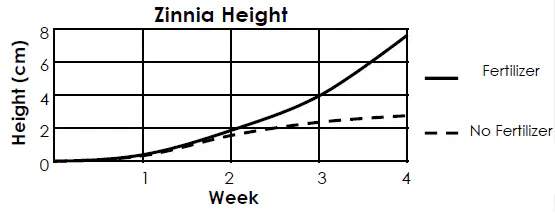
A student set up an investigation to determine the effect of fertilizer on zinnias. He kept all variables the same except for the fertilizer. Which of the following is a reasonable explanation that can be inferred from the evidence in the graph?
a)
Zinnias grow more flowers with no fertilizer
b)
Zinnias grow taller when provided with fertilizer
c)
Zinnias need fertilizer to grow
17.
What is a conclusion in an experiment?
a)
A list of steps to carry out the experiment
b)
An interpretation of what you have learned by using evidence to accept of reject your hypothesis
c)
Only true if it supports your hypothesis
18.

If I blow bubbles using dish soap, then I predict that Dawn soap will blow the biggest bubbles because it is the thickest and most expensive. Does the data support the hypothesis? Why or Why not?
a)
Yes, because, Dawn dish detergent is more expensive so it will blow the biggest bubbles
b)
No, because the data shows that the Kroger brand had an average bubble size of 108 cm which is larger than the average Dawn bubble size of 100.8cm
c)
No, because Dawn brand had an average bubble size of 100.8 while the average bubble size of the Palmolive brand was 63cm
100 %

