wayground logo

Free Printable Worksheets

Font size

S
M
L
XL
Worksheets

Proofs Intro Quiz

Total questions: 34

Worksheet time: 1hrs 15mins
Name
Class
Date
1.

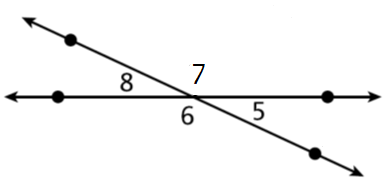
Which angles are vertical angles?

a)

8 & 7\angle8\ \&\ \angle7

b)

8 & 6\angle8\ \&\ \angle6

c)

8 & 5\angle8\ \&\ \angle5

2.
What is the value of "a"?
a)
45
b)
55
c)
35
d)
65
3.
What is the value of "a"?
a)
75°
b)
65°
c)
55°
d)
85°
4.

Find the missing angle.

a)

28

b)

32

c)

60

d)

38

5.

Find the missing angle.

a)

53

b)

67

c)

77

d)

43

6.

What type of angle is this?

a)

Acute

b)

Right

c)

Obtuse

d)

Straight

e)

Reflex

7.

What type of angle is this?

a)

Acute

b)

Right

c)

Obtuse

d)

Straight

e)

Reflex

8.

What type of angle is this?

a)

Acute

b)

Right

c)

Obtuse

d)

Straight

e)

Reflex

9.

What type of angle is this?

a)

Acute

b)

Right

c)

Obtuse

d)

Straight

e)

Reflex

10.

Match the following angle measurements with the type of angle.

a)

Acute

1.

36°

b)

Right

2.

90°

c)

Obtuse

3.

137⁰

d)

Straight

4.

180°

e)

Reflex

5.

271°

11.
Solve for x
a)
5
b)
90
c)
25
d)
10
12.
What angle pair is pictured?
a)
Alternate Interior Angles
b)
Supplementary Angles
c)
Vertical Angles
d)
Corresponding Angles
13.
complementary, supplementary, or neither?
a)
Complementary
b)
Supplementary
c)
Neither
14.

11) Given the two parallel lines cut by a transversal,

What is the measure of 4\angle4  if  m8=76°m\angle8=76\degree  ?


(a)  

15.

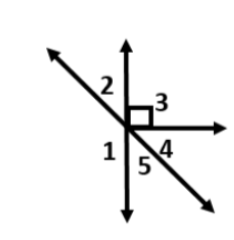
What angle is vertical to angle 2?

a)

∠4

b)

∠1

c)

∠2

d)

∠5

16.

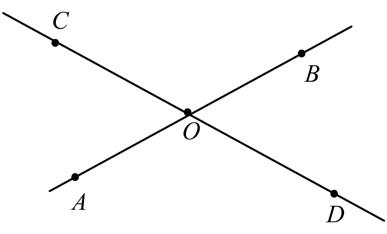
Which are pairs of adjacent angles?

a)

∠COB and ∠DOA

b)

∠AOD and ∠AOC

c)

∠COB and ∠AOD

d)

∠BOD and ∠AOC

17.
What is statement #1?
a)
BC≅DC
b)
AC≅EC
c)
BC≅DC, AC≅EC
d)
∆BCA≅∆DCE
18.
What is statement #2?
a)
∠ABC≅∠EDC
b)
∠BCA≅∠DCE
c)
BC≅CD
d)
∠E≅∠A
19.

What is the "statement" for step 3 of the proof?

a)

HA=HA

b)

HA=AH

c)

MA=AM

d)

MA=MA

20.
What is always the 1st statement in reason column of a proof?
a)
Prove
b)
Given
c)
Reason
d)
Statement
21.
Use the congruence statement to find the missing part of the statement
a)
WV
b)
WU
c)
VU
d)
WB
22.
What is the justification (reason)?
a)
reflexive property
b)
definition of segment bisect
c)
definition of a midpoint
d)
substitution property
23.
Identify the property you would use to solve this equation:
4x = 72
a)
Addition Property of Equality
b)
Subtraction Property of Equality
c)
Multiplication Property of Equality
d)
Division Property of Equality
24.
Identify the property you would use to solve this equation:
y – 7 = 28
a)
Additive Property of Equality
b)
Subtraction Property of Equality
c)
Multiplicative Property of Equality
d)
Division Property of Equality
25.
Name the first property you will use to solve this equation:
3(x – 7) = 42
a)
Multiplication Property of Equality
b)
Commutative property
c)
Associative Property
d)
Distributive Property
26.
Name the property you will first use to solve this equation:
4x – 5 = 17
a)
Addition Property of Equality
b)
Subtraction Property of Equality
c)
Multiplication Property of Equality
d)
Division Property of Equality
27.
Which equation shows the commutative property of addition?
a)
m + n = n + m
b)
a + (b + c) = (a + b) + c
c)
r + y = m + v
d)
v + r + p = t
28.
Which equation shows the associative property of addition?
a)
m + n = n + m
b)
a + (b + c) = (a + b) + c
c)
r + y = m + v
d)
v + r + p = t
29.
Which property of addition is shown below:
(9 + 6) + 4 = 9 + (6 + 4)
a)
Associative
b)
Commutative
c)
Identity
30.
Which property of addition is shown below:
(2 + 7) + 4 = (7 + 2) + 4
a)
Associative
b)
Commutative
c)
Identity
31.
Which property is shown below?
__________________________
7n = 21 then n = 3
a)
Division Property
b)
Sorcery
c)
Reduction of Multiples
d)
Distributive Property
32.
If y/4 = 5, then y = 20
a)
Multiplication Property of Equality
b)
Division Property of Equality
c)
Addition Property of Equality
d)
Subtraction Property of Equality
33.

If 3x + 4x - 5 = 10, then 7x - 5 = 10

a)

Addition Property of Equality

b)

Combine Like Terms or Simplify

c)

Subtraction Property of Equality

d)

Transitive Property of Equality

34.
Which property is shown below?
__________________________
4(x+6) = 4x + 4(6)

a)
Reflexive
b)
Distributive
c)
Transitive
d)
Substitution