Wayground logo

Free Printable Worksheets

Font size

S
M
L
XL
Worksheets

review Food chain Food web

Total questions: 30

Worksheet time: 26mins

Name
Class
Date
1.

What is the driving source of energy for the food web to

the right?

a)

Sun

b)

Orca

c)

Seal

d)

Larvae

2.

What are plants called in a food chain?

a)

Producers

b)

Consumers

c)

Decomposers

d)

Scavengers

3.

What are the organisms that break down dead stuff?

a)

Producers

b)

Consumers

c)

Decomposers

d)

Organisms

4.

Which of these organisms would receive energy from the snake?

a)

Plant

b)

Rabbit

c)

Mouse

d)

Hawk

5.

Which type of consumer is always a first consumer?

a)

Herbivore

b)

Omnivore

c)

Carnivore

d)

Producer

6.

Which type of consumer could be a first or second consumer?

a)

Herbivore

b)

Omnivore

c)

Carnivore

d)

Producer

7.

What is at the top of the food chain?

a)

producer

b)

sunlight

c)

consumer

d)

decomposer

8.

What is a producer?

a)

an orginisim that makes its own food

b)

Plant

c)

something that gets energy from the sun

d)

something that eats other orginisims

9.

What is an omnivore?

a)

the sun

b)

consumers that eat both plants and animals

c)

mouse

d)

a consumer at the top of the food chain

10.

What is a decomposer?

a)

a carnivore that eats dead animals

b)

a consumer that breaks down the remains of dead organisms

c)

the sun

d)

the soil

11.

What is a carnivore?

a)

a consumer that eats other animals

b)

tiger

c)

a plant

d)

a consumer that eats animals and plants

12.

What is at the top of the food chain?

a)

producer

b)

sunlight

c)

consumer

d)

decomposer

13.

What is a decomposer?

a)

a carnivore that eats dead animals

b)

a consumer that breaks down the remains of dead organisms

c)

the sun

d)

the soil

14.

What is a carnivore?

a)

a consumer that eats other animals

b)

tiger

c)

a plant

d)

a consumer that eats animals and plants

15.
__________ is an organism that only eats plants for energy.
a)
Carnivore
b)
Herbivore
c)
Omnivore
d)
Terivore
16.
An organism that needs to eat other organisms to obtain energy is known as a:
a)
Autotroph
b)
Producer
c)
Consumer
d)
Mutualist
17.
What does a Secondary Consumer eat?
a)
Tertiary Consumers
b)
Primary Consumers
c)
Producers
d)
Secondary Consumers
18.
What is a producer?
a)
an organism that gets energy from eating other organisms
b)
an organisms that uses sunlight to make its own food
c)
an organism that gets energy from eating dead organisms, non-living material or waste
19.
What is a carnivore?
a)
an animal that gets energy by eating other animals
b)
An animal that gets energy by eating only plants
c)
an animal that gets energy by eating both plants and animals
20.
Which of the following is a herbivore?
a)
cricket
b)
frog
c)
hawk
d)
shrew
21.

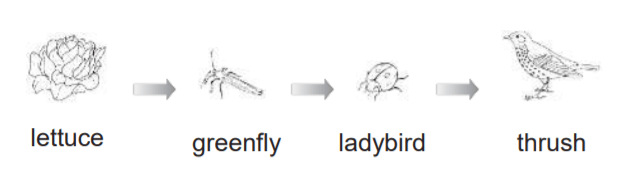
Who is the producer?

a)

lettuce

b)

greenfly

c)

ladybird

d)

thrush

22.

A connection of food chains with many food energy paths in an ecosystem is a ____________

a)

ecosystem

b)

food web

c)

environment

23.
All energy transformations in an ecosystem begin with
a)
a scavenger
b)
the sun
c)
a decomposer
d)
a herbivore
24.
Which of the following is NOT a consumer
a)
grass
b)
dog
c)
shark
d)
fish
25.
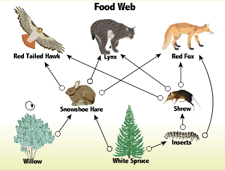
What may happen if the snowshoe hare was removed from the food web pictured?
a)
The insects in the habitat would increase.
b)
The shrew population would decrease due to being only hawk food source.
c)
The willow tree population would decrease.
d)
Foxes would dies due to no food source. 
26.
The rabbit in this food web would be considered a:
a)
Decomposer
b)
Producer
c)
Secondary Consumer
d)
Primary Consumer
27.
The fox in this food web would be considered a:
a)
Tertiary Consumer
b)
Producer
c)
Secondary Consumer
d)
Primary Consumer
28.
The mouse in this food web would be considered a:
a)
Primary Consumer
b)
Producer
c)
Tertiary Consumer
d)
Secondary Consumer
29.
an organism that makes its own food
a)
producer
b)
consumer
c)
herbivore
d)
scavenger
30.
A third-level consumer has to be which type?
a)
Carnivore.
b)
Decomposer.
c)
Producer.
d)
Herbivore.