
 Worksheets
AP Chem 1.1 - 3.3 Test Corrections
Total questions: 201
Worksheet time: 6hrs 32mins

According to the information in the table here, a 1.00 g sample of which of the following contains the greatest mass of oxygen?
Na2O
MgO
K2O
CaO
The average atomic mass of a newly discovered element is 10.600 amu. It has two naturally occurring isotopes. One has a mass of 10.000 and a natural abundance of 70.000%. What is the isotopic mass of the other isotope?
10.000
9.0000
12.000
11.000
A new element has two isotopes, one with a mass of 40.0 amu that is 75% abundant. The average atomic weight of the element is 40.50 amu. What is the isotopic mass of the other isotope?
40.0 amu
42.0 amu
41.0 amu
44.0 amu
108 g of an element Z reacts with oxygen to form 204 g of the oxide Z2O3. What is the element Z?
Al
Sc
Ag
Mn

Which contains the largest number of atoms?
3.0 mL of CH3OH (density = 1.2g/mL)
3.0 moles of CO
3.0 mg of water
3.0x10²² molecules of nitrogen gas
Estimate the number of moles of hydrogen in 176g of pentanol, C5H11OH. The molar mass of pentanol is 88g/mol.
12 mol H
144 mol H
24 mol H
72 mol H
An Olympic medal contains 71.5% of gold by mass. How much gold could be extracted from a medal that weighs 115 grams?
0.417 mol
1.33 mol
0.817 mol
14.1 mol
How would you be able to separate the hydrogen from the oxygen in water?
by using a filter
distillation
electolysis (using electricity)
by using tweezers
If matter is not uniform throughout and can be separated by physical means it is a ________.
a compound
an element
a heterogeneous mixture
a homogeneous mixture

What is the element?
Mass Number = 197
Number of Electrons = 79
Number of Neutrons = 118
Copper
Boron
Silver
Tin

What is the mass number of this element?
17
18
35
7
An atom with 2 protons, 3 neutrons, and 4 electrons has a charge of ____.
+2
-2
+3
0
How do you write the balanced equation of burned propane (C3H8) in the presence of oxygen to produce water and carbon dioxide?
C3H8 + O2 → H2O + CO2
C3H8 + O2 → 4H2O + 3CO2
C3H8 + 5O2 → 4H2O + 3CO2
C3H8 + 3O2 → 2H2O + 3CO2

The blue elements (left side) are called
Write the formula for the following: Hydroiodic Acid
(a)
Find the molar masses of the following compounds:
(NH4)2CO3
303.3 g/mole
102.9 g/mole
74.1 g/mole
160.0 g/mole
96.0 g/mole
Find the percent composition of both Copper and Sulfur in the compound Cu2S?
%Cu= 67.987 %S= 32.013
%Cu= 79.854 %S= 20.145
%Cu= 35.946 %S= 64.054
In a reaction, 9 grams of a substance are produced. The theoretical yield was 10 grams. What is the percentage yield?
80%
85%
90%
95%
Mg + 2HCl --> MgCl2 + H2
SO2 + PCl5 ⟶ SOCl2 + POCl3
What mass of SOCl2 is produced when 16.2g SO2 react with 13.7g PCl5?
Quinone, which is used in the dye industry and in photography, is an organic compound containing only C, H, and O. What is the empirical formula of the compound if you find that 0.105 g of the compound gives 0.257 g of CO2 and 0.0350 g of H2O when burned completely?
CHO
C2H10
C6H4O2
C3H2O
The simplest formula for an oxide of element Z (MM= 86.0) that is 32% oxygen by weight is
Z2O
ZO2
Z2O5
ZO
When reading a PES graph, the higher the peak, _______________
the more energy the electrons contain
the more electrons are in that sublevel
the further the electrons are from the nucleus
the higher the first ionization energy
When reading a PES graph, a larger binding energy means
there are more electrons in that sublevel
the closer the electrons are to the nucleus
the lower the ionization energy
the further away the electrons are from the nucleus
What is the electron configuration for the zinc atom in the ground state?
1s2 2s2 2p6 3s2 3p6 4s2 3d10
1s2 2s2 2p6 3s2 3p6 4s2 4d10
1s2 2s2 2p6 3s2 3p6 4d10
1s2 2s2 2p6 3s2 3p6 3d10
What is the electron configuration for the zinc ion?
1s2 2s2 2p6 3s2 3p6 3d10
1s2 2s2 2p6 3s2 3p6 4s2 3d8
1s2 2s2 2p6 3s2 3p6 4s2 3d10 4p2
1s2 2s2 2p6 3s2 3p6 4d10
In a PES graph, 1s electrons will have a _______ binding energy than 2s electrons.
higher
lower
same
When Ca becomes an ion, it _______ electrons and gets _________.
loses
smaller
loses
larger
gains
smaller
gains
larger

What element is represented by this mass spectroscopy graph?
B
C
Na
Be
Ne

How many isotopes does this mass spectroscopy graph represent?
(a)

How many neutrons does the most abundant isotope have on this mass spectroscopy graph?
24
25
26
12
13
Write the ionic formula for sodium acetate
NaC2H3O2
Na2C2H3O2
Na(C2H3O2)2
C2H3O2Na
C2H3O2Na2
Write the ionic formula for tin(II) chloride
SnCl2
Sn2ClO2
SnCl
Sn2Cl
SnCl4
Write the ionic compound for calcium hydroxide
Ca(OH)2
CaOH
CaO
Ca2OH
CaH2
Write the ionic compound for zinc sulfate
ZnSO4
not enough info
Zn2SO4
Zn(SO4)2
ZnSO3
Write the ionic compound for ammonium sulfate
(NH4)2SO4
NH4SO4
NH3SO4
(NH4)2SO3
(NH3)2SO3
Write the ionic compound for manganese(II) chloride
(a)
Write the ionic compound for copper(I) nitrate
(a)
Write the ionic compound for silver chloride
(a)
Write the ionic formula for lead(II) nitrate
(a)
Write the ionic compound for sodium iodide
(a)
Write the ionic formula for lithium fluoride
(a)
Write the name for K2S
potassium sulfide
potassium sulfate
dipotassium sulfide
potassium(II) sulfide
Match an ionic formula with each name:
lead(II) nitrate = (a)
lead(II) nitrite = (b)
lead(IV) nitride = (c)
Metals (a) electrons in order to acquire a full octet.
Non-metals (b) electrons in order to acquire a full octet.
Organize these options by charge the element makes as an ion:
Na
Mg
F
O
K
Ca
Br
Se
Group 1A
Group 2A
Group 7A
Group 6A
Cations
Gain electrons, has an overall positive charge
Lose electrons, has an overall positive charge
Lose electrons, has an overall negative charge
Gain electrons, has an overall negative charge
Write the formula for the binary ionic compound: aluminum sulfide.
(a)
Write the formula for the binary ionic compound: magnesium iodide.
(a)
Write the formula for the ternary ionic compound: strontium chlorate.
(a)
The proper formula for magnesium hydroxide.
MgOH
Mg2OH
Mg(OH)2
Mg2OH2
Which of the following is NOT an ionic compound:
NaCl
Cl2
CaF2
KOH
K forms the compound K2O, which is an ionic compound that is brittle. Identify another element, M, that is likely to form a brittle compound with the formula M2O.
Na2O because Na is in the same group as K therefore they have the same # of valence electrons
Ca2O because Ca is in the same row as K, therefore they have similar properties
Ba2O because Ba is in the same row as K, therefore they have the same # of valence electrons
Zn2O because Zn is in the same row as K, therefore they have similar properties
Rb2O because Rb is in the same group as K therefore has more energy shells which creates brittle compounds
Cl forms the compound MgCl2, which is a white crystalline solid with a high melting point. Identify another element, X, that is likely to form a white crystalline solid with a high melting point with the formula MgX2.
MgF2 because F is in the same family as Cl therefore they have the same # of valence electrons
MgS2 because S is in the same row as Cl, therefore they have similar properties
MgSi2 because Si is in the same row as Cl, therefore they have the same # of valence electrons
MgNa2 because Na is also a metal and metallic solids have high melting points.
MgBr2 because Br is in the same group as Cl therefore has more energy shells which creates crystalline solids
How many moles is 100.0 grams of the ionic compound formed between sodium and sulfur?
Round to 3 significant digits and don't include units
(a)
What is the molar mass of the ionic compound formed between calcium and phosphate?
Round to a whole number
(a)
How many grams is 1.30 moles of the ionic compound formed from zinc and nitrate?
Round to 3 significant figures
(a)

The table here shows the first ionization energy and atomic radius of several elements. Which of the following best helps to explain the deviation of the first ionization energy of oxygen from the overall trend?
The atomic radius of oxygen is greater than the atomic radius of fluorine
The atomic radius of oxygen is less than the atomic radius of nitrogen
There is repulsion between paired electrons in oxygen's 2p orbitals
There is attraction between paired electrons in oxygen's 2p orbitals
Which of the following best helps to account for the fact that the F- ion is smaller than the O2- ion?
F- has a larger nuclear mass than O2- has.
F- has a larger nuclear charge than O2- has.
F- has more electrons than O2- has.
F- is more electronegative than O2- is.

For element X represented here, which of the following is the most likely explanation for the large difference between the second and third ionization energies?
The effective nuclear charge decreases with successive ionizations.
The shielding of outer electrons increases with successive ionizations.
The electron removed during the third ionization is, on average, much closer to the nucleus than the first two electrons removed were.
The ionic radius increases with successive ionizations.
Which of the following correctly compares periodic properties of two elements and provides an accurate explanation for that difference?
The first ionization energy of Al is greater than that of B because Al has a larger nuclear charge than B does.
The first ionization energy of F is greater than that of O because O has a higher electronegativity than F has.
The atomic radius of Ca is larger than that of Mg because the valence electrons in Mg experience more shielding than the valence electrons in Ca do.
The atomic radius of Cl is smaller than that of S because Cl has a larger nuclear charge than S does.

Based on the ionization energies of element X given in the table here, which of the following is most likely the formula of the compound formed between element X and SO42-?
XSO4
X2SO4
X2(SO4)3
X(SO4)2
Which of the following best helps to explain why the electron affinity of Br has a greater magnitude than that of I?
Br has a lower electronegativity than I does.
Br has a lower ionization energy than I does.
An added electron would go into a new shell in Br but not in I.
There is greater attraction between an added electron and the nucleus in Br than in I.
Choose the one that has the highest electronegativity
Cs
Pb
Br
Se
Choose the one that has the largest atomic radius
Cs
Pb
Br
Se
Choose the one that has the lowest first-ionization energy
Cs
Pb
Br
Se
Given that the density of Hg(l) at 0oC is about 14 g/mL, which of the following is closest to the volume of one mole of Hg(l) at this temperature?
0.07 mL
0.14 mL
1.4 mL
14 mL
Given that the density of Tl(l) at 0oC is about 11.85 g/mL, which of the following is closest to the volume of one mole of Tl(l) at this temperature?
0.084 mL
0.17 mL
1.7 mL
17 mL
A student has a 1 g sample of each of the following compounds:
NaCl, KBr, and KCl.
Which of the following lists the samples in order of increasing number of moles in the sample?
NaCl < KCl < KBr
NaCl < KBr < KCl
KCl < NaCl < KBr
KBr < KCl < NaCl
A student obtains a sample of a pure solid compound. In addition to Avogadro's number, which of the following must the student know in order to determine how many molecules are in the sample?
Mass of the sample, volume of the sample
Mass of the sample, density of the sample
Molar mass of the compound, mass of the sample
Molar mass of the compound, density of the sample
A solution of methanol, CH3OH, in water is prepared by mixing together 128 g of methanol and 108 g of water. The mole fraction of methanol in the solution is closest to:
0.80
0.60
0.50
0.40
A solution is prepared by adding 16 g of CH3OH (molar mass 32 g) to 90 g of H2O (molar mass 18 g). The mole fraction of CH3OH in this solution is closest to which of the following?
0.1
0.2
0.3
0.4
In 1.00 mol of potassium zirconium sulfate trihydrate, K4Zr(SO4)4 * 3 H2O, there are:
4 x 6.02 x 1023 potassium atoms
3 x 6.02 x 1023 hydrogen atoms
6.02 x 10²³ sulfur atoms
4 moles of zirconium atoms
How many carbon atoms are contained in 2.8 g of C2H4?
1.2 x 10²³
3.0 x 10²³
6.0 x 10²³
1.2 x 1024
How many hydrogen atoms are contained in 2.8 g of C2H4?
1.2 x 10²³
2.4 x 10²³
6.0 x 10²³
1.2 x 1024
A 100.0 g sample of which of the following compounds contains the most molecules?
CO2
SO2
H2O
N2O
Which of the following numerical expressions gives the number of particles in 2.0 g of Ne?


Which of the following are covalent compounds?
Zn2+
CH2O
NH4+
NaI
F2

Which of the following bonds will be most polar?
Si-O
C-H
O-O
B-F
Which of the following best explains why copper conducts electricity?
It can have two or three valence electrons
It has delocalized electrons that can flow in a circuit
It is a transition metal
It has a low electronegativity
Atoms are most likely to form a covalent bond:
(select 2)
When they are at the lowest potential energy possible
When they are at the highest potential energy possible
When they are opposite charges
When they are close enough for valence electrons to be attracted to the other atom's nucleus
When they are so close their nuclei are touching
What is a substitutional alloy?
A metal with one element
A metal with two elements of similar size
A metal with two elements of very different sizes
A metal with layers of different elements
Which is the correct Lewis structure for the compound CH2O?


What hybridization exists for the compound CH2O?
sp3
sp2
sp
there is no hybridization

What type of Alloy is this?
Substitutional Alloy
Interestial Alloy
Subsitutional/Interestial Alloy

What type of Alloy is this?
Subsitutional Alloy
Interestial Alloy
Subsitutional/ Interestial Alloy
What is the bond angle of CH4?
180
120
109.5
90
A molecule with a bond angle of approximately 109.5 is said to be:
linear
bent
trigonal planar
Octahedral
A molecule that is trigonal planar will have a bond angle of approximately:
180
120
109.5
90
A molecule that is trigonal planar has a hybridization of:
sp3
sp2
sp
sp3d
Which bond is most polar?
C-H
C-N
C-O
C-F

According to the diagram, what is the internuclear distance in this bond?
300 pm
420 pm
600 pm
85 pm

According to the diagram, how much energy is required to break the bond?
200 kJ/mol
400 kJ/mol
0 kJ/mol
600 kJ/mol
300 kJ/mol
Which of the following pairs will have the greatest ionic bond strength?
Mg-O
Mg-F
Na-O
Na-F

What is the molecular geometry of the molecule shown?
Linear
Trigonal Planar
Tetrahedral
Bent

What is the molecular geometry of the Lewis structure shown?
tetrahedral
bent
trigonal planar
trigonal pyramidal

In the nitrite ion (NO2-), __________.
both bonds are single bonds
both bonds are double bonds
both bonds are the same because of resonance
there is one single and one double bond

In the resonance form of ozone shown, the formal charge on the central oxygen atom is _______.
0
+1
-1
+2
-2

Partial charges are present in which type of bond?
Ionic
Nonpolar Covalent
Polar Covalent
Both Polar Covalent and Ionic
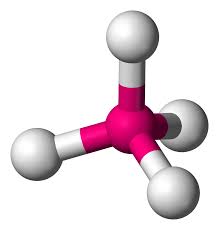
What is the hybridization of this molecule shown above
sp
sp2
sp3
sp4
Factors affecting the value of lattice energy
the size of the ions only
the charges of the ions only
BOTH the size of the ions AND the charges of the ions
When comparing different ionic compounds, the one with the greater charges will have a _______ magnitude of lattice energy.
greater
less
same
When comparing different ionic compounds, the one with the ions of greater size or radius will have a _______ magnitude of lattice energy.
greater
smaller
same
Choose the ionic compound with the greater magnitude of lattice energy.
CaCl2
KCl

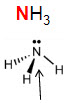
Linear shapes have what type of hybridization?
sp
sp2
sp3
none of the above
Which of these orbitals is NOT sp3 hybridized?
bent
linear
trigonal pyramidal
tetrahedral
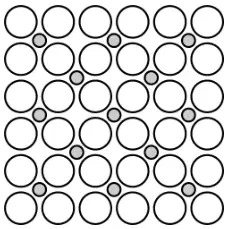
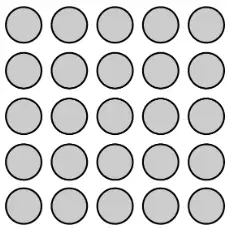
Copper Atoms and zinc atoms have the same radius, 135 picometers. Based on this information, which of the following diagrams best represents an alloy containing only copper and zinc atoms?

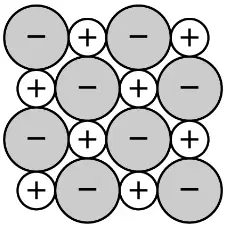

Based on the resonance structures shown, what are the bond orders of the two carbon-oxygen bonds?
1 and 1.5
1 and 2
1.5 and 1.5
2 and 2
Which of the following scientific claims about the bond in the molecular compound HF is most likely to be true?
There is a partial negative charge on the H atom
Electrons are shared equally between the H and F atoms
The bond is extremely weak
The bond is highly polar
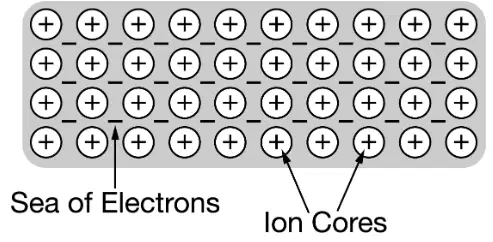
A particle-level diagram of a metallic element is shown. Typically, metals are both malleable and ductile. The best explanation for these properties is that the electrons involved in bonding among metal atoms are
unequally shared and form nondirectional bonds
unequally shared and form highly directional bonds
equally shared and form nondirectional bonds
equally shared and form highly directional bonds
Which of the following compounds contains both ionic and covalent bonds?
C2H5OH
MgF2
H2S
NH4Cl
Two pure elements react to form a compound. One element is an alkali metal, X, and the other element is a halogen, Z. Which of the following is the most valid scientific claim that can be made about the compound?
it has the formula XZ2
it does not dissolve in water
it contains ionic bonds
it contains covalent bonds
The elements C and Se have the same electronegativity value, 2.55. Which of the following claims about the compound that forms from C and Se is most likely to be true?
The carbon-to-selenium bond is unstable
The carbon-to-selenium bond is nonpolar covalent
The compound has the empirical formula CSe
A molecule of the compound will have partial negative charge on the carbon atom.
Which of the following substances has bonds with the greatest ionic character?
CCl4
CuCl2
CaCl2
NCl3
Steel is an alloy containing Fe atoms and C atoms. Which of the following diagrams best represents the particle-level structure of steel?

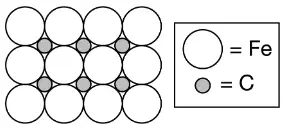
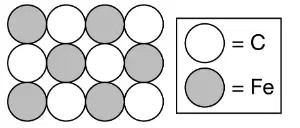
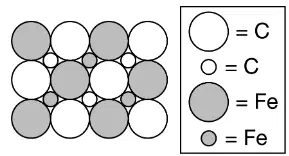

The table here provides some information about two types of steel, both of which are alloys of iron and carbon. Which of the following best helps to explain why high-carbon steel is more rigid than low-carbon steel?
Elemental carbon is higher than elemental iron.
The additional carbon atoms within the alloy make the high-carbon steel less dense.
The additional carbon atoms within the alloy increase the thermal conductivity o the high-carbon steel.
The additional carbon atoms within the alloy make it more difficult for the iron atoms to slide past one another.

When Reaction 3 occurs, does the hybridization of the carbon atoms change?
Yes; it changes from sp to sp2
Yes; it changes from sp to sp3
Yes; it changes from sp2 to sp3
No; it does not change
Which of the following contain 1 sigma (σ) and 2 pi (π) bonds?
Br2
N2
O2
F2
Li2
Which of the following contain 1 sigma (σ) and 1 pi (π) bond?
Br2
N2
O2
F2
Li2
Which of the following contain 1 sigma (σ) and 0 pi (π) bonds?
CO2
N2
O2
F2
H2O
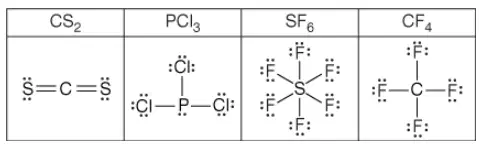
Based on the diagrams shown above, which of the following would have the greatest dipole moment, and why?
CS2, because double bonds create an area of higher electron density around the C atom
PCl3, because Cl atoms draw electron density away from the P atom and the bond dipoles do not cancel one another
SF6, because it has the greatest number of polar bonds
CF4, because the large electronegativity difference between C and F results in very polar bonds
Choose the molecule in which the intramolecular forces are strongest
BeCl2
SO2
N2
F2
Choose the molecule that is polar
BeCl2
SO2
N2
F2

Identify the IMF between the two iodine molecules shown.
London Dispersion Force
Hydrogen bonding
dipole-dipole
ion-dipole

Identify the IMF occurring between Na+ and H2O shown in the diagram.
London Dispersion Force
Ion-Dipole
Dipole-Dipole
Hydrogen bonding

Identify the IMF occuring in the diagram.
LDF
Ion-Dipole
Dipole-Dipole
Hydrogen Bonding

Identify the IMF in the diagram shown.
dipole-dipole
LDF
Hydrogen bonding
ion-dipole
Organize these compounds according to the strongest IMF they experience:
F2
He
HCl
SO2
HCN
H2O
HF
NH3
Organize these compounds according to the strongest IMF they experience:
Cl2
Ar
H2S
PH3
CH2O
CH3OH
CH3COOH
CO2
Between He and Ne, which one would have the higher boiling point and why?
Ne. Both experience LDF, Ne has more e- which means it is more polarizable and experiences stronger IMF's.
Ne. Both experience LDF, Ne has fewer e- which means it is more polarizable and experiences stronger IMF's.
He. Both experience LDF, He has more e- which means it is more polarizable and experiences stronger IMF's.
He. It experiences Dipole-dipole which is stronger than LDF.
Arrange the following in order of increasing boiling point:
CH4
C2H6
C4H10
C6H14
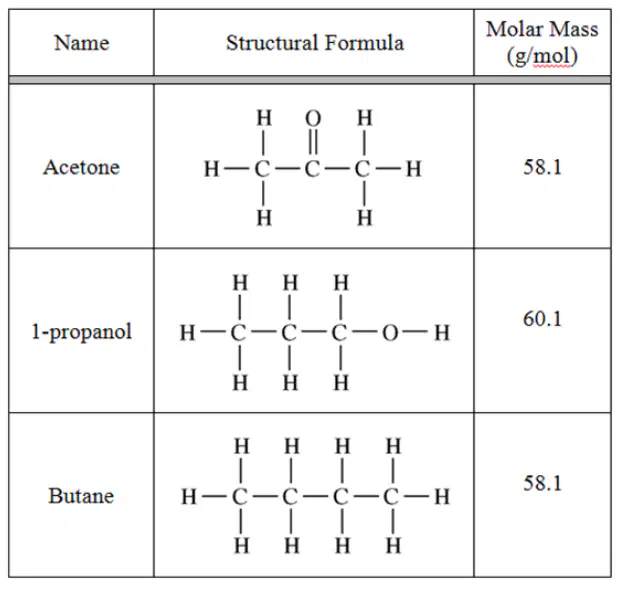
The table here shows the structural formulas and molar masses for three different compounds. Which of the following is a list of the compounds in order of increasing boiling points?
Butane < 1-propanol < acetone
Butane < acetone < 1-propanol
1-propanol < acetone < butane
Acetone = butane < 1-propanol

Refer to three gases in identical rigid containers under the conditions given in the table.
If the pressure of each gas is increased at constant temperature until condensation occurs, which gas will condense at the lowest pressure?
methane
ethane
butane
All the gases will condense at the same pressure.
The London (dispersion) forces are weakest for which of the following gases under the same conditions of temperature and pressure?
H2
O2
Xe
F2
N2
Solid ethyl alcohol, C2H5OH, is
A network solid with covalent bonding
A molecular solid with zero dipole moment
A molecular solid with hydrogen bonding
An ionic solid
A metallic solid

Nonane and 2,3,4-trifluoropentane have almost identical molar masses, but nonane has a significantly higher boiling point. Which of the following statements best helps explain this observation?
The C-F is easier to break than the C-H bond.
The C-F is more polar than the C-H bond.
The carbon chains are longer in nonane than they are in 2,3,4-trifluoropentane.
The carbon chains are farther apart in a sample of nonane than they are in 2,3,4-trifluoropentane.

The liquefied hydrogen halides have the normal boiling points given above. The relatively high boiling point of HF can be correctly explained by which of the following?
HF gas is more ideal.
HF is the strongest acid.
HF molecules have a smaller dipole moment.
HF is much less soluble in water.
HF molecules tend to form hydrogen bonds.
On the basis of strength of intermolecular forces, which of the following elements would be expected to have the highest melting point?
Br2
Cl2
Fr2
Kr
N2
In solid methane, the forces between neighboring CH4 molecules are best characterized as
ionic bonds
covalent bonds
hydrogen bonds
ion-dipole forces
London (dispersion) forces

Identify the IMF between the two bromine molecules shown.
London Dispersion Force
Hydrogen bonding
dipole-dipole
ion-dipole
Which of the following elements would have the highest boiling point?
Neon
Argon
Krypton
Xenon

Identify the IMF occurring between NH3 and H2O shown in the diagram.
London Dispersion Force
Ion-Dipole
Dipole-Dipole
Hydrogen bonding
Which of the following compounds has the highest boiling point?
CH4
SiH4
GeH4
SnH4
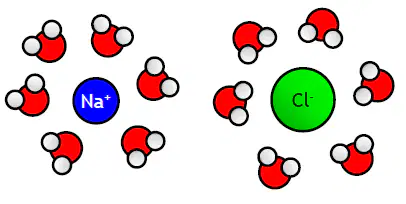
Identify the IMF occurring in the diagram.
LDF
Ion-Dipole
Dipole-Dipole
Hydrogen Bonding
Dipole induced dipole
The boiling points of the elements helium, neon, argon, krypton, and xenon increase in that order. Which of the following statements accounts for this increase?
The London (dispersion) forces increase.
The hydrogen bonding increases.
The dipole-dipole forces increase.
The chemical reactivity increases.
The number of nearest neighbors increases.
The best explanation for the fact that diamond is extremely hard is that diamond crystals
are made up of atoms that are intrinsically hard because of their electronic structures
consist of positive and negative ions that are strongly attracted to each other
are giant molecules in which each atom forms strong covalent bonds with all of its neighboring atoms
are formed under extreme conditions of temperature and pressure
contain orbitals or bands of delocalized electrons that belong not to single atoms but to each crystal as a whole
In which of the following processes are covalent bonds broken?
I2(s) → I2(g)
CO2(s) → CO2(g)
NaCl(s) → NaCl(l)
C(diamond) → C(g)
Fe(s) → Fe(l)
A 0.10 M aqueous solution of sodium sulfate, Na2SO4 , is a better conductor of electricity than a 0.10 M aqueous solution of sodium chloride, NaCl. Which of the following best explains this observation?
Na2SO4 is more soluble in water than NaCl is.
Na2SO4 has a higher molar mass than NaCl has.
To prepare a given volume of 0.10 M solution, the mass of Na2SO4 needed is more than twice the mass of NaCl needed.
More moles of ions are present in a given volume of 0.10 M Na2SO4 than in the same volume of 0.10 M NaCl.
The degree of dissociation of Na2SO4 in solution is significantly greater than that of NaCl.
Which one of the following is the best conductor of electricity?
0.10 M NaCl
0.10 M Na2SO4
0.20 M KNO3
0.30 M glucose (C6H12O6)
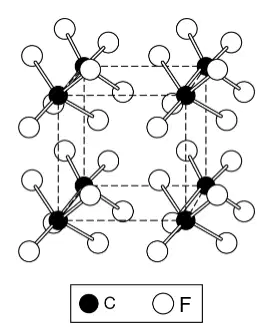
Solid carbon tetrafluoride, CF4, is represented by the diagram above. The attractions between the CF4 molecules that hold the molecules together in the solid state are best identified as
polar covalent bonds
nonpolar covalent bonds
intermolecular attractions resulting from temporary dipoles
intermolecular attractions resulting from permanent dipoles
A sample of a hard, solid binary compound at room temperature did not conduct electricity as a pure solid but became highly conductive when dissolved in water. Which of the following types of interactions is most likely found between the particles in the substance?
Ionic bonds
Metallic bonds
Covalent bonds
Hydrogen bonds
At 298 K and 1 atm, Br2 is a liquid with a high vapor pressure, and Cl2 is a gas. Those observations provide evidence that under the given conditions, the
forces among Br2 molecules are stronger than those among Cl2 molecules
forces among Cl2 molecules are stronger than the Cl−Cl bond
Br−Br bond is stronger than the Cl−Cl bond
Cl−Cl bond is stronger than the Br−Br bond
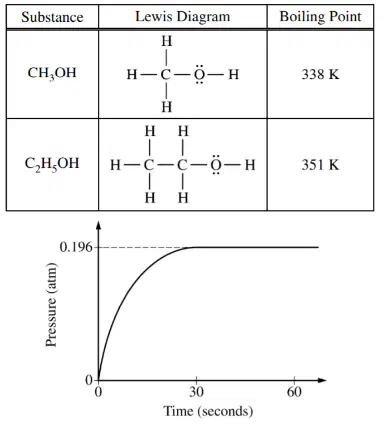
Equimolar samples of CH3OH(l) and C2H5OH(l) are placed in separate, previously evacuated, rigid 2.0 L vessels. Each vessel is attached to a pressure gauge, and the temperatures are kept at 300 K. In both vessels, liquid is observed to remain present at the bottom of the container at all times. The change in pressure inside the vessel containing CH3OH(l) is shown below.
Compared to the equilibrium vapor pressure of CH3OH(l) at 300 K, the equilibrium vapor pressure of C2H5OH(l) at 300 K is
The same, because both compounds have hydrogen bonding among their molecules
higher, because London dispersion forces among C2H5OH molecules are greater than those among CH3OH molecules
lower, because London dispersion forces among C2H5OH molecules are greater than those among CH3OH molecules
lower, because of the larger number of hydrogen bonds among C2H5OH molecules
At room temperature I2(s) is a molecular solid. Which of the following provides a characteristic of I2(s) with a correct explanation?
It has a high melting point because it has weak intermolecular forces.
It is hard because it forms a three-dimensional covalent network.
It is not a good conductor of electricity because its valence electrons are localized in bonding and nonbonding pairs.
It is very soluble in water because its molecules are polar.
Which statement best helps to explain the observation that NH3(l) boils at −28°C, whereas PH3(l) boils at −126°C?
The dispersion forces in NH3 are weaker than the dispersion forces in PH3.
The dispersion forces in NH3 are stronger than the dipole-dipole forces in PH3.
NH3 has hydrogen bonding that is stronger than the dipole-dipole forces in PH3.
NH3 has hydrogen bonding that is weaker than the dipole-dipole forces in PH3.
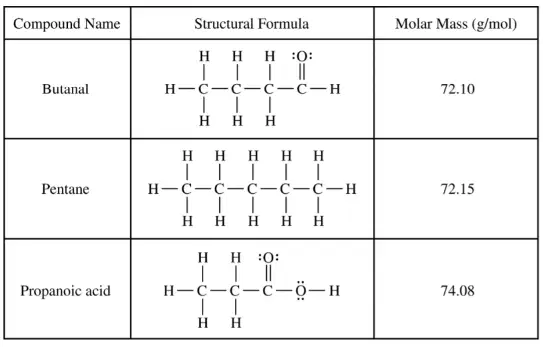
Based on the information in the table above, which of the compounds has the highest boiling point, and why?
Butanal, because it can form intermolecular hydrogen bonds
Pentane, because it has the longest carbon chain
Pentane, because it has the most C−H bonds
Propanoic acid, because it can form intermolecular hydrogen bonds
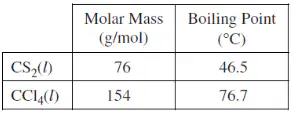
Based on the information in the table above, which liquid, CS2(l) or CCl4(l), has the higher equilibrium vapor pressure at 25°C, and why?
CS2(l), because it has stronger London dispersion forces
CS2(l), because it has weaker London dispersion forces
CCl4(l), because it has stronger London dispersion forces
CCl4(l), because it has weaker London dispersion forces
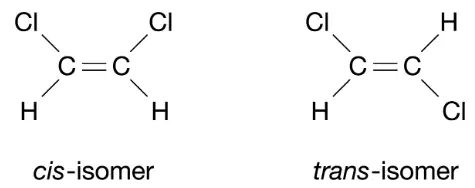
The structural formulas for two isomers of 1,2-dichloroethene are shown above. Which of the two liquids has the higher equilibrium vapor pressure at 20°C, and why?
The cis-isomer, because it has dipole-dipole interactions, whereas the trans-isomer has only London dispersion forces
The cis-isomer, because it has only London dispersion forces, whereas the trans-isomer also has dipole-dipole interactions
The trans-isomer, because it has dipole-dipole interactions, whereas the cis-isomer has only London dispersion forces
The trans-isomer, because it has only London dispersion forces, whereas the cis-isomer also has dipole-dipole interactions

The diagram above is a molecular model of a gaseous diatomic element that is just above its boiling point. Intermolecular forces between the gas molecules will cause them to condense into the liquid phase if the temperature is lowered. Which of the following best describes how the model is limited in its depiction of the phenomenon?
It does not show how hydrogen bonds are constantly forming, breaking, and reforming, which results in a net force of attraction between the molecules.
It does not show how the interactions between ions and the induced molecular dipoles result in a net force of attraction between the molecules.
It does not show how the interacting permanent dipoles of the molecules result in a net force of attraction between the molecules.
It does not show how the temporary fluctuating dipoles of the molecular electron clouds result in a net force of attraction between the molecules.
Which of the following best helps to explain why carbon tetrachloride, CCl4, is a liquid whereas carbon tetraiodide, CI4, is a solid when both are at 25°C?
The dipole moment of the CCl4 molecule is larger than that of the CI4 molecule because Cl is more electronegative than I.
The dipole moment of the CI4 molecule is larger than that of the CCl4 molecule because there is stronger repulsion between electrons in the C-I bonds compared to the repulsion between electrons in the C- Cl bonds.
The London dispersion forces are stronger in CCl4 than in CI4 because Cl is more electronegative than I.
The London dispersion forces are stronger in CI4 than in CCl4 because CI4 has a more polarizable electron cloud than CCl4
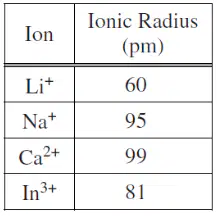
Based on Coulomb’s Law and the information in the table above, which of the following cations is most likely to have the weakest interaction with an adjacent water molecule in an aqueous solution?
Li+
Na+
Ca2+
In3+
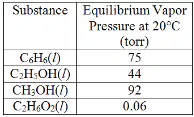
Based on the data in the table above, which of the following liquid substances has the weakest intermolecular forces?
C6H6(l)
C2H5OH(l)
CH3OH(l)
C2H6O2(l)
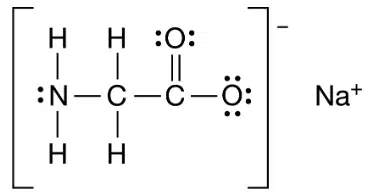
Which of the following statements is true about sodium glycinate, represented above?
It is an ionic solid at room temperature.
It is not soluble in water.
It evaporates easily because of the lack of hydrogen bonding.
It dissolves in water to form an acidic solution.
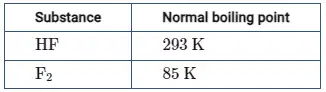
The electron cloud of HF is smaller than that of F2 , however, HF has a much higher boiling point than F2 has. Which of the following explains how the dispersion-force model of intermolecular attraction does not account for the unusually high boiling point of HF?
F2 is soluble in water, whereas HF is insoluble in water.
The F2 molecule has a greater mass than the HF molecule has.
Liquid F2 has weak dispersion force attractions between its molecules, whereas liquid HF has strong ionic interactions between H+ and F− ions.
Liquid F2 has weak dispersion force attractions between its molecules, whereas liquid HF has both weak dispersion force attractions and hydrogen bonding interactions between its molecules.
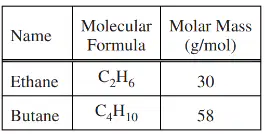
The molecular formula and molar mass of two straight-chain hydrocarbons are listed in the table above. Based on the information in the table, which compound has the higher boiling point, and why is that compound’s boiling point higher?
C4H10 ,because it has more hydrogen atoms, resulting in more hydrogen bonding
C4H10 , because it has more electrons, resulting in greater polarizability and stronger dispersion forces
C2H6 , because its molecules are smaller and they can get closer to one another, resulting in stronger dispersion forces
C2H6 , because its molecules are more polar, resulting in stronger dipole-dipole attractions
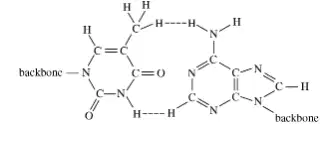
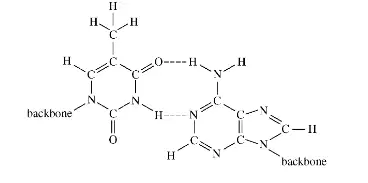
Thymine and adenine form a base pair in the DNA molecule. These two bases can form a connection between two strands of DNA via two hydrogen bonds. Which of the following diagrams shows the correct representation of the hydrogen bonding (denoted by dashed lines) between thymine and adenine base pairs? (In each diagram, thymine is shown at the left and adenine is shown at the right. The bases are attached to the backbone portion of the DNA strands.)
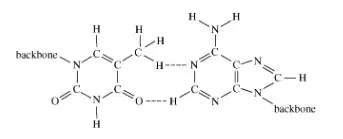
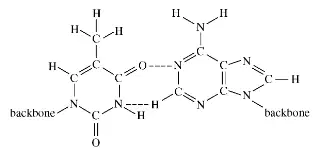
Which of the following could be the identity of a white crystalline solid that exhibits the following properties?
It melts at 320°C.
It does not conduct electricity as a solid.
It conducts electricity in an aqueous solution.
C6H12O6(s)
NaOH(s)
SiO2(s)
Cu(s)
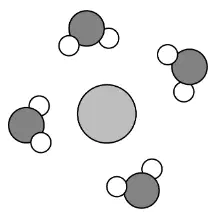
The diagram above represents a particle in aqueous solution. Which of the following statements about the particle is correct?
The particle must be a cation because the negative end of each water molecule is pointed toward it.
The particle must be an anion because the positive end of each water molecule is pointed toward it.
The charge of the particle cannot be determined because water molecules have no net charge.
The charge of the particle cannot be determined because the water molecules are arranged symmetrically and their partial charges cancel.
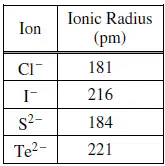
Based on Coulomb’s law and the information in the table above, which of the following anions is most likely to have the strongest interactions with nearby water molecules in an aqueous solution?
Cl-
I-
S2-
Te2-

Based on the structures shown above, which of the following statements identifies the compound with the higher boiling point and provides the best explanation for the higher boiling point?
Compound 1, because it has stronger dipole-dipole forces than compound 2
Compound 1, because it forms hydrogen bonds, whereas compound 2 does not
Compound 2, because it is less polarizable and has weaker London dispersion forces than compound 1
Compound 2, because it forms hydrogen bonds, whereas compound 1 does not
A certain crystalline substance that has a low melting point does not conduct electricity in solution or when melted. This substance is likely to be
a covalent network solid
a metallic solid
a polymer
an ionic solid
a molecular solid
A solid is tested in a laboratory to determine its properties. Which of the following provides the best evidence to support the hypothesis that the solid is a metal as opposed to a nonmetal?
It reacts with oxygen.
It is lustrous and malleable.
It has a high melting point (1700°C).
It has the same density as aluminum (2.7g/mL).
A student is given a sample of a pure, white crystalline substance. Which of the following would be most useful in providing data to determine if the substance is an ionic compound?
Examining the crystals of the substance under a microscope
Determining the density of the substance
Testing the electrical conductivity of the crystals
Testing the electrical conductivity of an aqueous solution of the substance
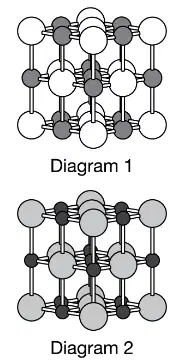
The ionic compounds NaCl and MgS are represented by the diagrams above. Which statement correctly identifies diagram 1 and identifies the compound with the lower melting point, explaining why?
Diagram 1 represents NaCl; it has a lower melting point than MgS has because the coulombic attractions between the singly charged Na+ ions and the Cl− ions in NaCl are stronger than those between the ions in MgS.
Diagram 1 represents NaCl; it has a lower melting point than MgS because the coulombic attractions between its singly charged Na+ ions and the Cl− ions are weaker than those between the ions in MgS.
Diagram 1 represents MgS; it has a lower melting point than NaCl because the coulombic attractions between its doubly charged Mg2+ ions and the S2− ions are stronger than those between the ions in NaCl.
Diagram 1 represents MgS; it has a lower melting point than NaCl because the coulombic attractions between the doubly charged Mg2+ ions and the S2− ions are weaker than those between the ions in NaCl.
Ne, HF, C2H6, CH4
Which of the substances listed above has the highest boiling point, and why?
Ne, because its atoms have the largest radius
HF, because its molecules form hydrogen bonds
C2H6 , because each molecule can form multiple hydrogen bonds
CH4 , because its molecules have the greatest London dispersion forces
Which element, Ne or Xe, has the lower boiling point, and why?
Ne, because it has a smaller, less polarizable electron cloud than Xe
Ne, because its atoms have a faster average speed at a given temperature than Xe atoms
Xe, because it has a larger, more polarizable electron cloud than
Xe, because its atoms have a slower average speed at a given temperature than Ne atoms
Arrange the following in order of increasing boiling point?
F2
HCl
HF
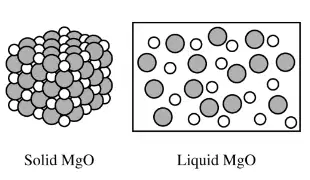
Based on the diagram above, which of the following best helps to explain why MgO(s) is not able to conduct electricity, but MgO(l) is a good conductor of electricity?
MgO(s) does not contain free electrons, but MgO(l) contains free electrons that can flow.
MgO(s) contains no water, but MgO(l) contains water that can conduct electricity.
MgO(s) consists of separate Mg2+ ions and O2− ions, but MgO(l) contains MgO molecules that can conduct electricity.
MgO(s) consists of separate Mg2+ ions and O2− ions held in a fixed lattice, but in MgO(l) the ions are free to move and conduct electricity.
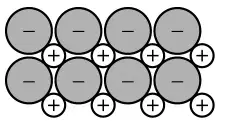
Which of the following most likely describes the solid represented in the diagram above?
It is soft and is a poor thermal and electrical conductor.
It has a low melting point and is a poor thermal and electrical conductor as a solid.
It is a brittle, water-soluble electrolyte that is a poor thermal and electrical conductor as a solid.
It is malleable and is an excellent thermal and electrical conductor as a solid.
At 298K and 1atm, Br2 is a liquid and I2 is a crystalline solid. Which of the following statements best explains the different physical states of Br2 and I2 at 298K and 1atm?
The London dispersion forces among I2 molecules are stronger than those among Br2 molecules.
The London dispersion forces among Br2 molecules are stronger than those among I2 molecules.
The Br-Br bond is stronger than the I-I bond.
The I-I bond is stronger than the Br-Br bond.
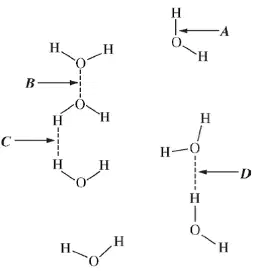
In the diagram above, which of the labeled arrows identifies hydrogen bonding in water?
A
B
C
D
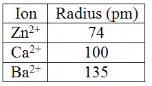
Based on the data in the table above, which of the following correctly predicts the relative strength of the attraction of Zn2+, Ca2+, and Ba2+ ions to water molecules in a solution, from strongest to weakest, and provides the correct reason?
Zn2+ > Ca2+ > Ba2+ because the smaller ions have a stronger coulombic attraction to water
Zn2+ > Ca2+ > Ba2+ because the smaller ions are more electronegative
Ba2+ > Ca2+ > Zn2+ because the larger ions are more polarizable
Ba2+ > Ca2+ > Zn2+ because the larger ions are less electronegative
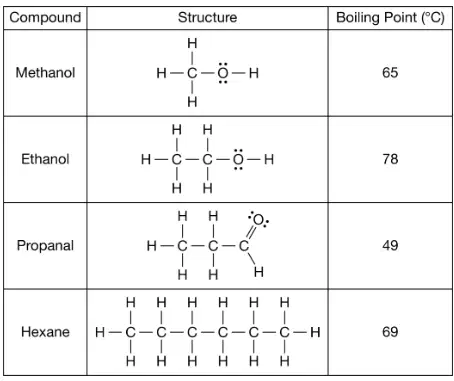
Which of the following best helps to explain why hexane has a higher boiling point than methanol has?
Methanol molecules can form hydrogen bonds with other methanol molecules.
Hexane cannot form hydrogen bonds with other hexane molecules.
Methanol molecules have attractions to one another due to London dispersion forces.
Hexane molecules have electron clouds that are larger than those of methanol molecules.
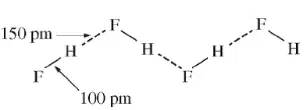
The figure above shows that in solid hydrogen fluoride there are two different distances between H atoms and F atoms. Which of the following best accounts for the two different distances?
Accommodation of the necessary bond angles in the formation of the solid
Difference in strength between covalent bonds and intermolecular attractions
Different isotopes of fluorine present in the samples
Uneven repulsions among nonbonding electron pairs
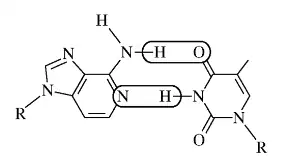
Which of the following is the strongest type of interaction that occurs between the atoms within the circled areas of the two molecules represented above?
Polar covalent bond
Nonpolar covalent bond
Hydrogen bond
London dispersion forces
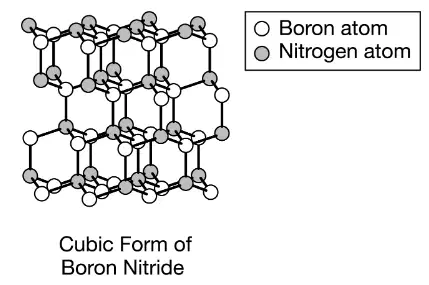
The structure of one form of boron nitride is represented above. This form of boron nitride is one of the hardest substances known. Which of the following best helps explain why boron nitride is so hard?
Boron ions and nitrogen ions are held together by ionic bonds.
Boron nitride is a network solid of atoms connected by covalent bonds with fixed bond angles.
Boron nitride is an alloy, and alloys are typically harder than the elements used to make them.
Boron nitride is a polymer made of long chains of boron atoms and nitrogen atoms held together by dispersion forces.
In which of the following liquids do the intermolecular forces include dipole-dipole forces?
F2(l)
CH4(l)
CF4(l)
CH2F2(l)
Which of the following substances is a strong electrolyte when dissolved in water?
Sucrose
Sucrose
Sodium nitrate
Acetic acid
Ammonia

