
Font size
 Worksheets
PHS Muscular System Review
Total questions: 28
Worksheet time: 14mins
Compare the three main kinds of muscle by describing the action of each.
Skeletal muscle is responsible for voluntary movements.
Cardiac muscle is responsible for involuntary movements of the heart.
Smooth muscle is responsible for involuntary movements in internal organs.
All of the above are correct.
Differentiate between voluntary muscle and involuntary muscle.
Voluntary muscles are controlled consciously, while involuntary muscles are not.
Involuntary muscles are controlled consciously, while voluntary muscles are not.
Both voluntary and involuntary muscles are controlled consciously.
Neither voluntary nor involuntary muscles are controlled consciously.
Which of the following are functions of muscles?
Movement of the body
Maintenance of posture
Production of heat
Digestion of food
Describe the two main ways muscles attach to bones.
Tendons and ligaments
Directly and indirectly
Via cartilage and synovial fluid
Through joints and capsules
Which of the following are diseases of the muscular system?
Muscular dystrophy
Osteoporosis
Arthritis
How many muscles make up the muscular system?
over 600
500
206
300
What type of muscle is found in the internal organs of the body such as those in the digestive and respiratory systems?
Skeletal muscle
Cardiac muscle
Smooth muscle
Striated muscle
Excitability refers to the ability to respond to a stimulus such as a ________.
nerve impulse
light
sound
temperature
Contractibility is when muscle fibers that are stimulated by nerves ________, or become short and thick, which causes movement.
contract
expand
relax
elongate
Extensibility is the ability to be ________.
stretched
compressed
reduced
limited
Elasticity allows the muscle to return to its original shape after it has been ________ or ________.
contracted, stretched
expanded, compressed
twisted, bent
relaxed, tensed
The point where the muscle attaches to the bone is called the ______.
origin
insertion
junction
connection
The end that moves when the muscle contracts is called the ______.
origin
insertion
belly
tendon
What is the definition of Adduction?
Movement towards the midline of the body
Movement away from the midline of the body
Rotation of a limb
Flexion of a joint
Flexion is defined as:
A decrease in the angle between two body parts
An increase in the angle between two body parts
A rotational movement around an axis
A movement away from the midline of the body
What is the definition of Rotation?
A circular movement of an object around a center or point
A straight-line movement from one point to another
An increase in size or volume
A decrease in temperature
What is the definition of Circumduction?
A circular movement of a limb
A straight movement of a limb
A rotational movement of a limb
A lateral movement of a limb
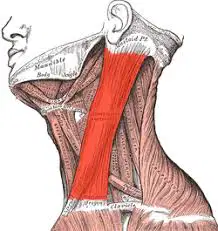
Identify the muscle in red.
sternocleidomastoid
biceps brachii
trapezius
deltoid
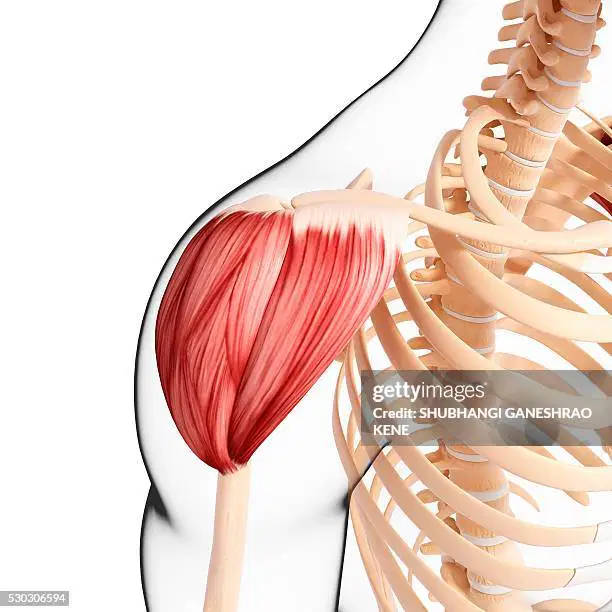
Identify the muscle in red.
latissimus dorsi
biceps
trapezius
deltoid

Identify the muscle labeled in red.
trapezius
bicep
deltoid
pectoralis major
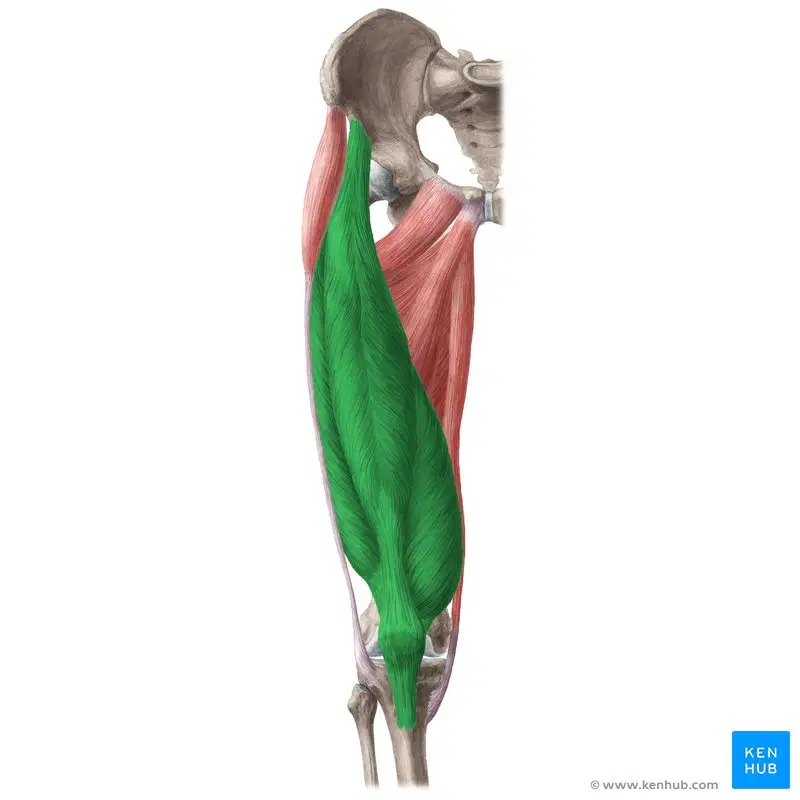
Identify the muscle labeled in green.
biceps brachii
trapezius
quadriceps femoris
latissimus dorsi
What is the state of partial contraction of muscles called?
Atrophy
Muscle tone
Contracture
Paralysis
Loss of muscle tone can occur in severe illness such as ______.
paralysis
fever
headache
cough
When muscles are not used for long periods of time, they shrink in size and lose strength. This condition is called ______.
atrophy
hypertrophy
dystrophy
myopathy
What is a severe tightening of a flexor muscle resulting in the bending of a joint called?
Atrophy
Muscle tone
Contracture
Paralysis
Fibromyalgia is a condition characterized by:
Chronic widespread pain
High blood pressure
Increased appetite
Improved vision
Muscular dystrophy is:
A type of cancer
A genetic disorder
A viral infection
A bacterial disease
Myasthenia gravis is:
A chronic autoimmune neuromuscular disease
A type of bacterial infection
A form of cancer
A genetic disorder

