
 Worksheets
Constitution Quiz #2
Total questions: 170
Worksheet time: 6hrs 38mins

First and failed plan for government for the United States of America
the Mayflower Compact
the Common Sense pamphlet
the Treaty of Paris
the Articles of Confederation
Ultimately, the weaknesses of the Articles of Confederation lead to the creation of -
the Treaty of Paris
the Affordable Care Act
the U.S. Constitution
the Declaration of Independence
In a popular sovereignty___________ are the source of the government authority.
laws
electricity
people
city hall


The promise from the Preamble that describes peace in our country is ___.
establish justice
provide for the common defense
promote the general welfare
insure domestic tranquility
The promise from the Preamble that mentions the idea of fairness is ___.
promote the general welfare
insure domestic tranquility
establish justice
provide for the common defense
The promise from the Preamble that describes our freedom is ___.
secure the blessings of liberty
provide for the common defense
insure domestic tranquility
promote the general welfare
In the Preamble, We the People means the ___.
Constitution was written for all the people of the United States
Constitution was only written for the delegates at the Constitutional Convention.
people who actually authored the constitution.
people of Philadelphia

The phrase that "No one is above the law" is known as what?
Elastic Clause
14th Amendment
Rule of Law
Checks and Balances
Which of these is an advantage of the system of checks and balances?
It makes it easy for one person or group to seize power.
It prevents election fraud and results in greater voter turnout.
It allows the executive branch the power to supervise the actions of the other two branches.
It requires the different branches of the federal government to work together to seek the common good.
the ability of the court system to interpret the constitutionality of the actions of the other two branches
Judicial Review
Popular Sovereignty
Federalism
Cooperative Federalism
Who is known as the "Father" of the US Constitution?
Thomas Jefferson
Stephen King
James Madison
William "Billy" Madison
Before officially taking effect, the constitution had to be ratified by how many of the original 13 states?
7
9
11
13
The _____________________ combined both of the plans proposed at the Constitutional Convention, the Virginia Plan and the New Jersey Plan, and created a two house Congress. One with equal representation and one based on population.
3/5 Compromise
Great Compromise
Compromise of 1775
Constitutional Compromise

True or False: George Washington presided over the Constitutional Convention of 1787.
True
False
An Anti-Federalist could be described this way.
One who wished for weaker state governements.
Someone who favored a stronger central government.
One who favored a more powerful Supreme Court.
Someone who feared a strong central government.
Which element of the U.S. Constitution reflects the philosophy of Baron de Montesquieu?
separation of powers
presidential limitations
a two-house Congress
pancakes for all
The supremacy clause place _____ powers above _____ powers.
state, federal
federal, state
a government document that expanded the powers of the English Parliament and expanded the rights of the people, as well as further limited the rights of the king; written by the members of the English Parliament in 1689
Magna Carta
Mayflower Compact
English Bill of Rights
Common Sense
a government document that limited the power of the king of England and protected the rights of the nobility; written by the English nobles in 1215
Magna Carta
Mayflower Compact
English Bill of Rights
Common Sense
How did the Magna Carta, Common Sense, and the English Bill of Rights help to change colonists beliefs?
made them believe that self gov.= independence
made them believe that self gov.= supporting Britain
made them believe that self gov.= limited monarchy
made them believe that self gov.= rule of law
"The end of law is not to abolish or restrain, but to preserve and enlarge freedom. For in all the states of created beings capable of law, where there is no law, there is no freedom." - Who said this quote and which idea does it explain?
Montesquieu - separation of powers
Montesquieu - Checks and balances
John Locke - Natural rights / natural law
John Locke - State of nature

“The state of nature has a law of nature to govern it. . . no one ought to harm another in his life, health, liberty, or possessions. . .” --Two Treatises on Government, 1690
Who wrote the passage from Two Treatises on Government?
John Locke
Montesquieu
Rousseau
Voltaire

“rule by __________ .”
Type of government where the people rule; the United States has this form of government
dictatorship
democracy
monarchy
The citizens choose leaders to make decisions on our behalf. Which type of government is this?
Direct Democracy
United Democracy
Republic Democracy
Representative Democracy
In a Direct Democracy who makes the decisions?
the people
the representatives
The Boston Tea Party was a demonstration of the opposition of colonial merchants to
a high tax on tea
taxation without representation
the British East India Company monopoly
all of the above
… We hold these truths to be self-evident, that all men are created equal, that they are endowed by their Creator with certain unalienable Rights, that among these are Life, Liberty and the pursuit of Happiness.—That to secure these rights, Governments are instituted among Men, deriving their just powers from the consent of the governed,—That whenever any Form of Government becomes destructive of these ends, it is the Right of the People to alter or to abolish it, and to institute new Government,…
--Thomas Jefferson
The purpose of this statement was to provide justification for declaring independence.
The purpose of this statement was to criticize the Articles of Confederation.
Why was the French and Indian War fought?
The French, Native Americans, and British did not like each other
The French and British were both trying to claim the Ohio Country Land
The French and the British wanted to have more power back in Europe
The Native Americans wanted to fight both the British and the French
What was a major consequence of the French and Indian War?
The war was very expensive and left Britain with pressing financial problems
The French won the war and drove the British out of North America
Russia began taking over parts of North America
None of the above
What was a result of the French and Indian War that eventually led to the American Revolution?
Britain placed its colonies under strict control and began taxing them to help pay for the war.
Colonists were not offered aid during the war but were still expected to serve British interests.
The loss of colonial territory to the French made colonists lose faith in the British government.
Britain expected colonists to fight the war at their own expense and offered no reimbursement.
·Common Sense was a pamphlet Thomas Paine published to distribute in the colonies to...
explain to Britain why they should end the quartering act
influence more people to join the independence movement.
to join the Loyalist party
abide by the Intolerable acts
Read this excerpt from the Declaration of Independence:
We hold these truths to be self-evident: that all men are created equal; that they are endowed by their creator with certain unalienable rights, that among these are life, liberty, and the pursuit of happiness...
Which of the following statements best explains what Jefferson means by "all men are created equal"?
All people are equally provided with brains and talent.
All people are entitled to equal treatment under the law.
All the people are equally qualified to hold high political office.
All people are entitled to obey only the laws they agree with.
The Mayflower Compact and the House of Burgesses are examples of
equal opportunities for women during the colonial period
steps toward self-government
Opponents of ratification of the Constitution and were called —
Federalists
Anti-federalists
Republicans
Loyalists
This law outlined how the New Territory will be governed & admission of new states to the Union —
Northwest Ordinance
Mercantilism
Land Ordinance
Shays' Rebellion
This plan settled disagreements between large and small states at the Philadelphia Convention —
Enslaved people will be counted for representation
The House of Representatives will elect women
The Senate will vote on salaries
Senate will have equal representation while the House will be based on population
What does ratification mean?
to delete
to repeal
to approve
to amend
In federalism, the national government and the states share power, but the __________________ has more power.
National government
State government
Supreme Court
The _________ had most of the power under The Articles of
Confederation
states
central government
Congress
The central government and states shared power
The first ten amendments to the U.S. Constitution are known as?
the Bill of Sale
the Rights of Passage
the Bill of Rights
the Civil Rights
Which plan called for states with bigger populations to have more representation in government?
Taco Plan
New Jersey Plan
Virginia Plan
What was the name of the Rebellion where, Farmers/soldiers rebelled after not being paid for fighting in the American Revolution and then lost their farms?
Shay's Rebellion
Slave Rebellion
American Revolution
Szechuan Chicken
Who is considered the Father of the Constitution?
James Madison
George Washington
Pocahontas
Thomas Jefferson
Which plan thought all states should have equal say in the government, no matter their size?
Virginia Plan
Florida Plan
New Jersey Plan
George Washington


The two (2) parts of Congress are:
Senate
Wesclin Middle School
House of Representatives
Library
In a _____, supreme political authority rests with the people.
Dictatorship
Democracy
Confederation
Republic
In which of the following cities was the Constitutional Convention held?
New York
Baltimore
Boston
Philadelphia
Decide whether the fact below applies to the Virginia Plan, the New Jersey Plan, or both:
William Paterson proposed this plan
Virginia Plan
New Jersey Plan
Both
How did the Federalists and Anti-Federalists "compromise" to ratify (approve) the U.S Constitution?
The added the Bill of Rights (First 10 Amendments)
They outlawed cruel and unusual punishment.
Ensured due process of the law.
The Federalists threatened the Anti-Federalists to war.
How many members are there in the Senate (Per State)?
Number based on population
2
How many members are there in the House of Representatives (Per State)?
Number based on population
2
The introduction to the Constitution is called the ___.
Articles of Confederation
Declaration of Independence
Bill of Rights
Preamble
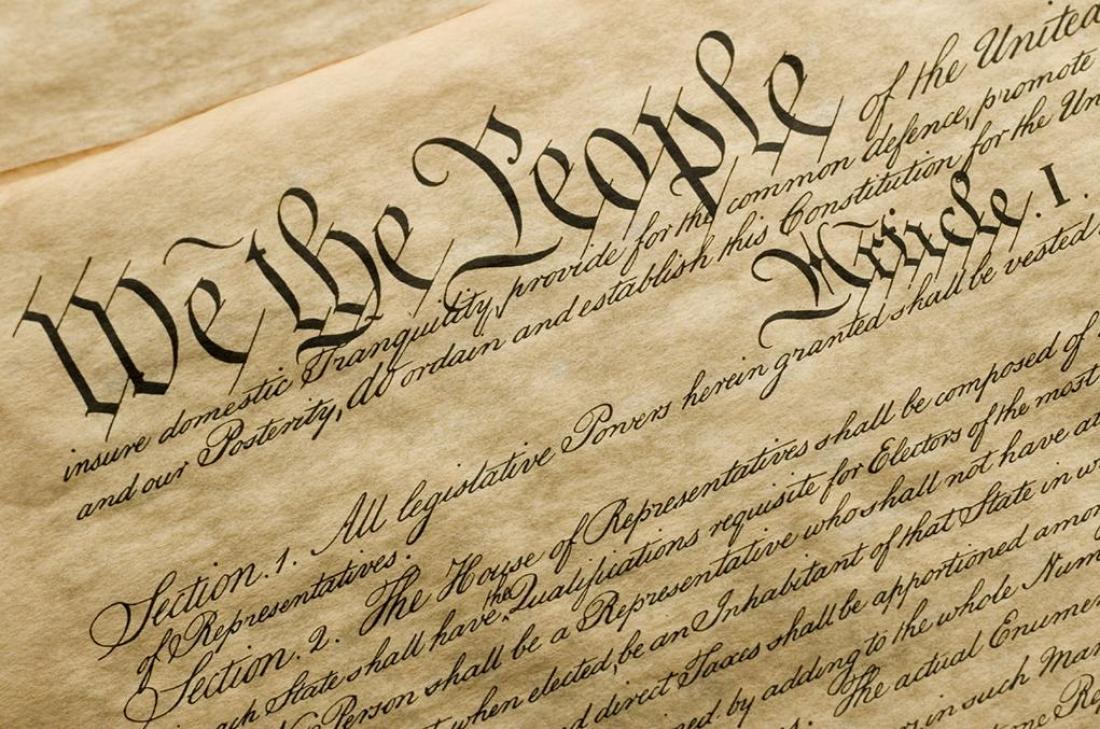
“We the People of the United States, in Order to form a more perfect Union, establish Justice, insure domestic Tranquility, provide for the common defence, promote the general Welfare, and secure the Blessings of Liberty to ourselves and our Posterity, do ordain and establish this Constitution for the United States of America.”
What do the words, "We the People" at the beginning of the Preamble refer to?
Popular sovereignty, the idea that the people rule this nation, and all the power of government comes from them.
Checks and Balances, the idea that each branch of government has the power to check or control the other 2, so that no one branch can become too powerful.
Limited government, the idea that all governments should be limited by law.
Federalism, the idea that the powers of government should be divided between the national government and the states.
The phrase "insure domestic tranquility" in the Preamble means ________________________.
promise that everything in our country will be peaceful
give protection to everyone
being fairness for all
care for those in need
The phrase "provide for the common defense" in the Preamble means ________________________.
all citizens in the US
begin fairness for all
give protection to everyone
make sure freedom and fairness continues for all generations
The phrase "secure the blessings of liberty to ourselves and our posterity" means ________________________.
make sure freedom and fairness continues for all generations
care for those in need
begin fairness for all
give protection to everyone
What does "...establish justice..." mean?
The people create the government and give the government its power
The government has to keep laws fair and protect rights
The government has to help make the country better and stronger
The government has to keep peace in the country
What does "...in order to form a more perfect union..." mean?
The people create the government and give the government its power
The government has to keep laws fair and protect rights
The government has to help make the country better and stronger
The government has to keep peace in the country
Word that means "two houses."
Bilevel
Bicameral
Binumeral
Bilegislature
The process of making laws
Legislate
Bicameral
Veto
Execute
Both the United States Senate and the House of Representatives are known collectively as _____________.
The U.S. Capitol
Congress
Majority Party
Judicial
The U.S. Senate has representation based on...
Population
Equal Representation
Political Party Affiliation
Geographical Size of the state
The number of people in the House of Representatives is based on a state's __________________.
Population
Equal Representation
Geographical size
Party Affiliation
How old do you have to be to run for the U.S. House of Representatives?
20
25
30
35
How old do you have to be to run for the U.S. Senate?
20
25
30
35
How many years must you be a citizen for if you want to run for office in the House of Representatives?
5
7
9
10
Who is the leader of the House of Representatives?
The Vice President
The President
The President Pro Tempore
The Speaker of the House
To be in the House of Representatives, you must live...
In the state you represent
In the city you represent
In the state and district you represent
In the country you represent
Who is the leader of the United States Senate?
The Vice President
The President
The Speaker of the House
The Majority Whip
When does the Vice President vote in the Senate?
Whenever he/she wants
When the world is ending
When there is a tie in votes
When the presidents says so
Senator's represent...
The entire state they live in
The district
The city
The Country
How many total members are in the House of Representatives?
100
150
235
435
How long does a representative serve for?
2 years
4 years
6 years
8 years
How long does a senator serve for?
2 years
4 years
6 years
8 years
The Senate approves presidential appointments and holds impeachment trials.
True
False
The House of Representatives initiates the impeachment process and writes bills dealing with money.
True
False
To officially accuse an elected official of wrongdoing is called...
Removal
Impeachment
Prosecute
Accusation
Powers that are written in the Constitution and left to the federal government are known as _________________ powers.
Expressed/Enumerated
Implied
Reserved
Concurrent
Once a bill is passed in both the House of Reps and Senate, it must be signed by the ____________________ in order to become law.
President Pro Tempore
President
Speaker of the House
Vice President
A president can _________________ a bill that he does not like.
Overturn
Cancel
Veto
Throw out
The Legislative Branch _____ the laws.
Makes
Enforces
Interprets

The ___ approves Presidential appointments.
House
Representatives
Vice President
Senate
Which chamber of Congress is elected based on population?
Senate
House of Representatives
The President
fake news
Congress may override a presidential veto with a
majority vote
3/4 vote
2/3 vote
unanimous vote
There are a total of ____ Senators in the US Senate.
46
124
435
100
How is the number of members in the House of Representatives determined?
Equality
How big the state is
The state's population
The President picks
Gwen is considering running for Senate. She is a US citizen by naturalization. How long would she have to have been a citizen of the US and how old would she have to be?
7 years a citizen and 25 years old
9 years a citizen and 30 years old
14 years a citizen and 35 years old
5 years a citizen and 21 years old
The Elastic Clause allows Congress to
make temporary treaties with foreign countries
regulate trade between states
stretch its powers to meet new needs
tax US citizens in times of economic crisis
The powers that are listed in the Constitution that belong to Congress are called
implied powers.
enumerated / expressed / delegated powers.
congressional powers.
powerful powers.

The Elastic Clause, the Necessary and Proper Clause and __________________ all mean the same thing!
shared powers
implied powers
expressed powers
delegated powers
What is a pocket veto?
A veto small enough to fit in your pocket
A veto with a pouch like a kangaroo
When the President doesn't act on a bill within 10 days
When Congress overrides a veto
When a bill passes the House of Reps, where does it go next?
Senate
Supreme Court
President
Library of Congress
Which State has the most seats in the House of Representatives?
Texas
California
New York
Nevada
If you want to be a representative of Wisconsin, what state do you need to live in?
Washington
West Virginia
Wisconsin
Wyoming
Check three House of Representatives qualifications
25 years old
9 year U.S. citizen
Live in state elected from
7 year U.S. citizen
What suggests within our Constitution that the House of Representatives was intended to reflect the interests of the people, rather than the states?
A representative is chosen by the lottery from a smaller district than a senator, therefore, most people feel closer to their representative.
A representative must be chosen by the state legislature who has the people's best interests at heart.
A representative is elected from a smaller district than a senator, therefore most people feel closer to their representative.
Representation must reflect the relative population of the states thus their requirements are less strict than the Senate.

an order that makes sure prisoners are told why they are being held
enumerated power
writ of habeas corpus
elastic clause
non legislative power

to accuse officials of wrongdoing
expressed power
implied power
impeach
regulate

a power of Congress that is listed in the Constitution
enumerated power
expressed power
elastic clause
implied power
a court order that requires police to bring a prisoner to court to explain why they are holding the person
writ of habeas corpus
implied power
Senate
majority power
In what article of the Constitution can you find the executive?
Article II
Article I
Article III
Article IV
What is the main job of the Executive Branch?
To interpret laws
To make laws
To enforce laws
To amend laws
For how many years is a president/vice president elected?
4 years
2 years
6 years
8 years
When are Presidential elections held?
Every 4 years
Every 2 years
Every 6 years
Every 8 years
How many electors are in the electoral college?
538
435
270
100
How many votes does it take to win the presidency?
270
250
300
200
How many electoral votes does Missouri have?
10
8
12
14
When does the president actually become president of the United States?
On Election Day
After the Electoral College votes
On Inauguration Day
When Congress certifies the election
Which of the following is a military power of the president?
The president can declare war.
The president is the Commander-in-Chief of the armed forces.
The president can draft soldiers.
The president can negotiate peace treaties.
Explain how treaties and presidential appointments are made.
The president makes treaties and appointments without any approval.
The president makes treaties with the approval of the Supreme Court.
The president makes treaties and appointments with the advice and consent of the Senate.
The president makes appointments with the approval of the House of Representatives.
How can a presidential veto be overridden?
By a simple majority vote in both the House and Senate
By a two-thirds vote in the Senate only
By a two-thirds vote in both the House and Senate
By a unanimous decision by the Supreme Court
What is the first step in the impeachment process of a President?
The Senate votes to impeach
The Supreme Court decides there are grounds for impeachment
The House of Representatives votes to impeach
The Vice President calls for impeachment
How many executive departments are there in the Cabinet as of the latest count?
15
20
10
25
Who has the authority to appoint Cabinet members?
The Vice President
The President
The Senate
The House of Representatives
The Executive Branch's job is to
Create laws
Interpret laws
Break laws
Enforce laws
If a presidential candidate wins more than 50% of the vote in a state, how many electoral votes do they get?
All of them from that state
The majority of votes from that state
The same percentage of votes that they won
The popular vote doesn't actually matter
Which of the following is NOT a requirement to become president according to the constitution?
Natural born citizen
at least 35 years old
reside in the US for 14 years
have a college degree
What is the ABSOLUTE MAX time that a president can be in office?
4 years
10 years
8 years
Forever
How many presidents have been convicted and removed after being impeached?
1
2
None
4
The Electoral votes for each state are determined by what?
States' total number of members of Congress
States' total number of members of Senate only
States' total number of members of House of Reps only
State population

Which word in the statement above describes this process the BEST?
primary election
party platform
general election
winner-take-all

What month do the people vote for President of the United States?
January
December
November
March

What is the purpose of the Electoral College?
Elect school board members.
Provide opportunities for kids to attend college.
Elect the President of the United States.
Elects representatives to Congress.

Why does California have more electoral votes than Texas?
California has a higher population than Texas
California had more influence in the Senate than Texas
California has a lower population than Texas
California's land area is more than Texas

What is the least amount of electoral votes that a state may have?
1
2
3
10

The Census is conducted every 10 years to count the total population in the nation. How can the population affect the Electoral College?
Change the number of electoral votes a state gets
It can't affect it the Electoral College
It can determine the number of Senators each state gets.
How we get 538 electors
Electoral College
100 senators, 435 representatives, 3 for D.C.
Popular Vote
Swing States