

wayground logo

Free Printable Worksheets

Font size

S
M
L
XL
Worksheets

ISEP 305_SDLC PRE ASSESSMENT

Total questions: 30

Worksheet time: 14mins

Name
Class
Date
1.
SDLC stands for...
a)

Systematic development life cycle. 

b)
Software development litigation cycle. 
c)
System development life conditions. 
d)
Software development life cycle. 
2.
Which of these are performed in the Analysis phase?
a)
Approve all project requests.  
b)
Build a prototype. 
c)
Perform a detailed analysis of the old system. 
d)
Review and allocate resources to the project. 
3.
When should users be trained on a new system?
a)
During the Analysis phase. 
b)
During the Implementation phase. 
c)
During the Development phase. 
d)
During the Evaluation phase. 
4.
in Analysis Phase, the main purpose of the Preliminary Investigation (feasibility study) is .....
a)
to determine the exact nature of the problem or improvement and decide whether it is worth pursuing
b)
to determine the users’ wants, needs, and requirements;
c)
to develop all of the details of the new or modified information system
5.
(1) Review and Approve the project requests;
(2) Prioritize the project requests;
(3) Allocate resources such as money, people, and equipment to approved projects;
(4) Form a project development team for each approved project.
These activities are found in
a)
Planning Phase
b)
Analysis Phase
c)
Implementation Phase
d)
Operation, Support, and Security Phase
6.
Conducting preliminary investigation is done in which phase?
a)
Planning
b)
Analysis
c)
Design
d)
Implementation
7.
Developing details of system is done in which phase?
a)
Planning
b)
Analysis
c)
Design
d)
Implementation
8.
What happens in the testing phase?
a)
The code is tested against the specfication
b)
Making changes when the software has been created
c)
Planning the solution, look and feel of the software interface
d)
Ensuring the requirements are understood
9.
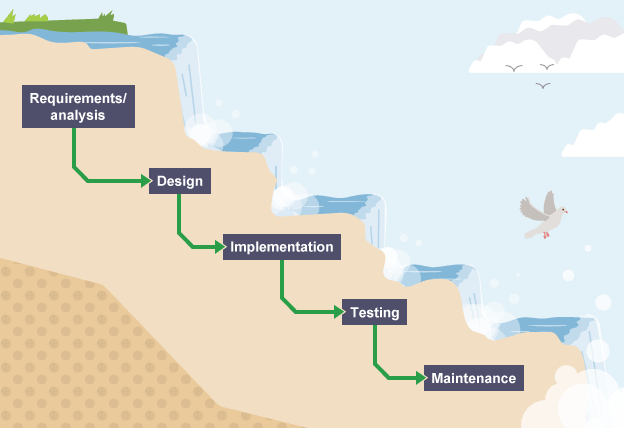
Which life cycle is this?
a)
Spiral
b)
Waterfall
c)
Incremental
d)
V-shaped
10.
Which life cycle is this?
a)
Spiral
b)
Waterfall
c)
Incremental
d)
V-shaped
11.

It is a process that consists of a series of planned activities to develop or alter the Software Products

a)

Software Development Life Cycle

b)

Life Cycle

c)

Development Process

d)

Graphical Representation

12.

What does SDLC stands for?

a)

Software Development Life Cycle

b)

Software Deployment Life Cycle

c)

System Deployment Life Cycle

d)

System Development Life Cycle

13.

Give at least 3 stages of SDLC

a)

Planning

b)

Deployment

c)

Building

d)

Scanning

e)

Arrangement

14.

It is the most important stage in SDLC

a)

Deployment

b)

Building

c)

Defining

d)

Planning

15.

Each phases in waterfall model must be completed before starting the next phase.

a)

True

b)

False

16.

This is based on feedback whether the product may be release as it is or with suggested enhancements in the targeting market segment.

a)

Deployment in the Market and Maintenance

b)

Testing in the Product

c)

Planning and Requirement Analysis

d)

Developing the Product

17.

What is the main purpose of Systems Analysis?

a)

To identify the strengths and weaknesses of the current system

b)

To identify and evaluate appropriate design alternatives

c)

To translate broad, user-oriented conceptual design requirements into detailed specifications

d)

To gather the information needed to purchase, develop or modify a system

18.

Which of the following statements best defines the Agile Development Philosophy?

a)

Working software over comprehensive documentation

b)

Responding to change over following a plan

c)

All of these choices

d)

Customer collaboration over contract negotiation

19.

What is the emphasis of Scrum in Agile Development Methodology?

a)

Focuses primarily on the team level

b)

Controls list of deliverables (product backlog) of what the system will do

c)

Combines best practices in a new way to produce results greater than the sum of its parts

d)

Emphasizes more on processes than people (developers)

20.

What is the main goal of software development methodologies?

a)

To focus on documentation requirements

b)

To create standalone prescriptive handbooks

c)

To work independently of other principles

d)

To define how every element of the product will be delivered

21.

What is the main characteristic of the waterfall methodology?

a)

No specific order of phases

b)

Sequential order of phases

c)

Simultaneous execution of phases

d)

Continuous improvement of phases

22.

Who is responsible for implementing the three traditional Scrum phases?

a)

Scrum master

b)

Project manager

c)

Product owner

d)

Team lead

23.
Which methodology is focused on "identifying risks"
a)
Waterfall
b)
RAD (Rapid Application Development)
c)
Spiral model
d)
Agile methodology
e)
Extreme programming
24.
Which methodology makes use of "a series of sprints to build project in short, time restricted periods"
a)
Waterfall
b)
RAD (Rapid Application Development)
c)
Spiral model
d)
Agile methodology
e)
Extreme programming
25.
Which methodology makes extensive use of Prototypes?
a)
Waterfall
b)
RAD (Rapid Application Development)
c)
Spiral model
d)
Agile methodology
e)
Extreme programming
26.

What does RAD stand for?

(a)  

27.
Which methodology is NOT suitable for complex projects?
a)
Waterfall
b)
RAD (Rapid Application Development)
c)
Spiral model
d)
Agile methodology
e)
Extreme programming
28.

It is the part where developers actually write code and build the application according to the earlier design documents and outlined specifications?

(a)  

29.

This is the stage were you need to make sure that there aren’t any bugs and that the end-user experience will not negatively be affected at any point?

(a)  

30.

this stage must begin practicing any activities required to handle issues reported by end-users?

(a)
