
 Worksheets
Energy and Interactions in Ecosystems
Total questions: 23
Worksheet time: 23mins
A consumer that eats only producers.
Primary Consumer
Secondary Consumer
Carnivore
Omnivore
An organism that makes its own food.
Autotroph
Heterotroph
Herbovore
Carnivore
This shows the total energy available at each trophic level of an ecosystem.
Energy Pyramid
Food Chain
Food Web
The complete removal of decomposers from an ecosystem will have the greatest effect on which of the following?
migration
the availability of water
the recycling of nutrients
the distribution of organisms

What level consumer is the frog
Primary Consumer
Secondary Consumer
Tertiary Consumer
Apex Predator

What level consumer is the snake?
Primary Consumer
Secondary Consumer
Tertiary
Apex Predator
In an ecosystem, snakes feed on frogs, which feed on mosquitoes. Use of a bug spray has decreased the number of mosquitoes. What will probably happen to the number of frogs and snakes?
Frogs will increase, snakes will increase
Frogs will increase, snakes will decrease
Frogs will decrease, snakes will increase
Frogs will decrease, snakes will decrease
What do producers need, other than sun, for photosynthesis?
Water and CO2
Glucose and O2
Love and happiness
Carbohydrates and water

The graph to the right shows the interaction of the wolf and moose populations on Isle Pekie. If the moose population continues to increase, the wolves' food supply will increase. What will most likely happen to the wolf population as a result?
It will decrease.
It will increase.
It will remain the same.

Using the biomass pyramid. Which organism has the most biomass?
acacia tree
rhinoceros
vulture
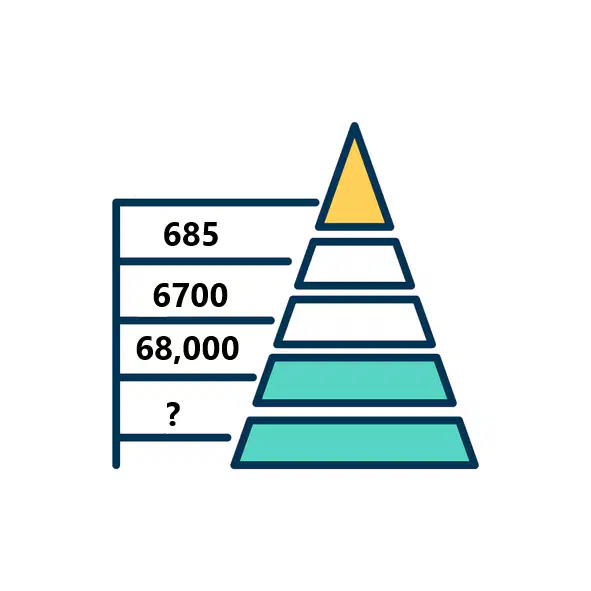
Using the energy pyramid. Which number best describes the amount of energy in trophic level 1?
68
680,000
6,800


In this food pyramid, the phytoplankton start with 500 calories of energy. How many calories make it to the shark?
500
50
5
0.5
0.05
Which layer of the food pyramid will receive the least energy?
Producers
Primary consumers
Secondary consumers
Tertiary consumers
Quaternary consumers

The rabbit would be a good example of a?
Producer
Primary Consumer
Secondary Consumer
Tertiary Consumer

When bull elk fight for dominance in the herd, this is an example of
Mutualism
Competition
Parasitism
Symbiosis

The clownfish provides the anemone some added nutrients and the clownfish gets some added protection, this example is a good representation of?
Mutualism
Competition
Parasitism
Journalism

The eagle and the fish's interaction can best be described by which word
Mutualism
Parasitism
Domination
Predation
The interaction between two organisms where one organism benefits and the other is harmed
Mutualism
Parasitism
Journalism
Comensalism

This is an interaction between the striped pilot fish and the oceanic white tip shark. The pilot fish benefit from this interaction by getting to eat the shark's leftovers and some protection from predators. The shark gets nothing from this interaction. What is the best word to describe this interaction?
Parasitism
Competition
Commensalism
Mutually Beneficial

